
The dust rose slowly, impossibly slowly, as Neil Armstrong's left boot pressed into the powdery gray surface of the Moon. It was 02:56 UTC on July 21, 1969—though still July 20 in Houston—and for the first time in the 4.5-billion-year history of Earth's nearest neighbor, a human being stood upon it. Nineteen minutes later, Edwin "Buzz" Aldrin followed him down the ladder of the Lunar Module Eagle, and together they walked where no life had ever ventured.
The moment represented the culmination of nearly a decade of extraordinary effort, fueled by Cold War rivalry, political ambition, and human audacity. What began as a response to Soviet space achievements had become something larger: a testament to what organized human ingenuity could accomplish when a nation committed itself to what President John F. Kennedy had called "the most hazardous and dangerous and greatest adventure on which man has ever embarked."
The Promise That Changed Everything
The Apollo program had been conceived in 1960 during the Eisenhower administration as a modest follow-up to Project Mercury, America's first human spaceflight effort. While Mercury could carry only one astronaut on limited Earth orbital missions, Apollo would carry three and might someday reach a space station or circle the Moon. But it had no urgent mandate, no singular focus—until geopolitics intervened.
On April 12, 1961, Soviet cosmonaut Yuri Gagarin became the first human in space, a propaganda victory that sent shockwaves through Washington. The newly inaugurated Kennedy, who had campaigned on closing the "missile gap" with the Soviets, faced mounting pressure to respond. Twenty days after America's own first astronaut, Alan Shepard, completed a brief suborbital flight aboard Freedom 7, Kennedy stood before Congress with a proposal that seemed almost reckless in its ambition.

"I believe that this nation should commit itself to achieving the goal, before this decade is out, of landing a man on the Moon and returning him safely to the Earth. No single space project in this period will be more impressive to mankind, or more important in the long-range exploration of space; and none will be so difficult or expensive to accomplish."
At the time Kennedy spoke those words on May 25, 1961, only one American had been to space—for fifteen minutes. NASA had not yet placed an astronaut in orbit. Even some within the space agency doubted whether the goal was achievable. Yet Kennedy's deadline—before the decade's end—was now national policy.
From Tragedy to Triumph
The path to the Moon proved as difficult as Kennedy had warned. The Apollo program encountered a devastating setback on January 27, 1967, when a cabin fire during a prelaunch test killed astronauts Gus Grissom, Ed White, and Roger Chaffee—the entire crew of Apollo 1. The tragedy forced a complete redesign of the spacecraft and an eighteen-month delay in crewed flights.
But NASA rebuilt and pressed forward. Apollo 8 became the first crewed mission to leave low Earth orbit in December 1968, orbiting the Moon on Christmas Eve. Apollo 9 and 10 followed, testing the Lunar Module in increasingly ambitious dress rehearsals. By July 1969, everything was ready for Apollo 11 to attempt the landing itself.
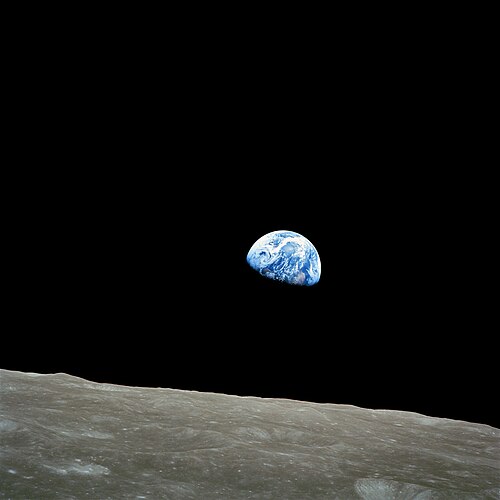
The crew consisted of three veteran astronauts: Neil Armstrong, a former naval aviator and test pilot who would command the mission; Buzz Aldrin, who had made three spacewalks on Gemini 12 and would pilot the Lunar Module; and Michael Collins, who would remain in lunar orbit aboard the command and service module Columbia while his crewmates descended to the surface.
Twenty-One Hours on Another World
The Eagle touched down in the Sea of Tranquility on July 20 at 20:17 UTC, with only seconds of fuel remaining after Armstrong took manual control to avoid a boulder-strewn crater. "The Eagle has landed," he reported to Mission Control in Houston, his voice betraying no hint of the tension that had gripped the final moments of descent.
Six and a half hours later, after depressurizing the cabin and opening the hatch, Armstrong made his way down the nine-rung ladder. A television camera mounted on the Lunar Module transmitted grainy black-and-white images to Earth, where an estimated 650 million people—roughly one-fifth of the world's population—watched transfixed. As his boot made contact with the surface, Armstrong spoke words he had composed during the journey: "That's one small step for man, one giant leap for mankind."

Aldrin joined him nineteen minutes later, and together they spent two and a half hours outside the Lunar Module. They planted an American flag, collected 47.5 pounds of rock and soil samples, deployed scientific instruments, and spoke by radio-telephone with President Richard Nixon. Aldrin described the stark landscape around them as "magnificent desolation."
A Legacy Beyond the Footprints
Armstrong and Aldrin lifted off from the Moon on July 21, rejoined Collins in lunar orbit, and the crew splashed down safely in the Pacific Ocean on July 24. Kennedy's promise, made eight years earlier by a president who had been assassinated in 1963, had been fulfilled with five months to spare.
Five more Apollo missions would land on the Moon through December 1972, with twelve humans total walking on its surface. The program returned 842 pounds of lunar rocks and soil to Earth, revolutionizing scientific understanding of the Moon's composition and geological history. It spurred advances in avionics, telecommunications, and computers, and established the infrastructure—including Kennedy Space Center and Johnson Space Center—that would support American human spaceflight for decades to come.

Yet no human has returned to the Moon since Apollo 17. Budget cuts, shifting priorities, and the end of the space race led NASA in other directions. Only with the Artemis program, established in 2017 as Apollo's successor, does humanity plan to return—a reminder that the footprints Armstrong and Aldrin left in the lunar dust remain, after more than half a century, as fresh as the moment they were made.
Did you know? Armstrong and Aldrin spent only 21 hours and 36 minutes on the lunar surface, with just 2 hours and 31 minutes outside the Lunar Module—yet those few hours represented the culmination of 400,000 people's work across eight years. Michael Collins, who orbited alone while his crewmates walked on the Moon, traveled farther from any other human being than anyone in history—2,000 miles when Eagle was on the far side of the Moon. The Apollo program cost approximately $25.4 billion in 1960s dollars—roughly $280 billion in today's money—making it one of the most expensive peacetime projects in American history.
Watch: Neil Armstrong - First Moon Landing 1969
From the NTD channel.
Sources and further reading: Wikipedia — Apollo program, Neil Armstrong, Buzz Aldrin (CC BY-SA). Images: Wikimedia Commons.


