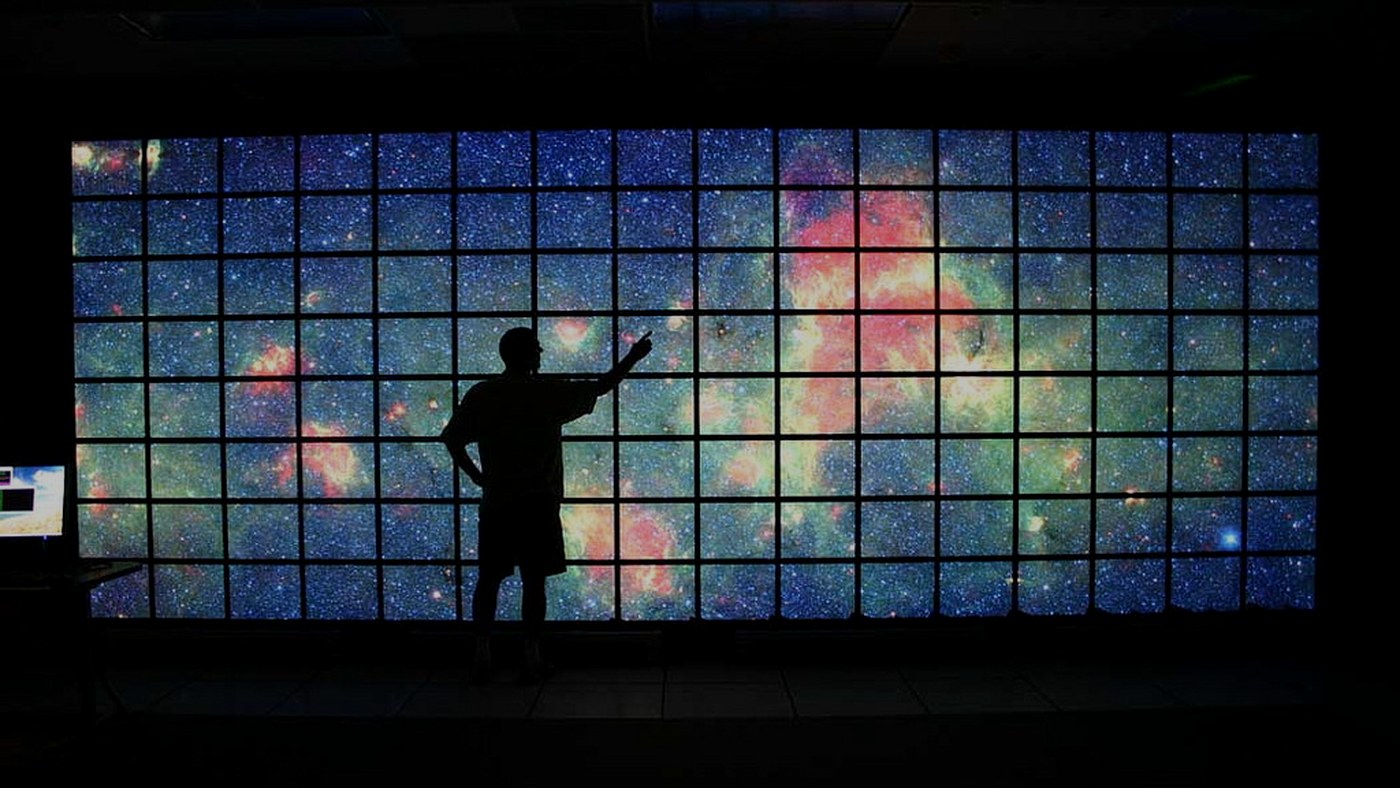
In March 1993, at the NASA Lewis Research Center near Cleveland, mathematician and science fiction writer Vernor Vinge told attendees at the VISION-21 symposium that humanity would achieve the technical means to create superhuman intelligence within thirty years. Vinge predicted that the human era would effectively conclude shortly thereafter, noting he would be surprised if this event occurred before 2005 or after 2030.1
Vinge drew the term "singularity" from physics, where it represents the point beyond an event horizon at which known mathematical models cease to function. Just as one cannot peer beyond a black hole's boundary and expect the laws of physics to remain consistent, Vinge argued that society cannot look past the threshold of superhuman intelligence and expect current patterns of human history to hold.
- The origin of the term "singularity": a threshold where existing models break down.
- The 1965 prediction that a self-improving machine would be the last invention humanity ever needs.
- A survey of 2,778 researchers estimating a 50 percent chance that machines will outperform humans in all tasks by 2047.
- The challenge of identifying a threshold that may be inherently unreadable to those who cross it.
Why did the concept of a singularity emerge from physics?
Vinge used the physics metaphor to suggest that history becomes unpredictable when the pace of change is dictated by an intelligence far superior to our own. This entity would continuously improve itself, leaving human models of progress behind. Although Vinge's 1993 window of 2005 to 2030 has not yet closed, and we are currently living through the years he identified, the mere passage of time does not confirm the arrival of the singularity. Vinge suggested four paths: a sentient supercomputer, a awakened network, the merging of humans with machines, or the biological enhancement of intelligence. While hardware capabilities have surged—modern smartphones far outpace the supercomputers of 1993—the "awakening" itself remains elusive. The singularity is not merely a date on a calendar, but a claim about the limits of human readability.
What did the concept of an intelligence explosion look like in 1965?
The conceptual framework for the singularity was established decades before Vinge. In 1965, British statistician I. J. Good defined the "ultra-intelligent machine" as one that could surpass all the intellectual activities of any human, no matter how brilliant. Since designing machines is an intellectual activity, such a system would inevitably design superior versions of itself, triggering an intelligence explosion. Good concluded that the first ultra-intelligent machine would be the last invention humanity ever needs to make.2 While machines like IBM's Deep Blue and AlphaGo have achieved dominance in specific tasks, they do not yet exhibit the recursive, self-improving intelligence required to trigger the chain reaction Good described.
Does the singularity look like noise to an outside observer?
In 2012, researcher Marcus Hutter inverted the problem by asking what a non-accelerating human would perceive during such an explosion. Hutter noted that to an outside observer, the process might resemble a bizarre physical transformation rather than a display of intellect. Because highly compressed information is mathematically indistinguishable from random noise, the era beyond the threshold might not appear as "smarter conversation," but rather as a signal we simply cannot decode.3 Our current struggle to fully interpret the internal operations of large language models is a modest preview of this phenomenon. If a system crosses the threshold, it is under no obligation to communicate that fact in a language we recognize or believe.
How do experts define the timing of the singularity?
In 2023, Katja Grace and colleagues surveyed 2,778 researchers in artificial intelligence to gauge the timeline for human-level performance. The respondents estimated a 10 percent chance of machines outperforming humans in all tasks by 2027 and a 50 percent chance by 2047.4 These predictions are difficult to unify because stakeholders often use different metrics—some define the singularity by economic utility, while others look for signs of true general intelligence. This lack of a shared "ruler" explains why some observers claim the singularity has arrived while others insist it is decades away. In 2010, philosopher David Chalmers analyzed the singularity and concluded that while a sudden explosion before 2100 was more likely than not, human-level AI arriving within thirty years would be surprising.5 If Vinge was right about the singularity being inherently unreadable, we may find that we cannot confirm its arrival through a conference or a headline, but only through the subsequent transformation of our reality.
Notes and Sources
- Vinge, V. (1993). "The Coming Technological Singularity: How to Survive in the Post-Human Era", Vision-21: Interdisciplinary Science and Engineering in the Era of Cyberspace, NASA CP-10129, pp. 11-22.
- Good, I.J. (1965). "Speculations Concerning the First Ultraintelligent Machine", Advances in Computers 6: 31-88.
- Hutter, M. (2012). "Can Intelligence Explode?", Journal of Consciousness Studies 19(1-2): 143-166.
- Grace, K., Stewart, H., Sandkühler, J.F., Thomas, S., Weinstein-Raun, B., Brauner, J. (2024). "Thousands of AI Authors on the Future of AI", Journal of Artificial Intelligence Research (arXiv:2401.02843).
- Chalmers, D.J. (2010). "The Singularity: A Philosophical Analysis", Journal of Consciousness Studies 17(9-10): 7-65.