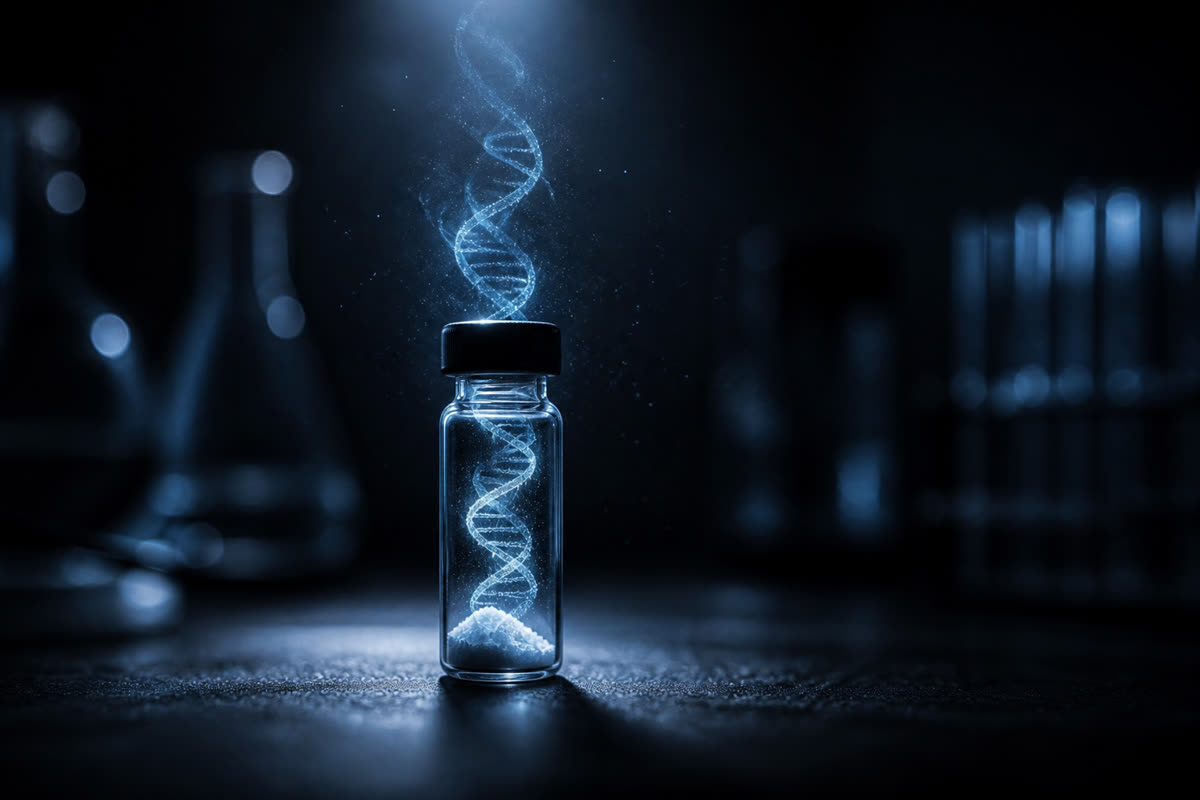
In the basement of a university building in Seattle, a small glass vial sits on a workbench. Inside is a smudge of white powder, barely visible, resembling a forgotten grain of salt. Yet, tucked within that powder is a high-resolution music video by the band OK Go, a collection of classic literature including Tolstoy's War and Peace, the Universal Declaration of Human Rights, and a global seed bank database. These files total 200 megabytes. In 2016, researchers from Microsoft and the University of Washington encoded this data into synthetic DNA and retrieved it without a single error.1
This powder is synthetic DNA, a lab-produced version of the same molecule that carries the blueprints for human biology. While nature has utilized this molecule for four billion years to store information, computer scientists have only begun to view it as a storage medium in the last fifteen years. No existing technology can pack data as densely as DNA.
How does DNA function as a digital alphabet?
The core concept of DNA-based storage is remarkably simple. Computers process files using binary code composed of zeros and ones. DNA utilizes its own four-letter alphabet: the molecular components adenine, cytosine, guanine, and thymine, known as A, C, G, and T. By converting binary data into these four bases, any digital file can be written as a DNA sequence. A synthesis company then converts this sequence into physical molecules, producing a tube containing a faint, microscopic residue. To retrieve the data, a DNA sequencer reads the sequence, and software translates it back into binary.
The power of this conversion lies in the molecular scale. In 2017, Yaniv Erlich of Columbia University and Dina Zielinski of the New York Genome Center demonstrated a method called DNA Fountain, showing that one gram of DNA could theoretically hold 215 petabytes, or 215 million gigabytes.2 To put this in perspective, if a smartphone has a 256 gigabyte capacity, a single gram of DNA holds more than 800,000 times that amount of data. Furthermore, the entire physics archive of CERN, which spanned hundreds of tape drives at the time, would fit into roughly 41 grams of DNA.3
What triggered the race to store digital data in DNA?
The modern era of DNA storage began in 2012, when Harvard geneticist George Church converted his own book into a 5.27 megabit DNA archive and successfully read it back using next-generation sequencing. This marked the largest amount of man-made data stored in DNA at the time.4 During the same period, bioinformaticians Nick Goldman and Ewan Birney began exploring the same problem while discussing the mounting costs of genomic data storage. They hypothesized that if they could write data into the molecule that defines the information itself, they might solve the storage crisis.
This idea evolved into a 2013 study published in Nature. Goldman's team successfully encoded Shakespeare's 154 sonnets, a recording of Martin Luther King's 'I Have a Dream' speech, and a photograph of their office into DNA with perfect retrieval accuracy.3 Later, Erlich and Zielinski expanded the record to include a full computer operating system, the 1895 film Arrival of a Train at La Ciotat, a 50-dollar Amazon gift card, and a digital virus. All data was recovered perfectly, and the gift card remained usable.2 Perhaps the most unusual experiment occurred at Harvard in 2017, where Seth Shipman and George Church used the CRISPR gene-editing system to embed a film into the genomes of living bacteria. They chose Eadweard Muybridge's 1870s motion capture of a galloping horse. As the bacteria divided, they copied the film into their offspring, and researchers successfully reconstructed the video days later.5
Why is DNA superior for long-term archival storage?
Beyond density, DNA offers unparalleled longevity. Standard hard drives often fail after five years, and magnetic tape—the backbone of data centers—must be replaced every ten to thirty years. DNA, by contrast, operates on a geological timescale. In 2013, scientists retrieved a draft genome from a horse bone found in the permafrost of Canada's Yukon, dating back approximately 700,000 years.6 The molecule survived without specialized intervention.
Under laboratory conditions, this durability is even greater. In 2015, Robert Grass and his team at ETH Zurich encapsulated DNA within glassy silica spheres, essentially creating synthetic fossils. Accelerated aging tests indicated that data packaged this way could be read for two thousand years in Central European climates, and for much longer in colder conditions.7 Furthermore, the DNA format is universal and immune to hardware obsolescence. While floppy drives, VHS players, and USB ports eventually become obsolete, humanity will always retain the ability to sequence DNA, as it is our own biological manual.
Why is this technology not yet in widespread use?
The primary barrier to DNA storage is cost. Synthesizing DNA letter by letter remains an expensive chemical process. Microsoft's 200-megabyte experiment required the synthesis of 1.5 billion DNA bases, and at the time, commercial synthesis cost several cents per base.1 While reading DNA has become cheaper due to the genomics revolution, the writing process has not yet experienced a similar cost breakthrough. Speed is also a factor, as retrieving a specific file requires chemical amplification and sequencing, which takes hours.
Consequently, the immediate goal is not personal computing, but 'cold data' archives—rarely accessed but vital information such as government records, hospital files, and scientific datasets. Today, this data requires energy-intensive climate-controlled server warehouses. DNA could achieve the same result with a few vials in a safe, consuming almost no electricity. As synthesis costs continue to plummet, experts anticipate that the first commercial adopters will be national archives and massive data repositories.
Humanity's most promising solution to the flood of digital data is a molecule tested for four billion years: life's own hard drive. Summary of the article
Notes and Sources
- Microsoft and University of Washington Molecular Information Systems Lab, 200 MB DNA storage announcement (July 2016); for the academic method, see: Bornholt, J. et al. (2016). "A DNA-Based Archival Storage System", ASPLOS 2016. ↩
- Erlich, Y. and Zielinski, D. (2017). "DNA Fountain enables a robust and efficient storage architecture", Science, 355(6328), 950-954. ↩
- Goldman, N. et al. (2013). "Towards practical, high-capacity, low-maintenance information storage in synthesized DNA", Nature, 494, 77-80. ↩
- Church, G. M., Gao, Y. and Kosuri, S. (2012). "Next-Generation Digital Information Storage in DNA", Science, 337(6102), 1628. ↩
- Shipman, S. L., Nivala, J., Macklis, J. D. and Church, G. M. (2017). "CRISPR-Cas encoding of a digital movie into the genomes of a population of living bacteria", Nature, 547, 345-349. ↩
- Orlando, L. et al. (2013). "Recalibrating Equus evolution using the genome sequence of an early Middle Pleistocene horse", Nature, 499, 74-78. ↩
- Grass, R. N. et al. (2015). "Robust Chemical Preservation of Digital Information on DNA in Silica with Error-Correcting Codes", Angewandte Chemie International Edition, 54(8), 2552-2555. ↩


