Pakistani Astronaut Zeeshan Ali Reaches Orbit Aboard China's Shenzhou-24 Mission
Pakistani Air Force pilot Muhammad Zeeshan Ali became the first foreign national to board China's Tiangong space station after launching aboard the Shenzhou-24 mission on Wednesday. The joint flight marks a historic milestone in space cooperation between Beijing and Islamabad.
W
World Desk
4 min read0 views
Pakistan Air Force pilot Muhammad Zeeshan Ali became the first Pakistani citizen and the first foreign national to reach orbit and enter China's Tiangong space station after the Shenzhou-24 spacecraft launched from the Jiuquan Satellite Launch Center in northwestern China at 8:18 a.m. local time on Wednesday, November 25, 2026.
What occurred during the launch and docking of Shenzhou-24?
The Shenzhou-24 spacecraft lifted off aboard a Long March-2F rocket from the Jiuquan launch site carrying a three-person crew. Alongside the 40-year-old Ali were two Chinese astronauts, 51-year-old mission commander Tang Hongbo and 39-year-old Wu Yi. According to the China Manned Space Agency, the capsule separated from its carrier rocket approximately 10 minutes into the flight to achieve low Earth orbit. Following a transit lasting three and a half hours, the vehicle docked at the Tiangong facility at 8:56 a.m. Pakistan time (03:56 GMT). The incoming crew entered the orbiting laboratory at approximately 11:45 a.m. (06:45 GMT), joining three resident astronauts from the previous Shenzhou-23 mission for joint orbital photographs.
Watch: Pakistan's first astronaut in space: How did the launch go? | DW News — DW News
How did audiences in Pakistan and leaders react to the launch?
Spectators gathered before dawn at the Islamabad headquarters of the Space & Upper Atmosphere Research Commission, Pakistan's national space agency, to observe live broadcasts of the liftoff. Attendance at the site filled the main auditorium beyond capacity by 5:00 a.m. local time, forcing late arrivals to stand along the interior walls. The audience rose to sing the Pakistani national anthem as the rocket departed the launch pad, followed by chants celebrating national pride and bilateral cooperation. Observers experienced minutes of quiet tension as the vehicle ascended beyond visual range before official confirmation of orbital insertion arrived.
"I carry the name of Pakistan on my shoulder, the hopes of 250 million Pakistanis," stated Pakistani astronaut Muhammad Zeeshan Ali prior to the launch, as reported by NewsCord.
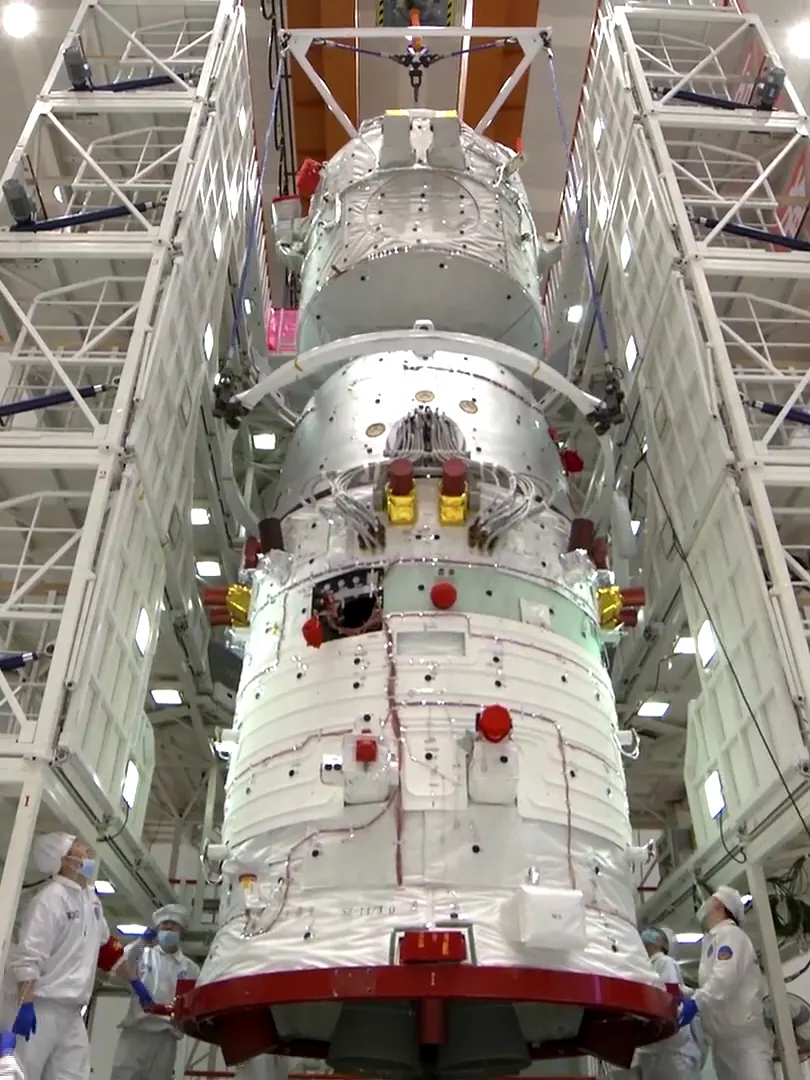
Shenzhou spacecraft assembly (Image: Wikimedia Commons)
Public broadcasts across Pakistan prompted widespread gatherings in public venues and private homes. Political leaders in both nations marked the event with formal statements. Pakistani President Asif Ali Zardari and Chinese President Xi Jinping exchanged congratulatory correspondence. President Xi characterized the Tiangong space station as a platform dedicated to international harmony and joint exploration, while Pakistani Prime Minister Shehbaz Sharif stated on social media that the expedition represents a collective achievement for the country's population, which he cited as 240 million people.
What scientific tasks will the Shenzhou-24 crew undertake?
Serving as the payload specialist on the mission, Ali is scheduled to handle equipment installations and execute in-orbit evaluations. The broader crew schedule encompasses more than 90 scientific experiments and technological assessments. The scientific agenda includes research within aerospace medicine, microgravity physics, space life sciences, material processing, and combustion science. Specific joint initiatives between China and Pakistan will focus on biotechnology and material science experiments.
To prepare for operational duties aboard the laboratory, Ali completed seven months of intensive Mandarin language instruction in Beijing. The preparation was required because all hardware interfaces, computer software menus, operational protocols, and automated vocal alerts inside the spacecraft and station function exclusively in Mandarin.
Tiangong space station (Image: Wikimedia Commons)
What background defines the Tiangong space station and Pakistan's space program?
The Tiangong space station, managed by the China Manned Space Agency, has maintained a continuous human presence in low Earth orbit since 2021. Crew transfers typically occur every six months via Shenzhou spacecraft, with temporary overlaps of six crew members during mission handovers. Pakistan's involvement in the mission was facilitated through its national space agency, the Space & Upper Atmosphere Research Commission, which oversees the country's aerospace research programs.
What remains unconfirmed about the mission schedule?
While the overall Shenzhou-24 mission is planned to span several months for its primary Chinese crew members, reporting differs regarding the precise duration of Ali's stay aboard the orbital facility. Details outlined by NewsCord indicate that Ali will complete a short-duration spaceflight lasting several days before returning to Earth aboard the returning Shenzhou-23 capsule. However, news outlets have not yet confirmed the exact date or time scheduled for his return landing. Furthermore, official statements vary slightly regarding Pakistan's national population figures referenced during the celebratory declarations, with Prime Minister Sharif citing 240 million citizens while Ali referenced 250 million.