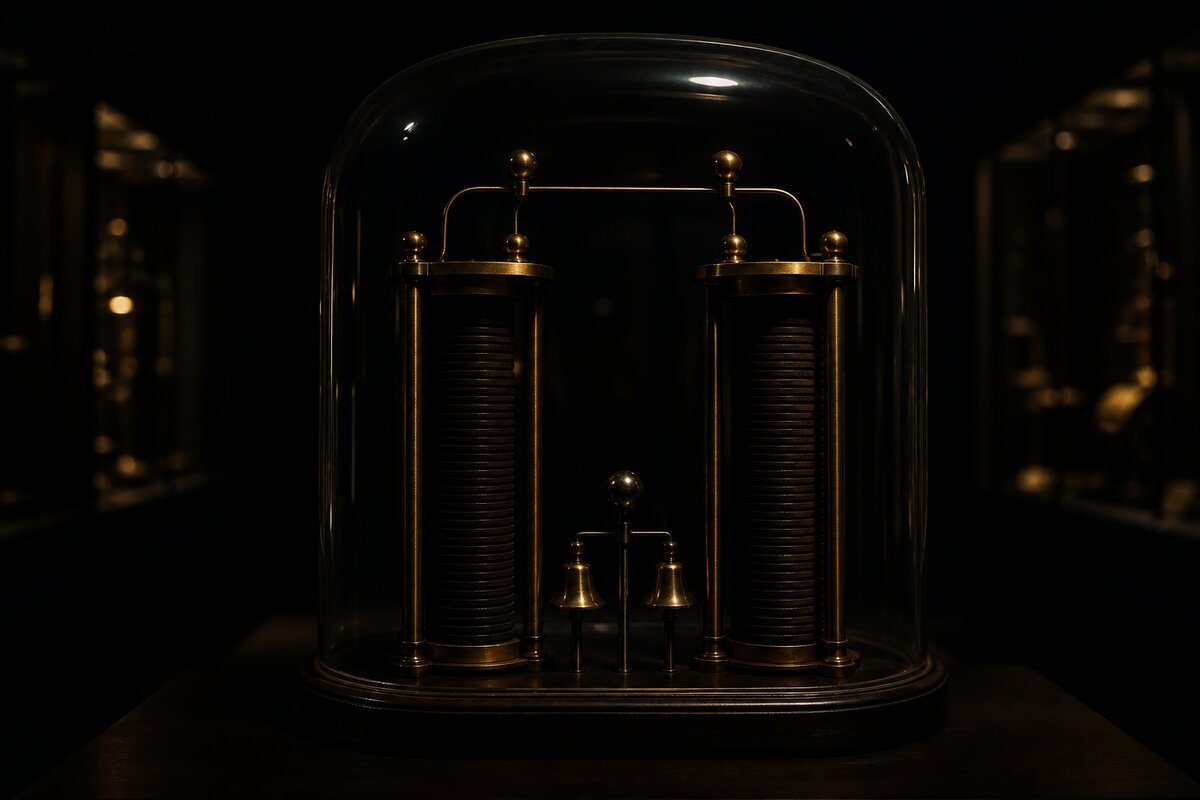
The Oxford Electric Bell, located in the Clarendon Laboratory at the University of Oxford, is a device powered by two dry piles that has been ringing almost continuously since 1840. The apparatus consists of two small bells separated by a metal sphere about the size of a chickpea, which oscillates between them at a frequency of approximately two hertz. Because it is housed behind a glass case, the sound is rarely heard, yet the motion has persisted for nearly two centuries.1
What is the history behind the 1840 label?
The bell apparatus was acquired by physics professor Robert Walker, who inscribed the note "Set up in 1840" in his own hand. Later records suggest the device may have been manufactured around 1825 by the London-based firm Watkin and Hill. The design is based on the dry pile columns developed by Italian physicist Giuseppe Zamboni, which utilized alternating layers of metal foil, paper impregnated with zinc sulfate, and manganese dioxide, all insulated with sulfur. In the nineteenth century, these piles were popular parlor curiosities rather than utility-scale power sources.2
The exact internal composition of the two piles in the Clarendon Laboratory remains a matter of scientific estimation. The laboratory's own archives state that the internal structure is based on assumptions derived from contemporary artifacts of the era. The device serves as both an ongoing experiment and a sealed box that remains preserved; to open it would be to measure it, but to leave it sealed is to observe it for another century. Science sometimes protects its secrets by choosing not to dismantle them.
Why does the Oxford Electric Bell take so long to deplete?
The device is powered by two piles connected in series, keeping the bells at opposite electrical charges. When the 4-millimeter metal sphere touches one bell, it acquires a charge and is repelled, only to be attracted to the opposing bell. The amount of charge transferred during each contact is infinitesimal. While the high voltage produces the movement, the actual current flowing is so small that the piles can sustain the process for centuries. With a frequency of about 2 hertz, the laboratory estimates that the bell has struck approximately 10 billion times since 1840.1
The apparatus is not a perpetual motion machine, and it does not violate the second law of thermodynamics. The bell will cease to function once the charges equalize or the sphere sustains too much mechanical wear. The Guinness World Records classifies it not as magic, but as the world's most durable battery and the longest-running example of continuous tintinnabulation. It functions as a battery with a finite charge that is being depleted one drop at a time.2
What is the record of this silent experiment?
While the experiment has experienced brief interruptions due to high humidity, its near-continuous operation has spanned multiple generations of political leaders and two world wars. The battery has indeed outlived the reigns of monarchs and the terms of presidents. For a physicist, the bell serves as a tangible demonstration of how little energy is required to perform work via electrostatic force.3
A modern lithium-ion battery in a smartphone powers the device for a limited time because it mobilizes billions of electrons every second to meet high energy demands. In contrast, the piles in the Clarendon Laboratory move a tiny sphere using almost no current. While contemporary engineering focuses on megawatt capacity and rapid charging, this vitrine-housed relic holds the record for the most patient, whispered use of electricity.
When will the Oxford Electric Bell finally go silent?
There is no definitive date for when the bell will stop ringing. It could be tomorrow, or it could continue for another generation. The fundamental lesson is one of physics rather than history: a device that runs for a long time is not the same as a device that runs forever. The bell serves as an example of a limited supply that is consumed exceptionally slowly, rather than an infinite source of power.
Notes and Sources
- University of Oxford, Clarendon Laboratory archive, "Exhibit 1 – The Clarendon Dry Pile": 1840 installation, ~2 Hz, ~4 mm sphere, ~10 billion strikes. ↩
- Wikipedia, "Oxford Electric Bell"; Guinness World Records: world's most durable battery. Includes context on Zamboni dry pile layers and the laboratory's confirmation that it is not a perpetual motion machine. ↩
- BBC News (2019), "Oxford Electric Bell: The battery that's outlived queens and presidents"; SPARK Museum, context on Zamboni / dry pile technology. ↩