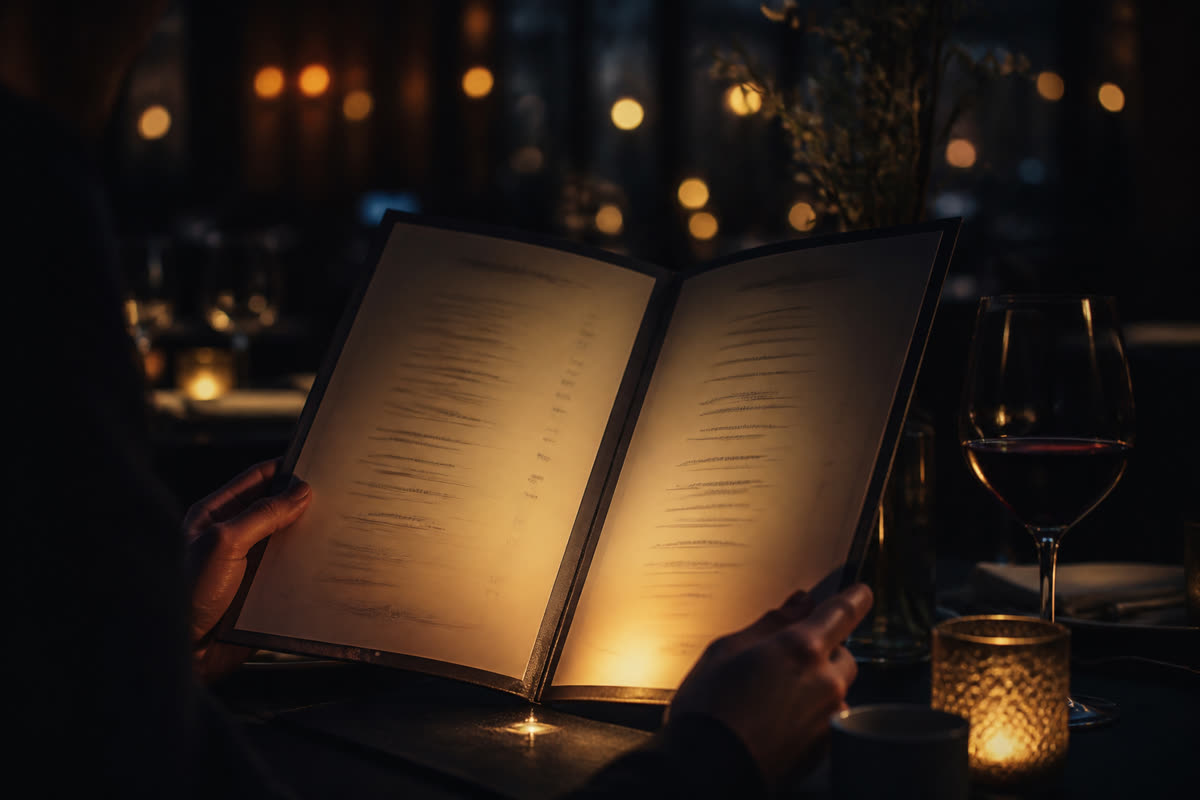
A menu is not merely a list of food items; it is a meticulously designed negotiation tool where the house often holds the advantage. From the removal of currency symbols to the strategic placement of high-priced items, every detail is engineered to nudge diners toward a higher total bill. This discipline, known as menu engineering, combines legitimate behavioral science with industry lore that often masks deeper ethical or scientific questions.
How do currency symbols affect how much we spend?
Removing currency symbols can significantly increase average customer spending because it diminishes the psychological pain of paying. A 2009 study by Sybil Yang and Sheryl Kimes at Cornell University found that diners were served one of three menus: one with a dollar sign ($20.00), one with the word written out (twenty dollars), and one with just the raw number (20). Customers who received the menu with just the numbers spent an average of $5.55 more per person—a roughly eight percent increase. The researchers argued that the symbol acts as a subtle reminder of the financial cost of a meal; by removing it, the connection between the food and the money becomes more abstract, causing the price to feel like a neutral index rather than a personal expense.
Why is the most expensive dish on the menu rarely meant to be sold?
The most expensive item on a menu is often included as an anchor to make other, lower-priced options seem like a reasonable value. This psychological phenomenon, known as anchoring, occurs when a person's first exposure to a number biases their subsequent judgments. According to classic experiments by Kahneman and Tversky, people are influenced by even irrelevant numbers they encounter. In a restaurant, once a diner sees a dish priced at, for example, $1,450, a secondary option at $590 suddenly feels like an accessible middle ground. Restaurants place their most expensive items at the top or in prominent spots specifically to manipulate this comparison, steering the majority of diners toward the second-most expensive items, which are often the most profitable.
Does the left-digit effect make prices feel cheaper?
The widespread use of prices ending in .99 works because the human brain encodes the magnitude of a number from left to right, locking onto the first digit before the full value is processed. A 2005 study by Manoj Thomas and Vicki Morwitz demonstrated that consumers perceive a price of 2.99 as being in the two-dollar range, whereas 3.00 is mentally categorized as being in the three-dollar range. Even though the mathematical difference is a single cent, the perceived difference is nearly a full unit. This effect is persistent and resistant to awareness; even knowing the strategy exists does not protect the shopper from the cognitive bias, as the process occurs in the deeper layers of number perception rather than in conscious calculation.
Is the golden triangle of menu design real?
The idea that there is a "golden triangle" where specific locations on a menu automatically drive higher sales lacks consistent scientific support. While some consultants claim that the center and top-right corners of a menu are prime real estate, eye-tracking research conducted by Sybil Yang in 2012 suggests that people generally read a menu like a book: starting at the top left, moving down, and proceeding to the next column or page. While specific positions are not inherently magical, labeling items with tags like "chef’s choice" or using visual frames does effectively draw attention. In the digital age, this has shifted to the first items visible on a screen, as diners are often reluctant to scroll, giving a distinct advantage to the items listed first.
How did a scientific scandal affect the study of menu descriptions?
The study of descriptive language in menus was dealt a significant blow following the academic downfall of its leading proponent, Brian Wansink. A famous 2001 study co-authored by Wansink claimed that descriptive names like "grandmother's zucchini cookies" increased sales by 27 percent compared to generic labels. However, in 2018, Cornell University determined that Wansink had engaged in academic misconduct, including the misuse of data and flawed statistical reporting, leading to the retraction of at least 18 of his articles. While the 2001 study itself was not among those retracted, the incident has cast doubt on the precision of the statistics often cited in menu engineering. While descriptive language likely still influences expectations and taste perception, the exact "27 percent" figure must be viewed with skepticism.
How can a diner defend against menu manipulation?
Diners can counter menu engineering by setting a budget before opening the menu and viewing items from bottom to top to disrupt the intended narrative flow. Rounding prices up to the nearest whole number helps negate the left-digit effect, and ignoring visual cues like "bestseller" badges can help focus on genuine preferences rather than psychological triggers. Finally, mentally stripping away descriptive adjectives—such as "slow-roasted" or "hand-carved"—helps the customer focus on the core dish, allowing them to evaluate the value of the food itself rather than the marketing surrounding it.
Notes and Sources
- Yang, S. S., Kimes, S. E. and Sessarego, M. M. (2009). "$ or Dollars: Effects of Menu-price Formats on Restaurant Checks", Cornell Hospitality Report / International Journal of Hospitality Management, 28(1).
- Tversky, A. and Kahneman, D. (1974). "Judgment under Uncertainty: Heuristics and Biases", Science, 185(4157).
- Thomas, M. and Morwitz, V. (2005). "Penny Wise and Pound Foolish: The Left-Digit Effect in Price Cognition", Journal of Consumer Research, 32(1), 54-64.
- Yang, S. S. (2012). "Eye movements on restaurant menus: A revisitation on gaze motion and consumer scanpaths", International Journal of Hospitality Management, 31(3).
- Wansink, B., Painter, J. and van Ittersum, K. (2001). "Descriptive Menu Labels' Effect on Sales", Cornell Hotel and Restaurant Administration Quarterly, 42(6), 68-72.
- Official statement from Michael I. Kotlikoff, Provost of Cornell University, September 20, 2018; Retraction Watch database, ongoing documentation of Wansink's retracted papers.