On July 31, 1960, the Soviet youth newspaper Komsomolskaya Pravda published a short article by young Leningrad engineer Yuri Artsutanov. Artsutanov proposed dropping a tether down to Earth from a satellite in geostationary orbit and running electric trains with enclosed cars along that cable. According to his calculations, traveling to space would be only slightly more complicated than taking a train from Moscow to the suburbs.
American engineer Jerome Pearson arrived at the same idea independently of Artsutanov and published it along with detailed calculations in 1975. The concept has remained strictly on paper ever since. The reason comes down to a figure of 48 megajoules per kilogram: the exact same number dictates both the energy the elevator must consume and the load the tether must bear.
- An exploration of how many kilowatt-hours of electricity are required for every kilogram of cargo traveling from the equator to geostationary orbit, and how Earth's rotation subsidizes part of this cost.
- An explanation of how this exact energy calculation demonstrates why the tether cannot be manufactured from steel or Kevlar.
- Numerical data showing how far record-breaking nanotube fibers still fall short of the required threshold as of July 2026.
- The real-world story of a severed Kevlar tether in space and the theoretical calculation for launching a spacecraft from the top of the tether toward Jupiter.
How much energy does it take to lift a kilogram to geostationary orbit?
A payload launching from the equator faces two competing forces. Gravity pulls it downward. Because the tether rotates alongside Earth, the cargo also experiences an outward centrifugal effect. At ground level, this second force is negligible, but it grows progressively stronger with altitude until it equals gravity at an altitude of 35,786 kilometers. That altitude is geostationary orbit, where an object remains stationary relative to the surface while matching Earth's rotational speed.
Transporting a kilogram of cargo from the ground to this point requires the climber's motor to perform roughly 48 megajoules of work. In units found on an electricity bill, this amounts to 13.5 kilowatt-hours. When one kilogram of gasoline burns, it releases 44.3 megajoules of thermal energy. Consequently, every kilogram delivered to orbit requires slightly more energy than is contained in a single kilogram of gasoline.
When the payload reaches orbit, it travels at a velocity of approximately 3.07 kilometers per second. The climber's motor does not pay the energy cost for this velocity. As the climber ascends, it pushes backward against the tether, and the Earth-anchored cable accelerates the payload sideways. Roughly 9 megajoules per kilogram are supplied through this mechanism, funded by Earth's rotation, which slows the planet down by an immeasurably small amount. In his 1975 paper, Pearson designated the structure as "a spacecraft launcher using the Earth's rotational energy."
Why does the energy calculation limit the materials used for the tether?
Every segment of the tether must support the weight of the entire cable hanging beneath it. In a tether with a uniform cross-section throughout its length, maximum tension occurs at the geostationary anchor point. The ratio of this maximum tension to the material density once again yields 48 megajoules per kilogram, a metric physicists refer to as specific strength. If gravity remained as powerful at every altitude as it is at the surface, a tether with this specific strength could hang downward for nearly 5,000 kilometers without snapping.
Engineers have considered utilizing weaker materials by engineering the tether to thicken progressively toward orbit. However, the required thickening factor grows exponentially with any deficit in the material's strength. According to a table published in the American Journal of Physics in 2007 by P. K. Aravind of Worcester Polytechnic Institute, a steel tether would require an orbital cross-section 1.6×1033 times larger than its base on Earth. For Kevlar, that ratio is 2.5×10⁸. An idealized carbon nanotube boasting a tensile strength of 130 gigapascals and a density of 1,300 kilograms per cubic meter maintains a ratio of just 1.6.
Notes and Sources
- Artsutanov, Y. (1960). "V kosmos na elektrovoze" (To Space by Electric Train). Komsomolskaya Pravda, July 31, 1960. English translation of content: Lvov, V. (1967). "Sky-Hook: Old Idea". Science 158(3803): 946-947. doi.org/10.1126/science.158.3803.946 ↩
- Pearson, J. (1975). "The orbital tower: a spacecraft launcher using the Earth's rotational energy". Acta Astronautica 2(9-10): 785-799. doi.org/10.1016/0094-5765(75)90021-1 ↩
- Aravind, P. K. (2007). "The physics of the space elevator". American Journal of Physics 75(2): 125-130. doi.org/10.1119/1.2404957 ↩
- Edwards, B. C. (2000). "Design and deployment of a space elevator". Acta Astronautica 47(10): 735-744. doi.org/10.1016/S0094-5765(00)00111-9 ↩
- IPCC (2006). 2006 IPCC Guidelines for National Greenhouse Gas Inventories, Volume 2, Chapter 1, Table 1.2: motor gasoline net calorific value 44.3 TJ/Gg. ipcc-nggip.iges.or.jp ↩
- Bai, Y., Zhang, R., Ye, X. et al. (2018). "Carbon nanotube bundles with tensile strength over 80 GPa". Nature Nanotechnology 13: 589-595. doi.org/10.1038/s41565-018-0141-z ↩
- Wang, J. N., Chen, Y. T., Zhang, H. et al. (2026). "Improvement of the tensile strength of carbon nanotube fibers to 12.5 GPa by fluidics-induced alignment and densification". Nature Communications 17. doi.org/10.1038/s41467-026-75150-1 ↩
- Fuchita, Y., Otsuka, K., Omoto, E., Ishikawa, Y., Hitomi, T. (2021). "Recent Research Efforts towards Construction of Space Elevator". Obayashi Corporation Technical Research Institute Report No. 85. obayashi.co.jp; also Obayashi, "The Space Elevator Construction Concept". obayashi.co.jp/en ↩
- NASA (1996). TSS-1R Mission Failure Investigation Board, Final Report. NASA Technical Reports Server 19970011947. ntrs.nasa.gov/citations/19970011947 ↩
- Nohmi, M. et al. (2019). "Past Results and Future Missions of STARS Series Satellite". 27th International Symposium on Space Flight Dynamics (ISSFD). issfd.org ↩
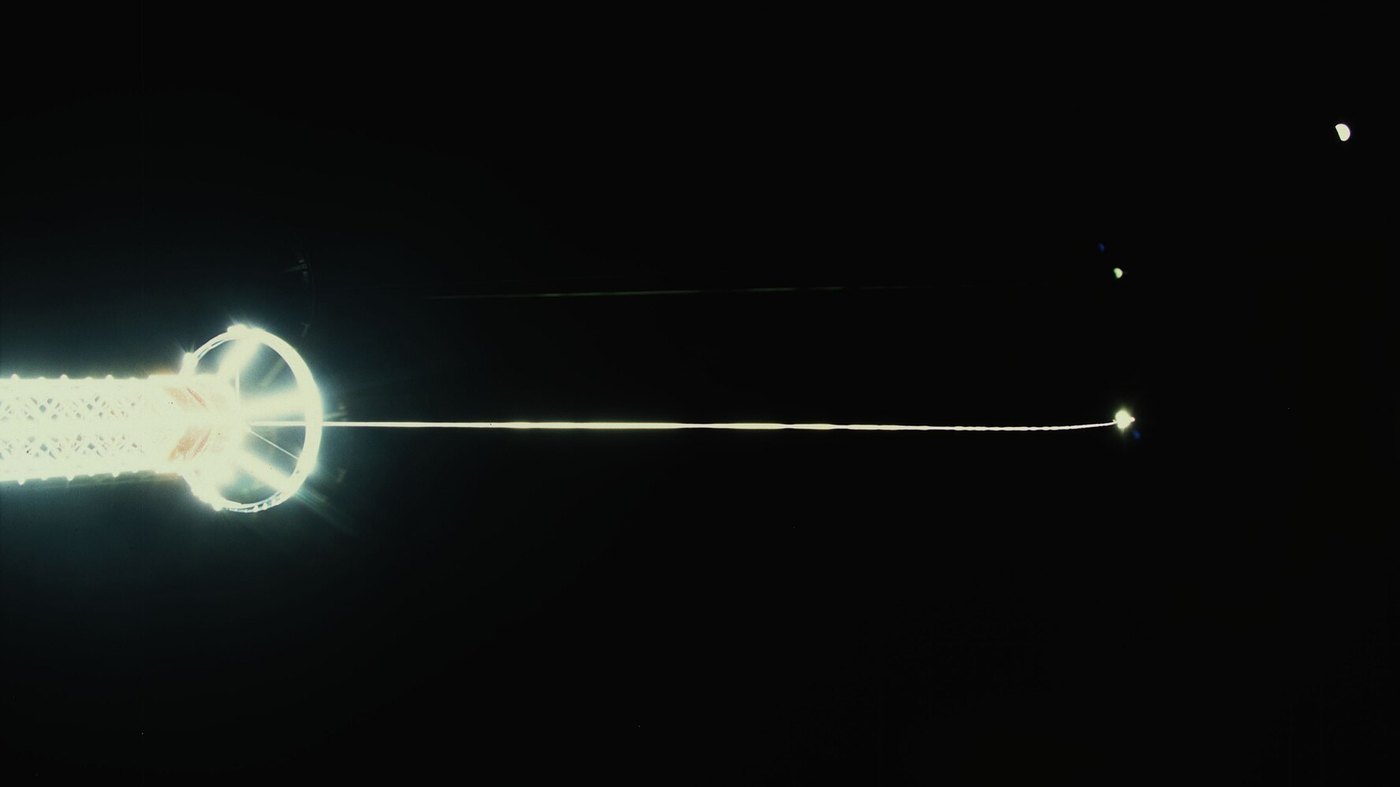
Cover image: The Kevlar tether of the TSS-1 satellite deployed from the Space Shuttle Atlantis during mission STS-46, 1992. NASA, public domain, Wikimedia Commons.