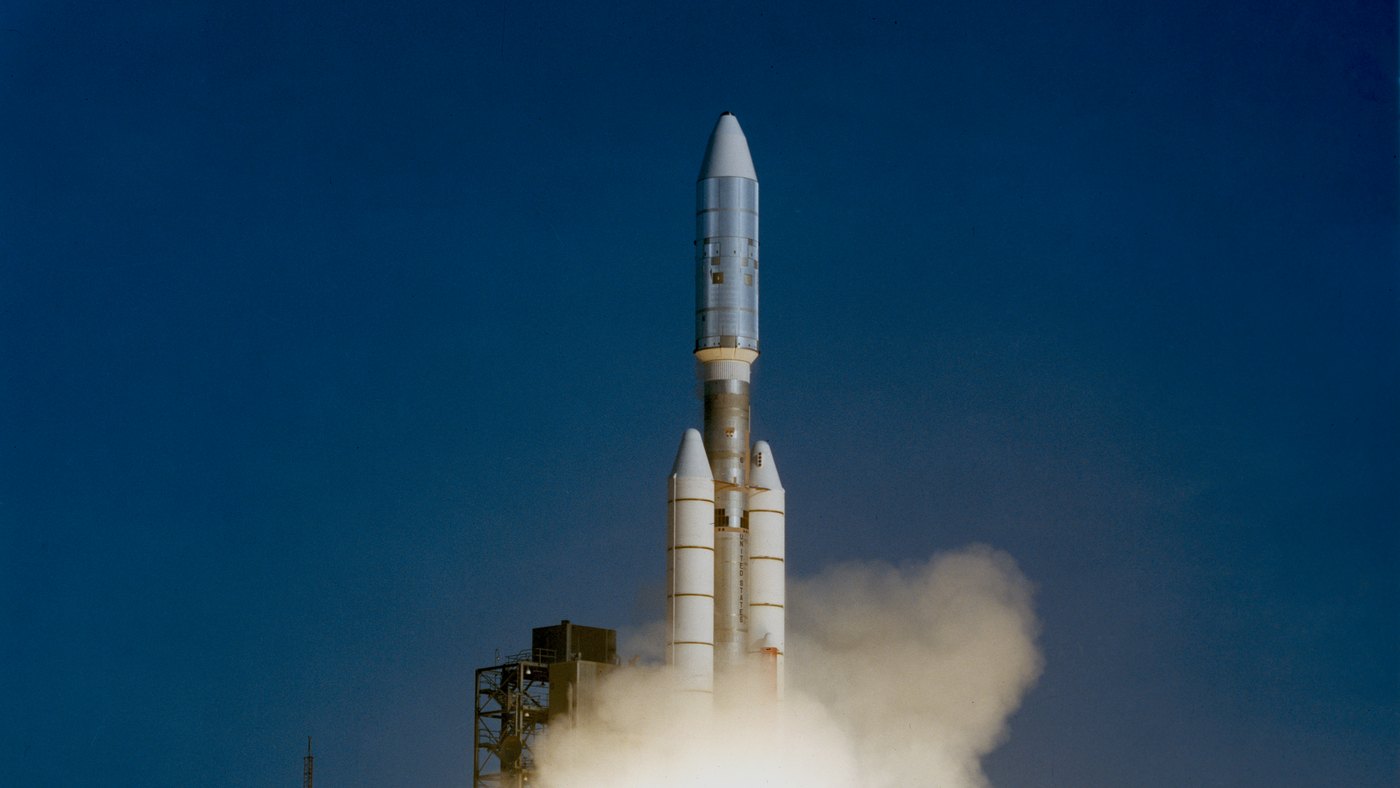
According to NASA calculations, on Wednesday, November 18, 2026, at 10:16 UTC, Voyager 1 will be 25,902,068,356 kilometers away from Earth. Light takes exactly 24 hours to cover this distance. No human-made object has ever reached this far. The spacecraft was launched on a Titan IIIE rocket from Cape Canaveral, Florida, on September 5, 1977, and by crossing this threshold, its journey will have lasted 49 years, 2 months, and 11 days.1
On that day, a command sent by NASA will reach the spacecraft the following day, and hearing the vehicle's response will take another full day.
What is in this article?
- Engineers sending commands to Voyager 1 must wait two days for a reply.
- Moving away from Earth, the spacecraft actually draws closer to Earth for three months every year, a dynamic recorded in NASA open orbit data.
- Only two of the ten scientific instruments carried by the spacecraft are still active today.
- Voyager 1 entered interstellar space in 2012, and reaching the outer shell of the solar system will take centuries.
How far is one light-day?
Light travels at 299,792 kilometers per second, reaching the Moon in 1.3 seconds and traveling from the Sun to Earth in 8 minutes and 20 seconds. It reaches Neptune, the most distant planet, in an average of 4 hours and 10 minutes from Earth. One light-day is approximately six times that distance, equating in astronomical terms to 173.14 astronomical units, or 173 times the average distance between Earth and the Sun.1
Voyager 1 travels at a speed of roughly 61,000 kilometers per hour. While this speed is enough to cover the 450-kilometer highway distance between Istanbul and Ankara in under half a minute, it is only about 1/17,700th the speed of light. According to NASA, the spacecraft is moving in the direction of the star Gliese 445 in the constellation Ursa Minor and will pass within 1.7 light-years of it in about 40,000 years.1 It will never actually arrive at the star.
There is also a subtle detail regarding the distance. While the separation reaches one light-day on the afternoon of November 18, the signal arriving back on Earth has traveled for a full 24 hours only by 05:17 on the morning of November 19, because the spacecraft continues to move farther away while the signal is in transit.2 As of October 26, Voyager 1 is 25.84 billion kilometers away from Earth, leaving it 62 million kilometers short of the threshold.2
Does Voyager 1 move closer to Earth each year while receding?
Voyager 1 moves closer to Earth each year during specific periods because the orbital data NASA relies on, publicly available in the Jet Propulsion Laboratory's Horizons system, shows that the distance does not increase in a straight line. When extracting Voyager 1's distance from Earth day by day, 2026 saw the distance peak at 25.435 billion kilometers on January 20, before decreasing to 25.394 billion kilometers by April 24. During those three months, the spacecraft drew roughly 41 million kilometers closer to Earth.2
This happens because of Earth's own orbit. Voyager 1 is receding from the Sun at about 17 kilometers per second, while Earth orbits the Sun at approximately 30 kilometers per second. During one part of the year, Earth's orbit curves toward the spacecraft, causing Earth to approach the probe faster than the spacecraft is retreating. In the other half of the year, the reverse happens. According to Horizons data, the distance between the two bodies increases by 41 kilometers per second in early September, while decreasing by 7.7 kilometers per second in early March.2 This is why the calendar moment of "one light-day" is determined by orbital calculation rather than simply dividing the spacecraft's speed by the distance.
This oscillation will not reverse the November 18 crossing. During the 2027 approach phase, the distance will drop to a maximum of 25.927 billion kilometers, remaining roughly 25 million kilometers above the one light-day mark.2
How many instruments and what transmitter power does Voyager 1 have?
Voyager 1 communicates with Earth using its 3.66-meter dish antenna, which in 1977 was the largest single-piece reflector ever sent into space. Its X-band transmitter delivers 18 watts of radio power to the antenna at peak setting.3 The typical data rate is 160 bits per second, equivalent to about 20 letters per second in plain text. Commands are sent to the spacecraft at one-tenth of that speed, at 16 bits per second.4

Capturing this faint signal requires the massive dishes of NASA's Deep Space Network, which maintains 70-meter antennas in California, Spain, and Australia. According to JPL's communications monograph, sending commands to the spacecraft and downloading recorded data is performed using one of these 70-meter antennas, while the daily 160-bit stream can also be received by 34-meter antennas.3 A shutdown command sent on April 17, 2026, took nearly 23 hours to reach the spacecraft.5
Notes and Sources
- NASA Science. Voyager 1: What Is a Light-Day? 2026. science.nasa.gov ↩
- NASA JPL Horizons System. Target Voyager 1 (-31), Earth-centered observer table, July 1, 2025 - July 1, 2028, daily step; distance, recessional velocity, and light time. Query October 26, 2026. Peaks, troughs, approach amounts, and 2027 closest values calculated from this data. ssd.jpl.nasa.gov/horizons ↩
- Ludwig, R. and Taylor, J. (2002). Voyager Telecommunications. DESCANSO Design and Performance Summary Series, Article 4. Jet Propulsion Laboratory, Caltech. voyager.gsfc.nasa.gov ↩
- NASA Science. Voyager: Spacecraft. science.nasa.gov ↩
- NASA Science, Voyager blog. NASA Shuts Off Instrument on Voyager 1 to Keep Spacecraft Operating, April 17, 2026. science.nasa.gov ↩
- NASA Science. Where Are Voyager 1 and 2 Now? Instrument status table, April 17, 2026 update. science.nasa.gov ↩
- NASA Science, Voyager blog. NASA Engineers Help Prolong Voyager 2's Science Mission, August 4, 2026. science.nasa.gov; Scientific American. NASA's Voyager 2 survives daring 'big bang' maneuver, August 2026. scientificamerican.com ↩
- Gurnett, D. A., Kurth, W. S., Burlaga, L. F. and Ness, N. F. (2013). In Situ Observations of Interstellar Plasma with Voyager 1. Science, 341(6153), 1489-1492. doi:10.1126/science.1241681 ↩
- NASA Science. Oort Cloud: Facts. science.nasa.gov ↩