World Court Finds Myanmar Responsible for Genocide Against Rohingya Population
The International Court of Justice has determined that Myanmar committed genocide against its Rohingya Muslim minority during a brutal 2017 military offensive. The landmark majority verdict mandates that Myanmar make reparations, allow displaced refugees to return safely, and investigate security forces.
W
World Desk
4 min read0 views
The International Court of Justice in The Hague ruled on Thursday that the state of Myanmar committed genocide against its Rohingya Muslim population, concluding a landmark seven-year legal procedure over the military's brutal 2017 crackdown in northern Rakhine state.
What did the International Court of Justice decide in the Myanmar case?
In a 9-6 split decision, the 15-judge panel at the United Nations' highest judicial body established that Myanmar breached its legal obligations under the 1948 Genocide Convention. Reading the judgment in the Great Hall of Justice, ICJ President Yuji Iwasawa declared that the court found the state directly responsible for committing genocidal acts against the Rohingya minority. The panel determined that the only reasonable conclusion from the gathered evidence was that Myanmar acted with specific genocidal intent to destroy a substantial portion of the ethnic group.
Watch: ICJ delivers landmark ruling in Gambia's genocide case against Myanmar — Al Jazeera English
What evidence and specific acts were cited by the judges?
The tribunal confirmed at least four distinct genocidal violations carried out by security forces, including the widespread slaughter of civilians, the forced displacement of hundreds of thousands, severe physical and emotional harm, and measures intended to prevent births within the group. Evidence evaluated by the court indicated that Myanmar armed forces killed approximately 10,000 Rohingya civilians during the clearance operations. Judge Iwasawa highlighted that military personnel perpetrated extreme violence against children, committed systemic sexual violence, and targeted civilians as they attempted to escape across the border. The court noted that Rohingya people were subjected to targeted birth control programs and long-standing institutional discrimination prior to the campaign.
"The court is fully convinced that Myanmar committed acts falling under … the genocide convention with an intent to destroy a substantial part of the Rohingya population in Myanmar," ICJ President Yuji Iwasawa stated, as reported by The Guardian.
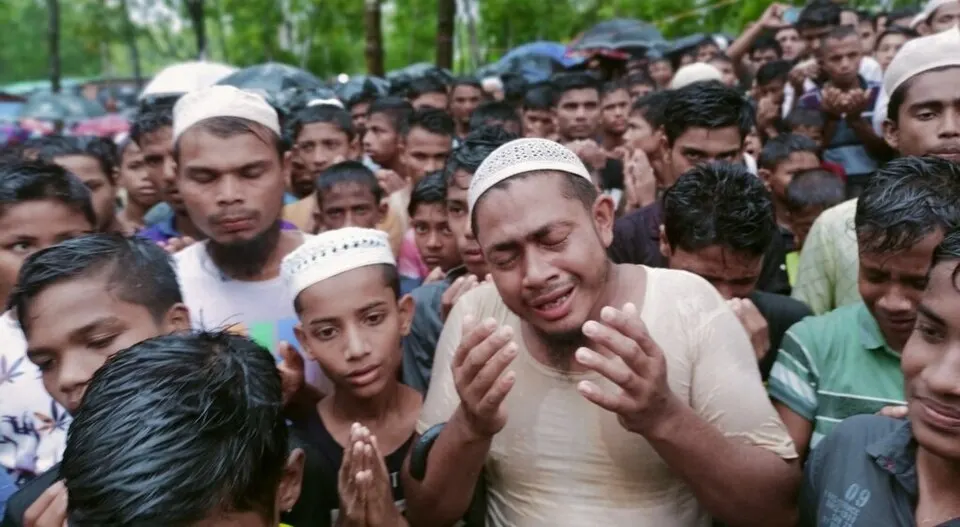
Rohingya Refugee Camp 26 (Image: Wikimedia Commons)
How did the legal proceedings against Myanmar unfold?
The legal battle began in 2019 when The Gambia, a Muslim-majority West African nation, brought the case to the World Court to hold Myanmar accountable for violating international law. Myanmar argued that its military operations were lawful counterinsurgency responses triggered by coordinated attacks on security posts by the Arakan Rohingya Salvation Army militia. Aung San Suu Kyi, serving as civilian leader at the time, personally appeared in The Hague to reject the allegations, labeling them incomplete and incorrect. To evaluate the claims, the panel held closed-door hearings earlier this year to receive testimony directly from survivors who traveled from Bangladeshi refugee settlements. The court explicitly affirmed that the Rohingya constitute a distinct ethnolinguistic group defined by their own language and culture, granting them legal protection under the treaty rules against genocide.
What measures and remedies did the UN court order?
The International Court of Justice instructed Myanmar to provide comprehensive reparations and restitution to the victims of the military campaign. The justices demanded that the government permit the safe, voluntary return of displaced Rohingya to their ancestral homes, restore or compensate for destroyed property, and fund physical and psychological rehabilitation. Furthermore, the ruling obligates authorities in Myanmar to conduct formal investigations into individual perpetrators within its national armed forces and prosecute those found responsible for military atrocities.
What is the background of the Rohingya crisis in Myanmar?
The Rohingya are a predominantly Muslim minority group native to Rakhine state along the western coast of Myanmar. For decades, state authorities systematically denied them citizenship under a 1982 nationality law, subjecting them to severe restrictions on movement, employment, and education in conditions that human rights groups have likened to apartheid. In August 2017, an intense military campaign drove more than 700,000 Rohingya to flee across the border into neighboring Bangladesh. Today, more than 1 million Rohingya reside in Cox's Bazar, forming the world's largest refugee settlement, while fewer than 600,000 remain inside Buddhist-majority Myanmar, which is currently governed by military leader Senior General Min Aung Hlaing following recent elections.
Den Haag - Carnegieplein - the Bench of Peace (with "Peace" written in all languages of the UN) & Peace Palace 1907-1913 by Louis M. Cordonnier (Image: Wikimedia Commons)
What happens next and what questions remain unresolved?
While the ICJ's ruling is legally binding and sets a major international precedent, the court lacks its own enforcement mechanism to compel physical compliance inside Myanmar, leaving the practical execution of reparations and refugee repatriation uncertain. Human rights organizations, including Amnesty International, are calling on the United Nations Security Council to implement a global arms embargo, refer the country to the International Criminal Court, and halt all external military assistance. Observers are also monitoring how this legal determination of genocidal intent will influence other active cases before the World Court, including South Africa's pending genocide lawsuit against Israel concerning the conflict in Gaza.