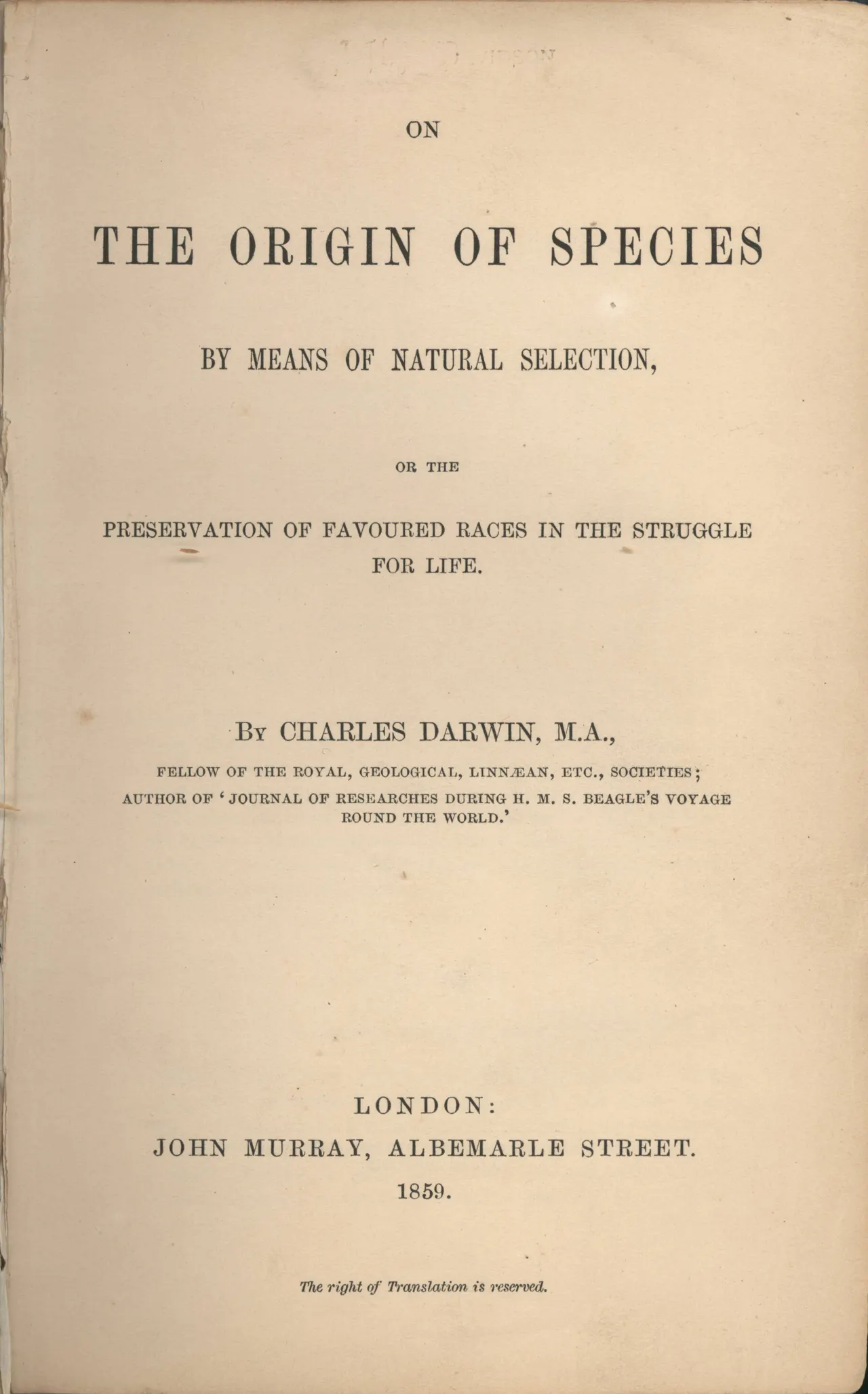
On November 24, 1859, the British naturalist Charles Darwin published his masterwork, On the Origin of Species by Means of Natural Selection. The book was released in London and offered a revolutionary scientific theory: that populations evolve over generations through a process of natural selection. By presenting a massive body of evidence for the branching pattern of evolution, Darwin fundamentally changed the human understanding of life on Earth and challenged the prevailing religious and scientific views of the 19th century.
Before this landmark publication, the English scientific establishment was deeply entwined with the Church of England. Science was largely viewed through the lens of natural theology, which held that species were fixed, unchanging, and part of a divine hierarchy. While various ideas about the "transmutation" of species had been whispered in radical circles, most naturalists believed that the biological world was a static reflection of a creator's design. Darwin’s work dismantled this concept of fixity, replacing it with a dynamic, ancient, and interconnected history of life.
How did a voyage on the Beagle lead to a revolution?
The seeds of Charles Darwin's theory were sown decades earlier during his time as a gentleman naturalist aboard the HMS Beagle. From 1831 to 1836, Darwin traveled the world, studying the geological history of landscapes and the distribution of modern species. On the island of St. Jago, he adopted Charles Lyell’s uniformitarianism, the idea that the Earth was shaped by slow, consistent processes over vast periods. This long timeline provided the necessary "deep time" for evolution to occur. In South America, Darwin discovered fossils of extinct creatures that bore a striking resemblance to modern armadillos, prompting him to wonder about the link between the living and the dead.

During his travels, Charles Darwin was also struck by the geographical variations of species. He observed that similar animals occupied neighboring regions but possessed distinct traits suited to their specific environments. Perhaps most tellingly, his encounters with the native people of Tierra del Fuego led him to conclude that there was no unbridgeable gap between humans and animals. Upon returning to England in 1836, Darwin began synthesizing these observations, eventually formulating the mechanism of natural selection after reading Thomas Malthus and observing the artificial selection used by animal breeders.
Prior to the modern synthesis in the 1930s, Darwin's theory faced a period known as "the eclipse of Darwinism," where his emphasis on natural selection was downplayed in favor of other evolutionary mechanisms.
What were the core arguments of Darwin’s theory?
Charles Darwin based his theory on a series of observable facts and logical inferences. He noted that every species is fertile enough to grow exponentially, yet natural populations remain relatively stable because resources like food are limited. This imbalance leads to a "struggle for life." Because individuals within a population vary significantly and much of this variation is heritable, those with traits better suited to their environment are more likely to survive and reproduce. Over time, this process of natural selection results in populations adapting and eventually diverging into new species.

The publication of On the Origin of Species was a strategic move. Darwin had delayed publishing for nearly twenty years, fearing the social and religious backlash. He finally moved toward publication after receiving a paper from Alfred Russel Wallace, who had independently arrived at similar conclusions. Darwin’s book was written for a non-specialist audience, ensuring that his evidence reached beyond the hallowed halls of academia and into the hands of the general public. It immediately generated intense scientific, philosophical, and religious discussion across Victorian society.
How did the world react to Darwin’s findings?
The reaction to Charles Darwin’s book was swift and polarizing. Because science at the time was part of natural theology, many clergymen and traditional scientists saw Darwinism as a threat to the divinely appointed social order. However, a younger generation of scientists, led by T. H. Huxley and the members of the X Club, used Darwin’s work as a catalyst to secularize science. They promoted scientific naturalism, arguing that the natural world should be explained by natural laws rather than supernatural intervention. Within just two decades, the scientific community reached a widespread agreement that evolution and common descent had indeed occurred.

The legacy of November 24, 1859, extends far beyond the 19th century. Although scientists were initially slow to accept natural selection as the primary driver of evolution, the development of the modern evolutionary synthesis in the 1930s and 1940s brought Darwin’s ideas to the forefront of biology. Today, his concept of adaptation through natural selection is the unifying principle of the life sciences, explaining everything from the antibiotic resistance of bacteria to the vast diversity of the fossil record. Darwin’s remains now lie in Westminster Abbey, a testament to his status as one of the most influential figures in human history.
Did you know that Charles Darwin’s grandfather, Erasmus Darwin, had outlined a hypothesis of transmutation as early as the 1790s?

Did you know that the full title of Darwin’s 1859 book is On the Origin of Species by Means of Natural Selection, or the Preservation of Favoured Races in the Struggle for Life?
Watch: Origin of Species 1859: Did 1,250 Copies Sell Out in a Day?
From the History Plainly Spoken channel.
Sources and further reading: Wikipedia — On the Origin of Species, Charles Darwin, Tes (magazine), Religious festival (CC BY-SA). Images: Wikimedia Commons.