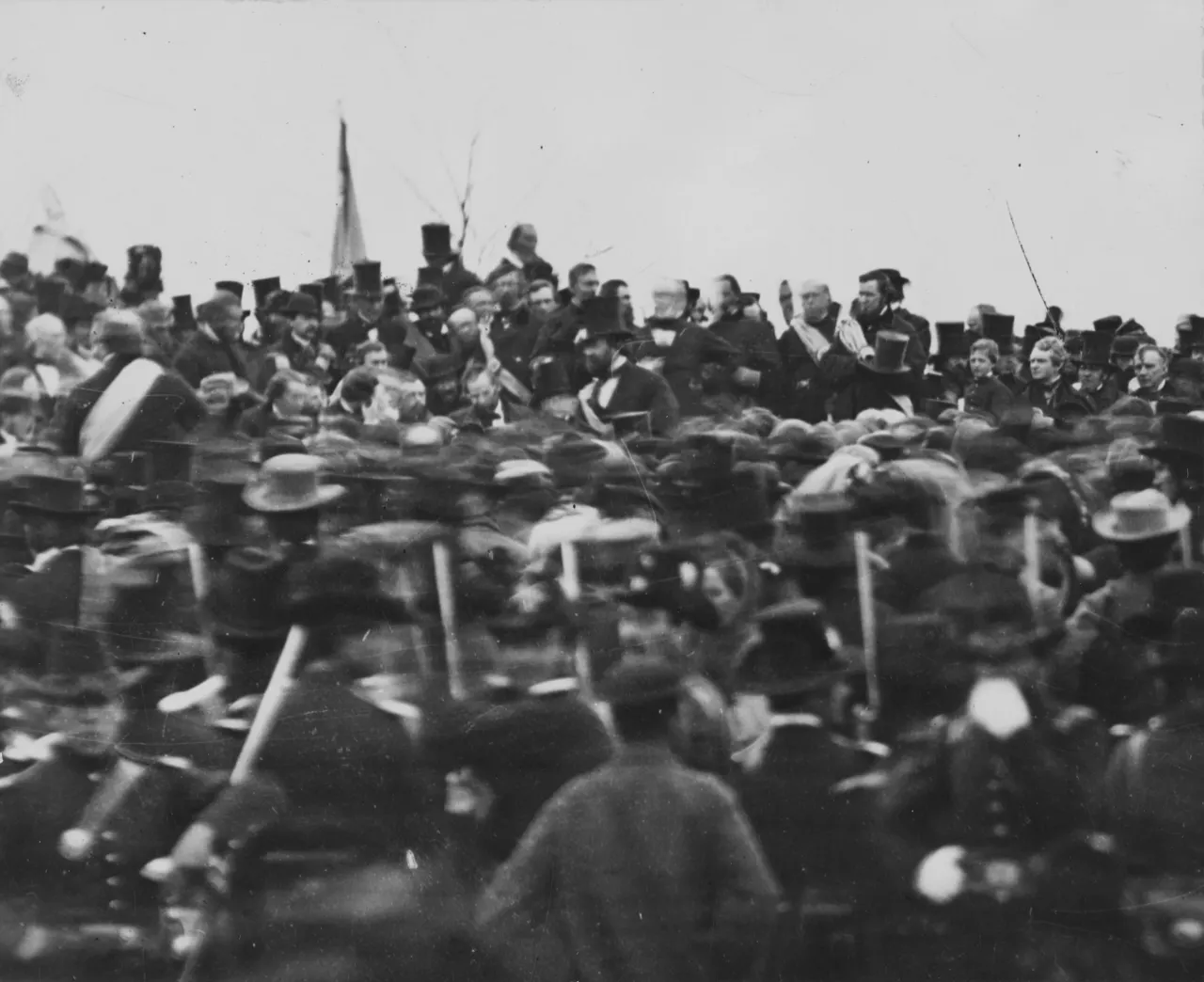
On November 19, 1863, President Abraham Lincoln delivered the Gettysburg Address at the dedication of the Soldiers' National Cemetery in Gettysburg, Pennsylvania. This event took place four and a half months after the Battle of Gettysburg, the deadliest conflict of the American Civil War. Lincoln’s 271-word speech transformed the purpose of the war from a mere struggle for territory into a pursuit of human equality and a 'new birth of freedom.' Today, it is remembered as one of the most significant and influential statements on democracy in human history.
The landscape Lincoln surveyed that November afternoon was one of fresh scars. The Battle of Gettysburg, fought between July 1 and July 3, 1863, had resulted in more than 50,000 casualties. It was a decisive Union victory that halted the Confederate invasion of the North, but the cost was staggering. Thousands of Union soldiers, over 3,000 of whom were killed in action, required a dignified final resting place. David Wills, a local attorney and member of the cemetery committee, invited the President to provide 'a few appropriate remarks' to formally set apart the grounds for their sacred use.
Why was Lincoln’s presence considered a secondary act?
Abraham Lincoln was not the featured speaker of the day. That honor belonged to Edward Everett, a renowned elder statesman and orator of the era. In the mid-19th century, cemetery dedications were grand, hours-long affairs. Everett delivered a massive oration of 13,607 words that lasted a full two hours, drawing on neoclassical traditions and comparing the American struggle to the ancient battles of Greece. When Lincoln finally rose to speak, many in the crowd of 15,000 expected a similarly lengthy performance, but the President had a different, more concise vision for the American national purpose.

Lincoln’s journey to the podium was marked by personal physical distress. He departed Washington, D.C., on November 18 accompanied by cabinet members William Seward, John Usher, and Montgomery Blair. During the trip, he complained of weakness and dizziness. By the morning of the ceremony, his secretary John Nicolay and assistant John Hay noticed his face had a 'ghastly color' and a 'haggard' expression. Modern medical analysis suggests Lincoln was likely in the early stages of a mild case of smallpox, suffering from a fever and a severe headache as he prepared to address the nation.
Lincoln’s speech lasted less than two minutes and contained only ten sentences, yet it redefined the American Constitution through the lens of the Declaration of Independence.
How did Lincoln use rhetoric to reshape the Union?
Abraham Lincoln began his address not by citing the Constitution, but by reaching back to 1776. By starting with 'Four score and seven years ago,' he anchored the nation’s identity in the proposition that 'all men are created equal.' While scholars like Garry Wills have noted parallels to Pericles’s Funeral Oration from the Peloponnesian War—such as the praise for ancestors and the exhortation of the living—others, like Adam Gopnik, argue that Lincoln’s primary source was the King James Bible. Lincoln used the imagery of birth, life, and death to frame the war as a test of whether a nation 'conceived in Liberty' could long endure.

The brevity of the address was jarring to some contemporaries. In just 271 words, Lincoln moved from the past ('our fathers') to the present ('a great civil war') and finally to the future. He argued that the living must be dedicated to the 'unfinished work' of the fallen. His concluding vow—that 'government of the people, by the people, for the people, shall not perish from the earth'—has since become the definitive shorthand for the democratic ideal. Despite his illness, Lincoln’s delivery was focused on the ideological stakes of the Union victory and the necessity of the total abolition of slavery.
What was the immediate aftermath of the speech?
Abraham Lincoln’s remarks were not immediately hailed as a masterpiece by everyone present. After he finished, he boarded a 6:30 pm train back to Washington, feeling increasingly feverish. He was soon diagnosed with smallpox and confined to bed. The focus of the local press was often on Everett’s long oration, which had been very well received at the time. However, as the text of Lincoln’s address was reprinted in newspapers across the North, its power began to resonate. The President himself later wrote out several copies of the speech; the 'Bliss version' is now considered the standard text and is the only one he signed.

The Battle of Gettysburg was the deadliest in American military history, resulting in more than 50,000 casualties over just three days of fighting.
The impact of the Gettysburg Address grew as the Civil War drew to a close. By framing the conflict as a 'new birth of freedom,' Lincoln helped prepare the public for the dissolution of the Confederacy and the national abolition of slavery, which freed four million African Americans. The speech effectively bridged the gap between the legalistic framework of the Union and the moral imperative of human rights. It transformed the cemetery from a place of mourning into a monument to a specific, egalitarian political cause.
Today, the Gettysburg Address is taught in schools worldwide as a pinnacle of English public oratory. It serves as a reminder of the turning point in 1863 when the Union army successfully repelled Confederate forces, altering the course of the war. Lincoln’s ability to recast abstract constitutional law into the cadence of the Bible allowed him to speak to a grieving nation’s soul. His few 'appropriate remarks' have outlived the two-hour orations of his contemporaries, standing as the ultimate statement on the endurance of the American experiment.

Did you know? Edward Everett, the main speaker of the day, wrote to Lincoln the next day saying, "I should be glad if I could flatter myself that I came as near to the central idea of the occasion, in two hours, as you did in two minutes."
Did you know? The exact wording of the speech remains a subject of scholarly debate because the five known handwritten copies by Lincoln, including the famous Bliss version, differ slightly in their punctuation and structure.
Watch: Abraham Lincoln's Trip to Gettysburg & the Gettysburg Address (1863)
From the Threads from the National Tapestry channel.
Sources and further reading: Wikipedia — Gettysburg Address, American Civil War, Abraham Lincoln, Gettysburg National Cemetery (CC BY-SA). Images: Wikimedia Commons.