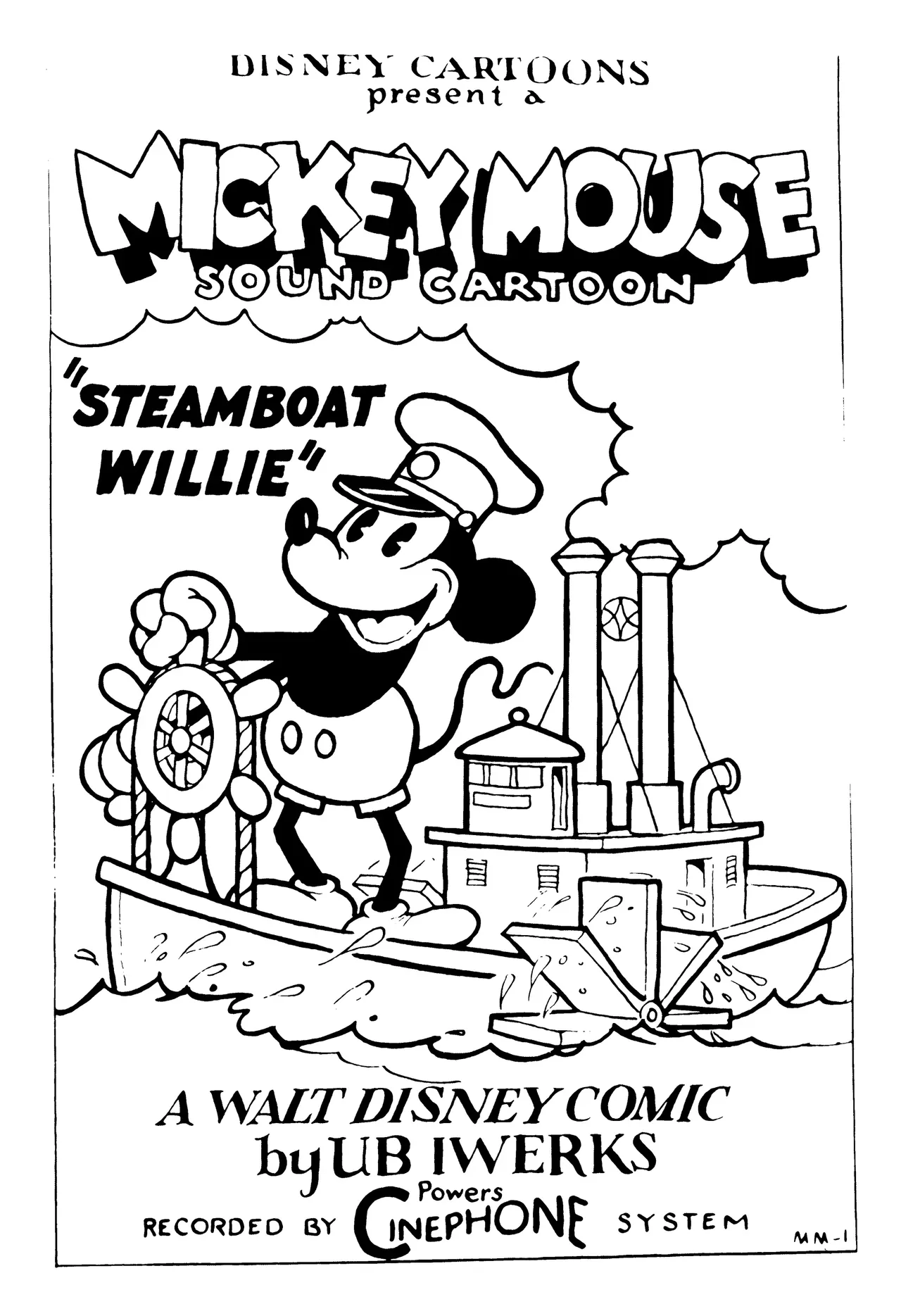
On November 18, 1928, the animated short film Steamboat Willie was released by Celebrity Productions, marking a watershed moment in motion picture history. Directed by Walt Disney and Ub Iwerks, this black-and-white production was the first cartoon to feature a fully synchronized, post-produced soundtrack, setting a new technical standard for the medium. The film served as the official debut for the iconic characters Mickey Mouse and Minnie Mouse, who would go on to become global cultural staples.
Why was Steamboat Willie the first to succeed?
While other studios had experimented with sound, Steamboat Willie was the first to achieve perfect synchronization using a click track to keep musicians precisely on the beat. Earlier attempts, such as the Song Car-Tunes series by Inkwell Studios, often suffered from timing drift, while Paul Terry’s Dinner Time failed to resonate with audiences just one month prior. Walt Disney became obsessed with the potential of sound after witnessing the success of The Jazz Singer in 1927. By partnering with producer Pat Powers to utilize the 'Powers Cinephone' system, Disney ensured that every whistle, footstep, and musical note aligned perfectly with the animation on screen.
How did Mickey Mouse come to be?
Mickey Mouse was created as a strategic replacement for an earlier Disney character, Oswald the Lucky Rabbit, who was lost due to studio ownership disputes. Before Steamboat Willie, Disney had produced two silent films, Plane Crazy and The Gallopin' Gaucho, but both had failed to secure a distributor. Walt Disney believed that adding synchronized sound would be the key to mass appeal. The character of Pete, the antagonist who appears as a captain in this short, actually predates Mickey by three years, having first appeared in 1925 as a bear-like villain.

In 1998, the United States Library of Congress selected Steamboat Willie for permanent preservation in the National Film Registry due to its profound cultural and historical significance.
What happened during the test screening?
Before the final soundtrack was produced, the production team held a tense test screening on July 29, 1928, to see if audiences would buy into a talking cartoon. To create a live effect, Roy O. Disney projected the film from outside the office window, while Ub Iwerks hung a bedsheet to serve as a screen. Behind this sheet, the team performed a live soundtrack: Wilfred Jackson played the mouth organ, Iwerks banged on pots and pans, and Johnny Cannon managed sound effects with devices like spittoons. Walt Disney provided the voices, and the overwhelmingly positive reaction from their employees proved that the concept was a triumph.
The plot itself is a whimsical display of musical chaos. Mickey navigates a paddle steamer, whistling 'Steamboat Bill' while the bullying Captain Pete attempts to dominate the bridge. After a series of mishaps involving a bar of soap, a bucket, and a disgruntled parrot, the ship stops at 'Podunk Landing' to collect livestock. When Minnie Mouse misses the boat, Mickey saves the day by hoisting her aboard with a cargo crane, hooking her bloomers in a moment of frantic improvisation.

The film reaches its crescendo when a goat consumes Minnie's sheet music for 'Turkey in the Straw.' The goat begins to emit musical notes, turning into a living phonograph. Mickey capitalizes on this by using various animals as percussion, from playing a sow like an accordion to utilizing a cow's teeth as a xylophone. This sequence of creative animation, perfectly synced to the rhythm of the music, solidified the film’s status as a technical marvel.
Captain Pete, entirely unamused by the barnyard concert, forces Mickey to peel potatoes as punishment. Even in this menial labor, Mickey finds an opportunity for defiance, wasting the potatoes and eventually tossing one at a heckling parrot. The film ends with Mickey laughing at his own mischief, capturing the irrepressible spirit of his character.

The film’s influence has been immense, leading to decades of critical acclaim and multiple copyright extensions by the U.S. Congress. After years of intense lobbying by The Walt Disney Company, Steamboat Willie eventually entered the public domain on January 1, 2024. Today, it is recognized not merely as a piece of animation, but as the foundation of an entire industry.
The production budget for Steamboat Willie was US$4,986.69, which is equivalent to approximately $94,000 in 2025 money.

The title of the film is widely considered to be a parody of the Buster Keaton film 'Steamboat Bill, Jr.', which was also released in 1928.
While Mickey and Minnie appear to speak, the film is actually performed in near-pantomime, with the only true intelligible dialogue coming from the ship’s parrot.
Watch: Steamboat Willie (1928) Walt Disney Animation Studio | Mickey Mouse cartoon
From the Cult Cinema Classics channel.
Sources and further reading: Wikipedia — Steamboat Willie, Cartoon (CC BY-SA). Images: Wikimedia Commons.