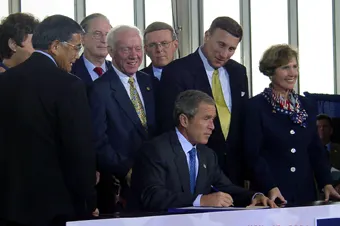
On November 19, 2001, the 107th United States Congress enacted the Aviation and Transportation Security Act, a landmark legislative response to the September 11 terrorist attacks. The Act, sponsored by Senator Fritz Hollings, established the Transportation Security Administration to federalize air travel security. This day marks the pivotal moment when the United States moved from a system of privatized, decentralized airport monitoring to a centralized federal security framework that permanently altered the experience of travel for millions.
The world prior to the passage of this Act functioned under a vastly different set of assumptions regarding aviation safety. In the months leading up to the catastrophic events of 2001, the American sky was managed by an industry that viewed air travel as a relatively open enterprise. Security, where it existed, was largely outsourced to private firms such as Wackenhut, Globe, and ITS. The responsibility for ensuring that passengers were not carrying prohibited items fell to individual airlines, which prioritized efficiency and flow over rigorous, standardized inspection.

Prior to the enactment of the Aviation and Transportation Security Act, the sterile concourses of American airports were viewed as public areas, where photo identification was not even required for passengers to board aircraft.
How did the security process work before the federal intervention?
Before the Transportation Security Administration was created, the passenger screening process relied on a rudimentary checklist and localized oversight. Ticket counter agents were the front line of defense, tasked with asking passengers only two specific questions: whether their luggage had remained under their control since packing, and whether any unknown individual had requested them to transport an item. Beyond these verbal inquiries, the mechanical security measures were limited to basic metal detectors and the X-raying of carry-on bags. Because the concourses were considered public space, the rigorous identity verification protocols common today were entirely absent, leaving the transition from the airport lobby to the aircraft cabin largely unchecked.

What prompted the creation of the Transportation Security Administration?
The Transportation Security Administration was created as an urgent, direct response to the September 11 attacks, during which 19 hijackers successfully commandeered four commercial airliners. The devastating impact of these planes on the World Trade Center towers, the Pentagon, and a field in Pennsylvania exposed profound weaknesses in the nation's aviation security protocols. The 107th United States Congress, meeting under the shadow of these events, recognized that the private security model could no longer protect the nation from the evolving threat of international terrorism. The resulting legislation sought to consolidate control and bring the full weight of federal law enforcement into every airport terminal across the country.

How did the legislative process shape this new agency?
The legislative process was spearheaded by Senator Fritz Hollings of South Carolina, who introduced S. 1447 with the support of 30 co-sponsors. The passage of the Aviation and Transportation Security Act represented a rare moment of swift, decisive action in Washington, D.C. While the agency began its life as an independent entity, the federal architecture of the government was already shifting to accommodate this new reality. By 2002, with the passage of the Homeland Security Act, the Transportation Security Administration was officially transferred to the newly formed Department of Homeland Security, cementing its role as the primary guardian of the nation's transportation networks.

The transition to a federal workforce transformed the air travel landscape from a decentralized environment into a highly regulated, high-security domain. The impact of the Aviation and Transportation Security Act continues to define how passengers move through terminals today, as the agency maintains authority over everything from the screening of passengers to the regulation of complex transportation systems that connect the United States to the rest of the world. What began in November 2001 as a crisis response has evolved into a permanent feature of the modern American experience.
Before the existence of the Transportation Security Administration, airport screening duties were contracted out to private firms like Wackenhut, Globe, and ITS.
The 107th United States Congress, which passed the Act, spanned from the final weeks of the Clinton administration through the first two years of the George W. Bush presidency.
Watch: Bush signs aviation security legislation
From the AP Archive channel.
Sources and further reading: Wikipedia — Aviation and Transportation Security Act, 107th United States Congress, September 11 attacks, Transportation Security Administration (CC BY-SA). Images: Wikimedia Commons.