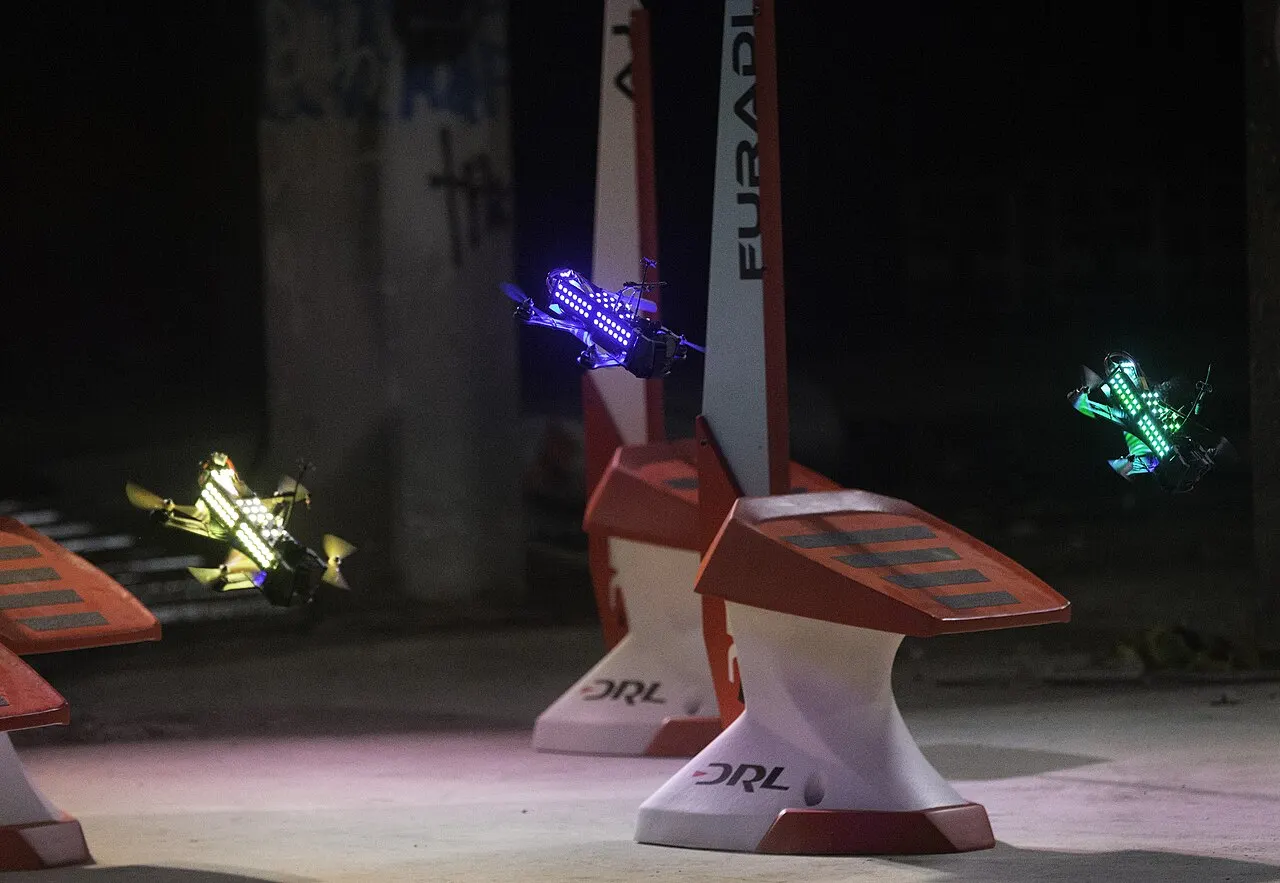
On April 12, 2025, a racing drone navigating an 11-gate circuit at the ADNEC Marina Hall in Abu Dhabi crossed the finish line in a blistering 16.56 seconds. The drone was entirely pilotless. The software, developed by the MAVLab team at Delft University of Technology in the Netherlands, outperformed three former Drone Champions League (DCL) world champions in qualifying rounds held at the same venue that day.1
The research team published the methodology behind this performance on October 14, 2026, in the journal Science Robotics. The system is known as MonoRace.1
- How the drone navigated space and velocity using only a single front-facing camera.
- How a program with no prior flight experience reached champion-level performance in a virtual simulation.
- The challenges the team faced regarding image noise and sensor overflow on race day.
- Why human pilots regained their competitive edge in a rematch nine months later.
How does a drone navigate using only a single camera and an inertial sensor?
The Abu Dhabi Autonomous Racing League (A2RL) and DCL prohibited teams from using proprietary hardware, requiring all participants to use identical drones: a 966-gram carbon fiber frame equipped with a single 155-degree wide-angle camera and an inertial measurement unit (IMU) embedded in the flight controller to measure acceleration and rotation. All calculations were processed by a compact NVIDIA Jetson Orin NX computer. The arena lacked motion-capture cameras, GPS, or auxiliary visual aids.1 This setup mirrors the experience of human First-Person View (FPV) pilots, who navigate the course exclusively through the drone's onboard camera feed.2 The course measured 76 meters in length and 18 meters in width, with each gate opening spanning 1.5 meters. Two gates were stacked vertically, requiring the drone to execute a "split-S" maneuver by passing through the upper gate and diving into the lower one. While organizers provided the dimensions and locations of the gates beforehand, they did not permit precise physical calibration or custom drone modifications.1
How does a compact neural network command the motors directly?
The system receives 90 frames per second from the camera. A neural network identifies the gates in each frame, extracts their corners, and calculates the drone's position relative to the target. This positional data is then processed by a secondary, highly compact network that determines the power output for all four motors 500 times per second directly within the flight controller’s 480 megahertz microcontroller. The system operates without classical stabilization software, allowing it to ramp motor power from zero to maximum in just two milliseconds.1 This architectural approach was originally pioneered by the European Space Agency’s Advanced Concepts Team for satellite and spacecraft navigation.3
The network learned to fly from scratch using reinforcement learning. The program underwent millions of simulated trials in a simplified physics environment, receiving performance scores after each attempt. Co-author Guido de Croon noted to Live Science that the initial training focused solely on maintaining altitude and reaching the first gate.4 During these simulations, variables including drone weight, battery voltage, air resistance, and sensor noise were varied by 30 to 40 percent across trials.1 Even when real-world flight data occasionally pushed these boundaries, the network successfully completed its rounds. The team trained several versions, labeling them by lap time; the fastest, M16, demonstrated extreme speed, while the most reliable version, M23, completed 88.4 percent of its 43 flights without error.1
Notes and Sources
- Bahnam, S. A., et al. (October 14, 2026). "MonoRace: Robust monocular AI for champion-level drone racing". Science Robotics. doi:10.1126/scirobotics.aee9250; preprint: arXiv:2601.15222
- TU Delft (October 16, 2026). "The science behind world's fastest autonomous racing drone". tudelft.nl; TU Delft (April 15, 2025). "Autonomous drone from TU Delft defeats human champions in historic racing first". tudelft.nl
- European Space Agency (2025). "From ESA lab to a historic drone race win". esa.int
- Bradley, A. (October 19, 2026). "World's fastest AI-powered racing drone outflies the best human pilots". Live Science. livescience.com
- Kaufmann, E., et al. (2023). "Champion-level drone racing using deep reinforcement learning". Nature, 620, 982-987. doi:10.1038/s41586-023-06419-4
- University of Zurich (August 30, 2023). "High-speed AI drone". news.uzh.ch
- A2RL (January 23, 2026). "A2RL Drone Championship Sets the Pace for AI in Autonomous Flight". a2rl.io; Abu Dhabi Media Office (April 17, 2025). mediaoffice.abudhabi