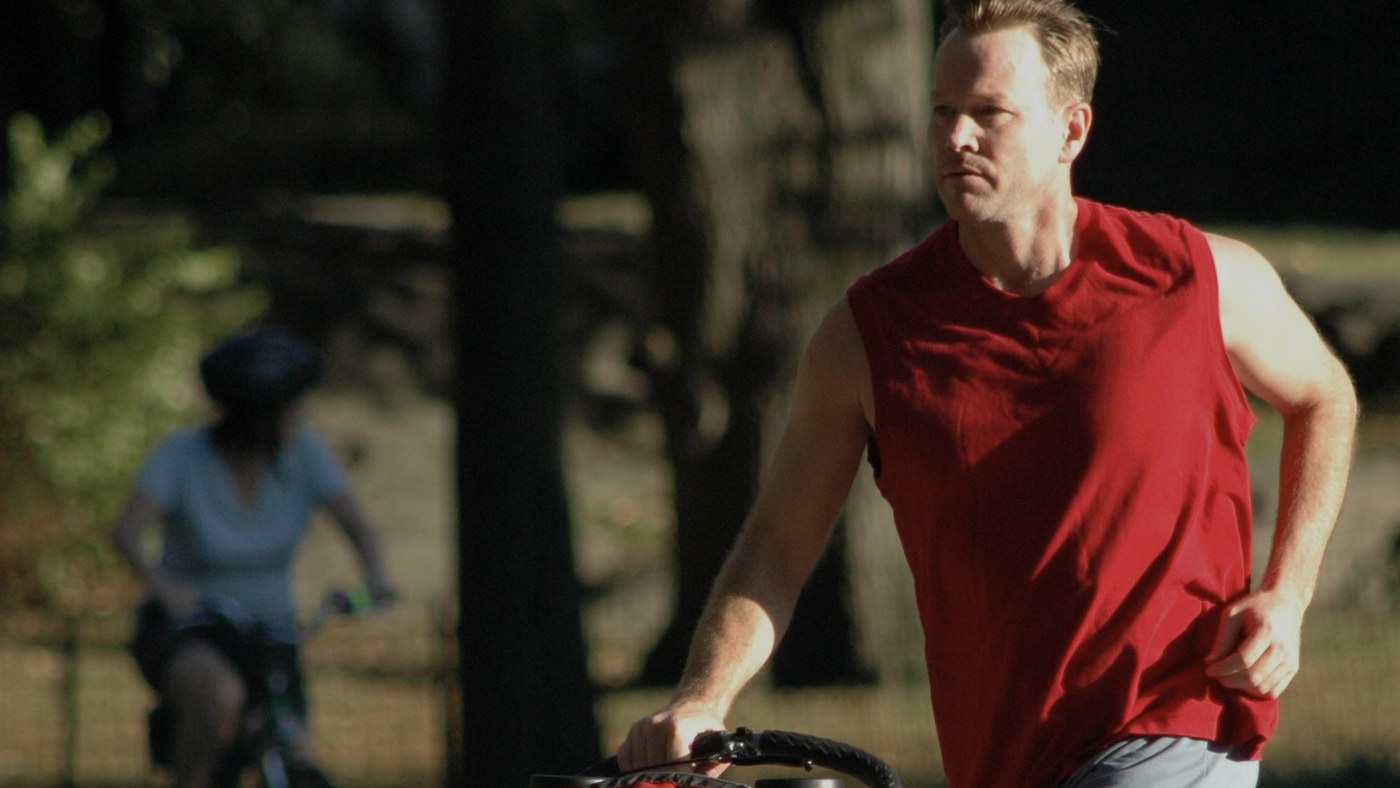
On August 12, 2026, a Penn State research team published a study in PLOS One revealing that parents who run with a stroller report fewer overuse injuries relative to distance compared to those who run without one.12 Initial intuition suggests the opposite outcome, because applying weight to the handlebar makes running appear more difficult. The striking aspect of the data lies precisely in this counterintuitive finding.
- Nineteen percent of stroller-pushing parents reported an overuse injury, compared to 30 percent of non-stroller runners.
- The injury rate per 1,000 miles was roughly 55 percent lower in the stroller group.
- The finding demonstrates correlation; a small control group and survey design do not yet lock down causality.

The vast majority of running injuries stem not from a single fall, but from repetitive loads placed on the same tissue. The list of trouble spots is familiar: around the kneecap, the Achilles tendon, the inner shin, and the plantar fascia. For parent runners, a second calculation enters the equation. Sleep is fragmented, training is irregular, and getting out for a run often depends on wheeling out the stroller rather than arranging childcare. Consequently, the question of whether strollers cause injuries is not merely biomechanical, but a practical matter of maintaining physical activity in early parenthood.
What did the survey find?
The study utilized a cross-sectional web survey involving parents who ran while their children were zero to three years old and who had logged at least five miles per week before having children. Following analysis, the dataset included 196 parents who ran with strollers and 53 who ran without. Within the non-stroller group, 30 percent reported at least one overuse injury, whereas only 19 percent of the stroller group reported the same. The injury rate per 1,000 miles was 0.19 for the stroller group and 0.42 for the non-stroller group, indicating a roughly 55 percent lower rate relative to distance among those using strollers.1

Both groups shared similar profiles in age, height, weight, and number of children. Parents who ran with strollers logged noticeably more mileage when their children were between 6 and 12 months old, accumulating about 34 percent more miles. This suggests the stroller does more than just correlate with fewer injuries; it actively facilitates getting outside during that narrow window. When children are between zero and six months old, both groups run very little, as most running strollers are not recommended during this stage. Mileage with strollers peaks between 12 and 36 months before declining as the child grows older. Thus, the protective advantage is not a lifelong shield, but is most visible during a specific slice of early parenthood. Multiple injury reports were also more frequent in the non-stroller group, indicating that consecutive load-related issues accumulate more readily on the side without strollers.1
The distribution of injury types remained similar across both groups. Plantar fasciitis, an inflammation of the connective tissue on the sole of the foot, appeared frequently on both sides, which researchers attribute primarily to postpartum physiology rather than the stroller itself.12
How does impact drop while torsional stress rises?
A mechanical story underpins these numbers. In a previous laboratory study conducted by the same team, 38 healthy runners ran with and without strollers on a force plate. When running with a stroller, vertical impact peaks, loading rates, and vertical impulses dropped by 8 to 17 percent. Pressure exerted on the handlebar transfers a portion of the body weight onto the wheels, meaning the legs bear slightly less vertical load with each stride. This reduction is viewed as a measurable advantage that minimizes repetitive loading on the knees and shins.3

However, this trade-off comes at a cost. In the same trials, torsional load—the twisting moment placed on the leg—increased by over 400 percent in certain measurements. While vertical impact drops, this torsional stress could theoretically elevate the risk of stress fractures. This fear of torsion did not manifest as a surge of injuries in the clinical survey, but it indicates that labeling stroller running as universally safer would be premature. Shorter strides, slower paces, and more consistent cadence are also common during stroller runs, all of which are considered protective habits in injury literature.34
Does the study prove prevention or just correlation?
The most accurate answer to the core question is nuanced. The study does not definitively prove that running with a stroller prevents chronic injuries. What it demonstrates is an association: parents who chose to use strollers reported overuse injuries less frequently, especially when evaluated per distance. The control group was small, the rate difference hovered near the threshold of p≈0.05, and the frequency difference fell just short of statistical significance. The data relied on retrospective self-reporting, without measuring confounding factors such as training intensity, running surfaces, footwear, and cross-training. Furthermore, parents who choose to use strollers may simply run more cautiously. The authors explicitly note that these findings should be interpreted cautiously and require prospective studies with objective measurements.1
Nevertheless, the practical takeaway remains clear. Pediatric safety guidelines generally advise against using most running strollers until an infant gains head and neck control, typically around six months of age. Beyond that age, the stroller helps parents maintain their running routines alongside their children rather than abandoning the sport entirely. The elements protecting the knees and calves are likely the slight support provided by the handlebars and the enforced pacing discipline, while plantar fascia and postpartum connective tissue concerns remain a separate matter.14
Notes and Sources
- Kim, H. G., Friesen, A., Altman-Singles, A. R. (2026). Injury risk and running habits in parents: Does stroller use make a difference? PLOS One, 21(8), e0354371. DOI: 10.1371/journal.pone.0354371. Stroller group n=196, non-stroller group n=53; injury rates 19% vs 30%; 0.19 vs 0.42 per 1,000 miles (~55% lower); 34% more miles logged at 6-12 months. ↩
- Penn State News (Yu, C., August 12, 2026): "Parents who run with a stroller have lower risk of overuse injury." Altman-Singles on handlebar pressure transferring vertical load to wheels; plantar fasciitis commentary regarding postpartum physiology. ↩
- Mahoney, J. M. et al. / Altman-Singles line (2025). Biomechanical tradeoffs in stroller running: Reduced vertical impact loading and increased torsional injury risk. PLOS One, e0332616. DOI: 10.1371/journal.pone.0332616. n=38; 8-17% drop in vertical load metrics; large increase in free moment / torsion. ↩
- Alcantara, R. S. & Wall-Scheffler, C. M. (2017). Stroller running: energetic and kinematic changes across pushing methods. PLOS One, 12(7), e0180575. Shorter stride, slower pace, increased perceived exertion. ↩