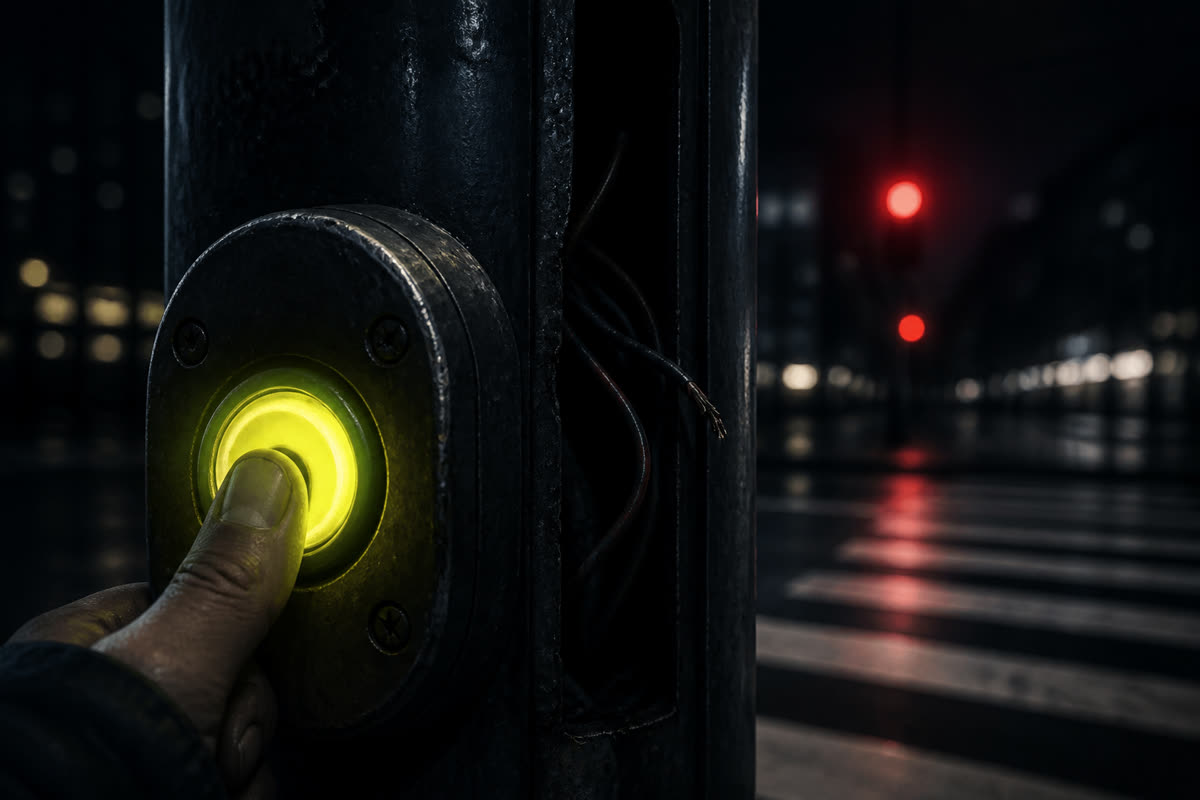
A 2004 investigation by the New York Times revealed that more than 2,500 of the 3,250 pedestrian push-buttons in New York City were not connected to the traffic signaling system. Once the city transitioned to computerized traffic management in the 1980s, these buttons were effectively retired, yet they were left in place to avoid the cost of removal, leaving millions of residents to press them for decades under the illusion that they were influencing the lights.
- New York City's 2,500 inactive pedestrian signals and their status today.
- The legal evolution of 'close door' elevator buttons since the 1990 Americans with Disabilities Act.
- The prevalence of 'dummy thermostats' in office building climate control.
- The psychological 'illusion of control' as defined by Harvard psychologist Ellen Langer.
Why do cities keep inactive pedestrian buttons?
New York City's pedestrian buttons were once functional components of 1970s traffic technology, designed to adjust signal cycles based on demand. With the advent of centralized computerized signal systems, these individual buttons became redundant. Authorities opted to keep them installed because removal is expensive, while leaving them in place is free. Over time, the number of active buttons declined further; by 2016, city officials indicated that only about 100 of the remaining pedestrian buttons were actually operational. Similar audits in other major American cities have frequently uncovered a lack of active buttons, often turning the discovery into a news event.
These are known as placebo buttons. While they do not alter the timing of the traffic light, they influence the behavior of the pedestrian. The act of pushing the button makes the wait feel more bearable and increases patience, as people who press the button are often more willing to wait for the signal to turn green. In this sense, the inactive button serves as a tool for urban traffic management by keeping pedestrians on the curb.
Why do elevator 'close door' buttons often fail to work?
In many elevators manufactured in the United States since 1990, the 'close door' button does not respond to standard passenger input. This is not a technical failure but a result of the 1990 Americans with Disabilities Act, which mandates that elevator doors remain open long enough for passengers with wheelchairs or canes to board safely. In most modern systems, the 'close door' function is only activated during maintenance or by emergency services using a key. Karen Penafiel, an executive with the National Elevator Industry, confirmed this reality in a 2016 interview with the New York Times. The buttons remain installed simply because passengers expect them to be there.
A similar strategy is used in office environments through the use of 'dummy thermostats.' In the HVAC industry, these are wall units that allow users to adjust settings and see a display change, even though the device is not wired to the building's climate system. Maintenance personnel often install these inexpensive, unconnected units to resolve complaints from employees who feel the temperature is uncomfortable. The goal is to provide a sense of agency, as workers are often more concerned with having a say in the environment than the specific temperature itself.
People are less concerned with the actual temperature of a room than they are with having the power to decide what that temperature should be.The silent assumption behind the dummy thermostat
What is the 'illusion of control' and how does it affect us?
The efficacy of these placebo interfaces can be traced back to 1975, when Harvard psychologist Ellen Langer demonstrated that people believe they can influence outcomes even in situations governed entirely by chance. In her experiments, participants who were allowed to choose their own lottery tickets valued them significantly higher than those given tickets at random. Similarly, those who were allowed to throw dice themselves believed they were more likely to win than those whose dice were thrown by someone else. Langer coined this phenomenon the 'illusion of control,' noting that performing an action provides a sense of agency that makes people feel better, even when they cannot actually affect the result.
This is the psychological mechanism at play at the crosswalk. Pushing the button does not change the light cycle, but it transforms the act of waiting from a state of passive helplessness into an active process. The psychological distinction between 'I am waiting' and 'I have signaled the system' is the primary purpose of the small plastic circle. Designers frequently utilize this mechanism, from computer progress bars to meaningless 'speed up' buttons in video games, to improve user experience through the perception of control.
Is the use of placebo buttons an acceptable design practice?
While it is easy to view these buttons as a form of deception, the alternative presents a practical trade-off. Removing an inactive button requires significant labor and budget, whereas leaving it in place costs nothing and carries no negative consequences for the public. If the button effectively encourages a pedestrian to remain on the sidewalk while waiting for a signal, it arguably fulfills a municipal function. When confronted with this reality, most people express surprise or skepticism, usually followed by an immediate recollection of their own daily habits in elevators or at traffic intersections.
Notes and Sources
- Luo, M. (2004). 'For Exercise in New York Futility, Push Button', The New York Times, February 27, 2004: 2,500 of 3,250 buttons inactive. 2016 data: NYC DOT statements, approximately 100 active buttons.
- Mele, C. (2016). 'Pushing That Crosswalk Button May Make You Feel Better, but...', The New York Times, October 27, 2016; National Elevator Industry executive Karen Penafiel on 'close door' buttons and the 1990 ADA.
- Sandberg, J. (2003). 'Employees Only Think They Control Thermostat', The Wall Street Journal, January 15, 2003: dummy office thermostats and HVAC industry practices.
- Langer, E. J. (1975). 'The Illusion of Control', Journal of Personality and Social Psychology, 32(2), 311-328.