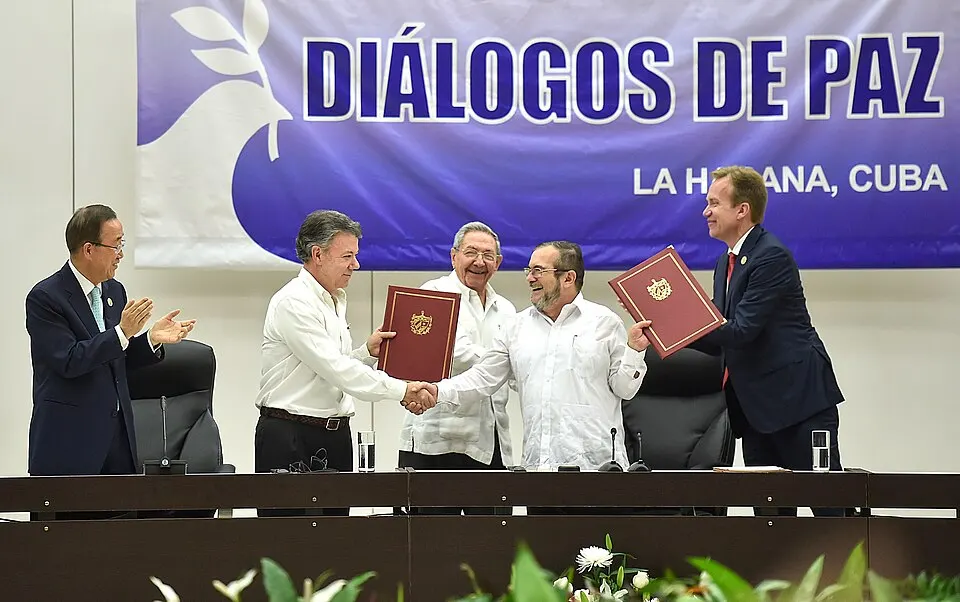
A decade after the historic 2016 peace accord between the Colombian government and the Revolutionary Armed Forces of Colombia (FARC), the nation finds itself marking a complicated anniversary. Photographers capturing life across the country today document a nation transformed in name, yet still waiting for true, lasting peace. While the agreement formally brought an end to decades of open conflict with Latin America’s largest leftist rebel group, rural territories across Colombia remain plagued by ongoing low-intensity violence. To understand why genuine peace remains so frustratingly elusive today, you have to go back to the mid-twentieth century, when partisan bloodshed tore the nation's countryside apart.
The roots of Colombia’s modern conflict lie in the decade-long wave of horrific civil unrest known simply as La Violencia, which consumed the nation from 1948 to 1958. Tensions had already begun simmering when the Conservative Party regained executive power following the 1946 presidential election. In rural regions, local police and Conservative political leaders actively encouraged party-aligned peasants to seize the agricultural lands of their Liberal-aligned neighbors. This institutional bias sparked brutal peasant-to-peasant violence that quickly spiraled out of control across the countryside.
The Spark of La Violencia
The simmering rural feud erupted into full-blown crisis on April 9, 1948, with the assassination of Jorge Eliécer Gaitán. Gaitán, a charismatic Liberal Party presidential candidate and the clear frontrunner for the upcoming 1949 election, was shot dead in the streets of Bogotá. His murder immediately triggered the Bogotazo, a ten-hour explosion of urban rioting, looting, and violent chaos that left an estimated 5,000 people dead in the capital.
From Bogotá, the violence spread exponentially into the provinces. For ten agonizing years, the Military Forces of Colombia and the National Police, backed by Conservative paramilitary units, waged a relentless campaign against Liberal paramilitary groups and self-defense forces. The human cost of the conflict was staggering, reshaping the social and political geography of the nation for generations.
La Violencia is estimated to have killed at least 200,000 people—claiming the lives of almost 1 in 50 Colombians during a single decade of partisan warfare.
From Partisan Feuds to Cold War Insurgency
Although La Violencia officially drew to a close in 1958 through political compromise between the party elites, its structural causes—particularly rural displacement and land theft—were never fully addressed. During the anti-communist repressions of the early 1960s, the state targeted rural enclaves where displaced peasants had organized self-defense communities. Faced with renewed military pressure, displaced Liberal and Communist militants reorganized into organized fighting units.
On May 27, 1964, this resistance solidified into a formal movement, marking the official start of the modern Colombian armed conflict. Out of these organized peasant factions emerged the Revolutionary Armed Forces of Colombia, known as the FARC. The guerrillas claimed they were fighting for social justice through communism, seeking to protect the impoverished rural population from state-sponsored violence and economic neglect. What began as a rural defense movement quickly evolved into a low-intensity, asymmetric war against the government.

A Decades-Long Asymmetric Struggle
Over the following five decades, the Colombian conflict expanded into a dizzying array of armed actors and competing interests. The fight was no longer restricted to the state and leftist guerrillas. Right-wing paramilitary groups formed to combat the rebels, while powerful criminal syndicates and the lucrative drug trafficking industry deeply entrenched themselves in the hostilities, financing multiple sides of the conflict. Multinational corporations and foreign powers—most notably the United States and Cuba—also became significant international contributors to the evolving crisis.
As armed groups fought to expand their territorial influence, the fundamental issues that sparked La Violencia—land ownership, state neglect, and armed self-defense in isolated regions—remained largely unresolved. By the time negotiators finally reached a breakthrough in 2016, the insurgency had become the longest-running armed conflict in the Western Hemisphere.
The Persistent Shadow of History
Ten years after the signing of the landmark 2016 accord, the historical echoes of 1948 and 1964 explain why disarming a single guerrilla group like FARC was not enough to deliver total tranquility. While thousands of fighters laid down their weapons, the power vacuums left behind in isolated rural areas were swiftly claimed by other criminal syndicates and splinter armed groups, all competing for territorial control and illicit revenues.
History suggests that peace deals, no matter how historic, cannot succeed on signatures alone if the deep-rooted conditions that birthed the violence—unequal land distribution, rural isolation, and a weak state presence—remain unaddressed. Until Colombia fully heals the structural wounds left behind by La Violencia and its long aftermath, the complete peace its citizens have sought for nearly a century will likely remain frustratingly out of reach.
Sources: This report draws on coverage by The New York Times. The wording is our own.