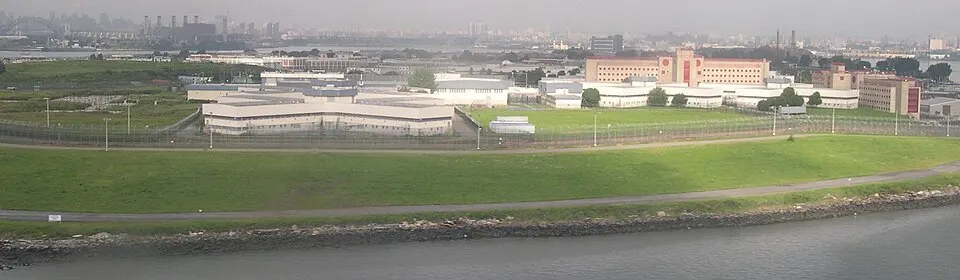
New York City officials have announced a formal timeline to shutter the notorious Rikers Island jail complex by 2032. The announcement by City Council Member Mamdani marks the latest chapter in a long-delayed effort to close the troubled facility. Plans to decommission the island date back to 2019, when the city council first voted for its closure, though political and logistical hurdles over where to relocate detainees repeatedly stalled progress.
The newly announced timeline aims to resolve years of stagnation surrounding New York’s largest jail complex. To understand why shutting down this single facility has proven so complex—and why its reputation became so thoroughly tarnished—you have to go back to the very origins of the land itself and the decades of institutional expansion that transformed an East River island into a world-famous symbol of carceral dysfunction.
Landfill and Labor: The Origins of a Prison Island
The island takes its name from Abraham Rycken, a Dutch settler who took possession of the land in 1664. For centuries, the island remained a relatively small footprint in the East River, measuring under 100 acres (40 hectares). That changed as New York City grew rapidly in the late 19th and early 20th centuries, requiring both expanded municipal infrastructure and new penal facilities to replace older, overcrowded city jails.
To accommodate a sprawling institutional footprint, the city expanded the island to more than 400 acres (160 hectares). The physical growth of Rikers Island was directly tied to the penal system it was built to house: the first stages of land expansion were accomplished largely by convict labor, who hauled in massive quantities of ashes for landfill. Politically designated as part of the Bronx, the island was tethered logistically to Queens, eventually connected by a single controlled-access bridge carrying traffic and the MTA Q100 bus line, using an East Elmhurst, Queens ZIP Code of 11370 for mail.
The World's Largest Pretrial Warehouse
Over the course of the 20th century, Rikers Island developed into one of the world's largest correctional institutions and mental institutions. Managed by the New York City Department of Correction, the island was designed to handle high volumes of detainment, functioning primarily not as a long-term state prison, but as a temporary city jail complex.

By 2015, the operational scale of Rikers Island was staggering. The facility operated on an annual budget of $860 million, employing a staff of 9,000 civilian correction officers and 1,500 additional civilian workers. Together, this workforce managed 100,000 admissions per year, maintaining an average daily population of roughly 10,000 inmates.
The majority—85 percent—of detainees held on Rikers Island were pretrial defendants, held on bail or remanded while awaiting trial rather than serving post-conviction sentences.
Because the vast majority of those held on the island had not been convicted of the crimes for which they were charged, Rikers Island functioned essentially as a vast holding pen. The sheer volume of admissions, combined with the physical isolation of an island accessible by only one bridge, fostered an environment where oversight was difficult and institutional reform frequently stalled.
Decades of Abuse and the Push for Closure
As the population on Rikers Island swelled, so did reports of systemic problems. Decades of documented abuse, operational corruption, violence, and neglected infrastructure gradually turned the complex into New York's best-known jail for all the wrong reasons. Critics noted that the island's geographic isolation insulated it from public scrutiny, compounding structural issues within the Department of Correction.

By the 2010s, public pressure from criminal justice reformers, legal advocates, and civil rights organizations made the island's continued operation politically unviable. When the New York City Council initially voted in 2019 to close the complex, it represented a formal acknowledgment that the physical and institutional design of Rikers Island was beyond repair. However, finding alternative, borough-based facilities to house thousands of detainees created deep political friction, delaying the shuttering process for years.
What History Teaches Us About the 2032 Deadline
The newly announced 2032 timeline represents the city's latest attempt to break the deadlock that has stalled closure plans since 2019. If history is any guide, achieving this goal will depend on whether the city can successfully navigate the same logistical and political obstacles that built Rikers Island in the first place.
From its literal creation out of ash dumped by penal labor to its rise as an isolated legal warehouse for thousands of unconvicted New Yorkers, Rikers Island illustrates how physical infrastructure can perpetuate systemic failures. Whether the 2032 deadline holds will serve as a ultimate test of New York City's ability to dismantle a carceral model nearly a century in the making.
Sources: This report draws on coverage by BBC News. The wording is our own.