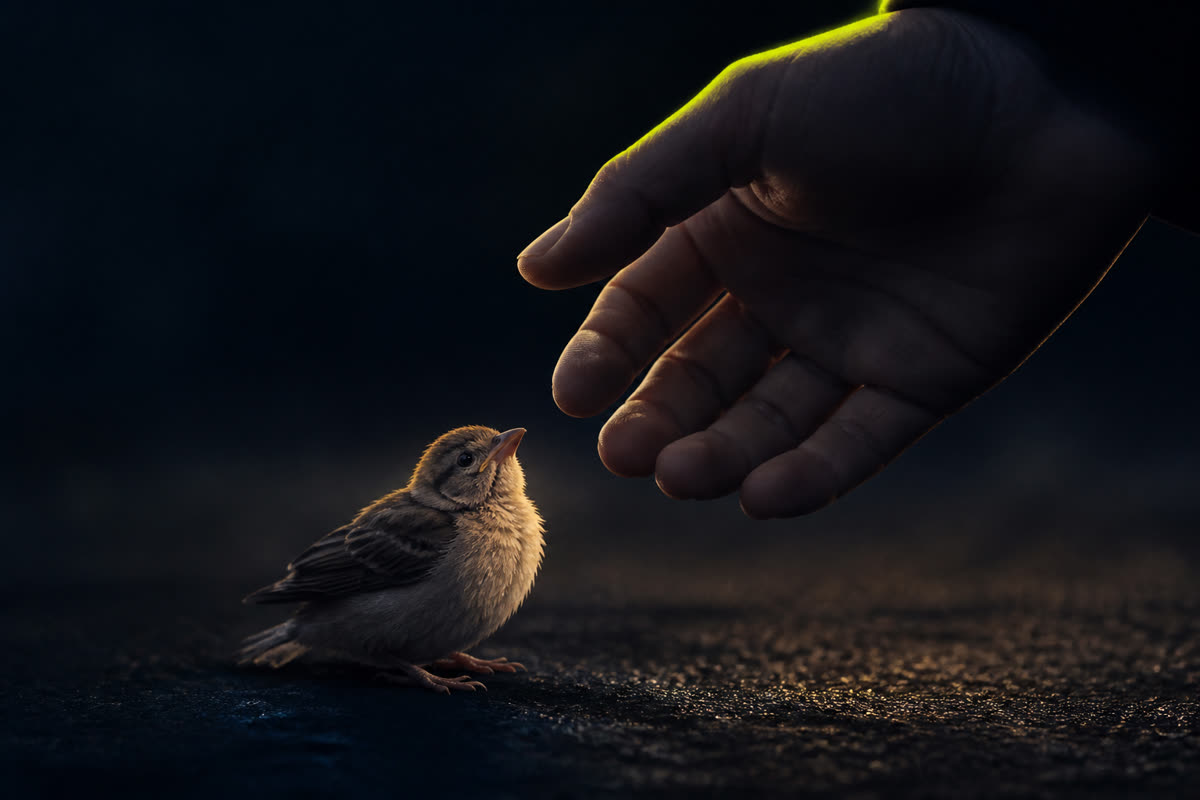
Biologist Miyoko Chu of the Cornell Lab of Ornithology provides a direct answer in their All About Birds guide: most songbirds do not have a sense of smell acute enough to detect human scent on their chicks. Contrary to the widespread myth that handling a fledgling will cause a mother bird to abandon her nest, touching a bird does not leave a scent trail that triggers an alarm in the parents. While this cautionary tale persists in many cultures, it is fundamentally unsupported by ornithological data.1
Do birds have a sense of smell?
The assumption behind the myth is that mother birds identify their offspring by scent and will reject them if a foreign odor is present. However, for the majority of songbird species, there is no evidence of such a mechanism. While certain species, such as the turkey vulture, can detect the scent of carrion from miles away and some seabirds use smell to locate prey, these capabilities do not extend to the rejection of nestlings. Mother birds identify their young primarily through location and sound rather than scent. While it is inaccurate to say birds lack a sense of smell entirely, the olfactory pathway required for the rejection of offspring based on human contact simply does not function in these species.2
Why would a bird not abandon its chick?
The second and more significant flaw in the myth is its lack of evolutionary logic. A pair of birds invests an immense amount of energy into building a nest, laying eggs, and foraging to feed their voracious offspring for weeks. Some songbirds carry insects to their young hundreds of times a day. Abandoning a chick after such a significant biological investment simply because of a perceived foreign scent would be an evolutionary waste that would not be favored by natural selection. As the All About Birds guide states, parents are far too invested in their young to abandon them due to human contact.1
Birds are not driven away from their nests by human scent, but rather by the repeated presence of humans near the nest site. Wildlife biologists
While birds can indeed abandon their nests, the cause is typically disturbance rather than scent. A bird during the nesting period may consider the area unsafe if it sees humans or predators near the nest repeatedly. The real danger is not the scent on a person's fingers, but the act of lingering near the site, which can inadvertently draw the attention of cats, crows, and foxes.3
How can you tell if a bird on the ground needs help?
Ornithologists generally classify found birds into two categories. If a bird has feathers, can hop, and is able to grip a finger, it is a fledgling. These birds are in the middle of flight training and have purposely left the nest; their parents are likely watching from a nearby branch. The best course of action is to move away and leave them alone. If the bird is featherless, has its eyes closed, and appears weak, it has likely fallen from the nest prematurely. Because the fear of human scent is unfounded, it is safe to gently return these birds to their nest.4
If a fledgling is in immediate danger, such as in the middle of a road or an area populated by cats, it is permissible to move the bird to the nearest bush or low branch. If the bird is injured, one should contact a wildlife rehabilitation center or veterinarian immediately rather than attempting to raise it, as rearing a wild bird requires specialized knowledge.
Why has this myth persisted for so long?
The myth likely persists because it serves as an effective, if scientifically inaccurate, deterrent. Warning children that a mother bird will abandon its young if touched is a simple, memorable way to ensure people keep their distance from wildlife. The problem arises when the incorrect justification prevents necessary human intervention. When people are afraid to return a fallen nestling to its home, they may mistakenly take it into their care, which often causes more harm than the original incident. The correct approach is to observe first: if the bird is feathered and mobile, keep a distance; if it is helpless and on the ground, return it to the nest or move it to a safe, nearby location.
Notes and Sources
- Cornell Lab of Ornithology, All About Birds: "If I handle a baby bird, will the parents abandon it?"; Cornell K-12 education materials.
- Eveleth, R. (2011). "Do Birds Really Abandon Their Chicks If Humans Touch Them?", Live Science; assessments by Miyoko Chu (Cornell) and Tom Hahn (UC Davis).
- Alaska Department of Fish and Game, "Ask a Wildlife Biologist": confirming scent-based abandonment is a myth; citing Scientific American (2007).
- Cornell Lab of Ornithology: distinctions between fledglings and nestlings and protocols for found birds.