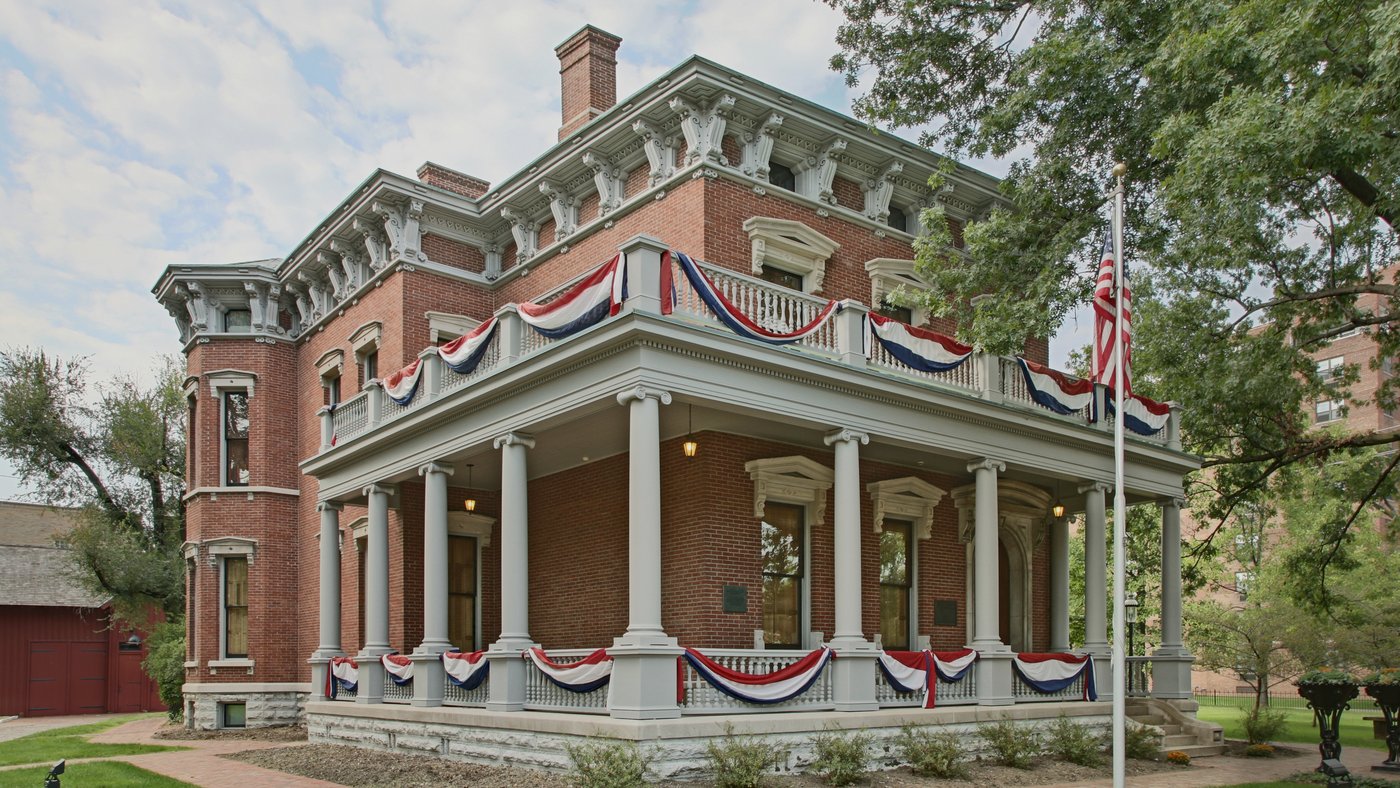
In the early hours of September 27, 2026, a life-sized white polymer statue of Benjamin Harrison was destroyed by fire on the grounds of the Benjamin Harrison Presidential Site in Indianapolis. Security footage captured the start of the blaze at approximately 1:30 a.m., with emergency services arriving shortly thereafter. The museum staff discovered the damage the following morning, finding a large, scorched patch of grass where the statue once stood.1
The statue had been installed only eleven days prior. Only its metal internal armature and piles of ash remained.
- Height: 1.68 meters, matching the 23rd president.
- Planned lifespan: 1 year of outdoor exposure.
- Actual duration: Approximately 265 hours.
- Museum status: Raising funds for a replacement.
Why was the statue designed to be 1.68 meters tall?
The statue depicted President Benjamin Harrison in a walking pose, holding his hat and legal documents with his coat draped over his arm. The height of 1.68 meters was chosen to reflect the physical stature of the 23rd U.S. president. Serving from 1889 to 1893, Harrison is considered the second-shortest president in American history, sharing that distinction with Martin Van Buren.23
The project was a collaborative effort between the Presidential Site and the Herron School of Art and Design at Indiana University Indianapolis. Students and faculty 3D-printed the statue using a white polymer. While monochromatic, the print captured intricate details such as the tie knot under the collar, vest buttons, and fabric folds. This work was the first in a planned initiative to translate the museum’s 11,000-piece collection into public art. It was installed on September 16, 2026, to coincide with Constitution Week and the lead-up to the 250th anniversary of the United States.145 Museum officials stated this was among the first significant public sculptures to be produced from 3D-printed polymer and placed in an outdoor setting.1
How long was the statue intended to remain in the garden?
The project was initially conceived as a temporary one-year installation, serving as both an art piece and a material experiment for the Herron team. Researchers intended to monitor how the printed polymer would withstand rain, summer sun, and Indiana winter conditions. The experiment aimed to determine if 3D printing could provide a significantly more affordable alternative to traditional bronze casting.1
Printing alone took over 1,200 hours, which would equate to 50 days of continuous operation. Material costs were reported at approximately 10,000 dollars, excluding labor, though local broadcaster WTHR cited an estimated value of 8,500 dollars.56 Regardless of the valuation, the statue stood in the public garden for no more than 265 hours.
Charles Hyde, president of the Presidential Site, characterized the event as a senseless act of vandalism. Lance Pruitt, director of the public art center at Herron, described the project as a pioneering application of 3D technology in the realm of public art.5
What does the "flame-resistant" label on plastic actually signify?
Hyde’s focus on the arson investigation stems from the material properties of the statue. He noted that the polymer was engineered to be heat and flame-resistant, suggesting it would not ignite spontaneously.15 While the commercial grade of the polymer was not specified, the term flame-resistant in materials science refers to standardized performance metrics rather than immunity to fire.
The most common industry benchmark is the UL 94 standard. In a vertical burn test, a sample is suspended and exposed to a 20-millimeter flame for 10 seconds. To achieve the V-0 rating, the material must self-extinguish within 10 seconds, and total burn time across multiple samples must not exceed 50 seconds.7 This rating indicates the material will resist ignition from a small source, such as a match, but does not suggest it can withstand a sustained, intentional fire. Once the polymer reaches its degradation temperature, it will soften and eventually combust. The Indianapolis Metropolitan Police Department’s arson unit continues to investigate the case, though no suspects have been named.5
What are the museum's plans for a second Harrison statue?
The museum has launched a 15,000-dollar fundraising campaign to reprint the statue. Hyde indicated that they intend to use more durable materials for the second iteration and have not ruled out the possibility of eventually casting the work in bronze for a permanent installation. He noted that public art relies on an implicit social contract where the community is expected to treat the work with respect.1
The site itself, known as the Neighborway, is part of an ongoing urban improvement project. The brick pedestrian and bicycle path was designed to restore connections between Delaware and Pennsylvania streets, which had been severed by highway construction roughly 50 years ago. The path was a component of the museum's 6.8 million dollar renovation completed in 2023.4
Students at Herron have already begun work on a follow-up piece for the same path scheduled for 2027. That project draws inspiration from the paintings of Caroline Harrison, the president's first wife, who passed away from tuberculosis during the 1892 campaign.18
Notes and Sources
- Marilyn Odendahl, "'Senseless act of vandalism': Arson suspected in destruction of polymer statue of Benjamin Harrison", The Indiana Citizen, 2026. indianacitizen.org ↩
- Miller Center, University of Virginia, "Benjamin Harrison: Life in Brief". millercenter.org ↩
- "Heights of presidents and presidential candidates of the United States", Wikipedia. en.wikipedia.org ↩
- "Fire destroys new Benjamin Harrison statue in suspected arson", IndyStar, 2026. indystar.com ↩
- Melea VanOstrand, "Arson investigation underway after Benjamin Harrison statue destroyed by fire", WRTV, 2026. wrtv.com ↩
- Sarah Kuta, "An Arson Investigation Is Underway After a Suspected 'Senseless Act of Vandalism' Destroys a Newly Installed Benjamin Harrison Statue", Smithsonian Magazine, 2026. smithsonianmag.com ↩
- UL Solutions, "Combustion (Fire) Tests for Plastics"; UL 94, Standard for Safety of Flammability of Plastic Materials. ul.com ↩
- Miller Center, "Benjamin Harrison: Life in Brief". millercenter.org ↩
- Cover image: Benjamin Harrison Presidential Site, Indianapolis. Photo: Daniel Schwen, Wikimedia Commons. commons.wikimedia.org ↩