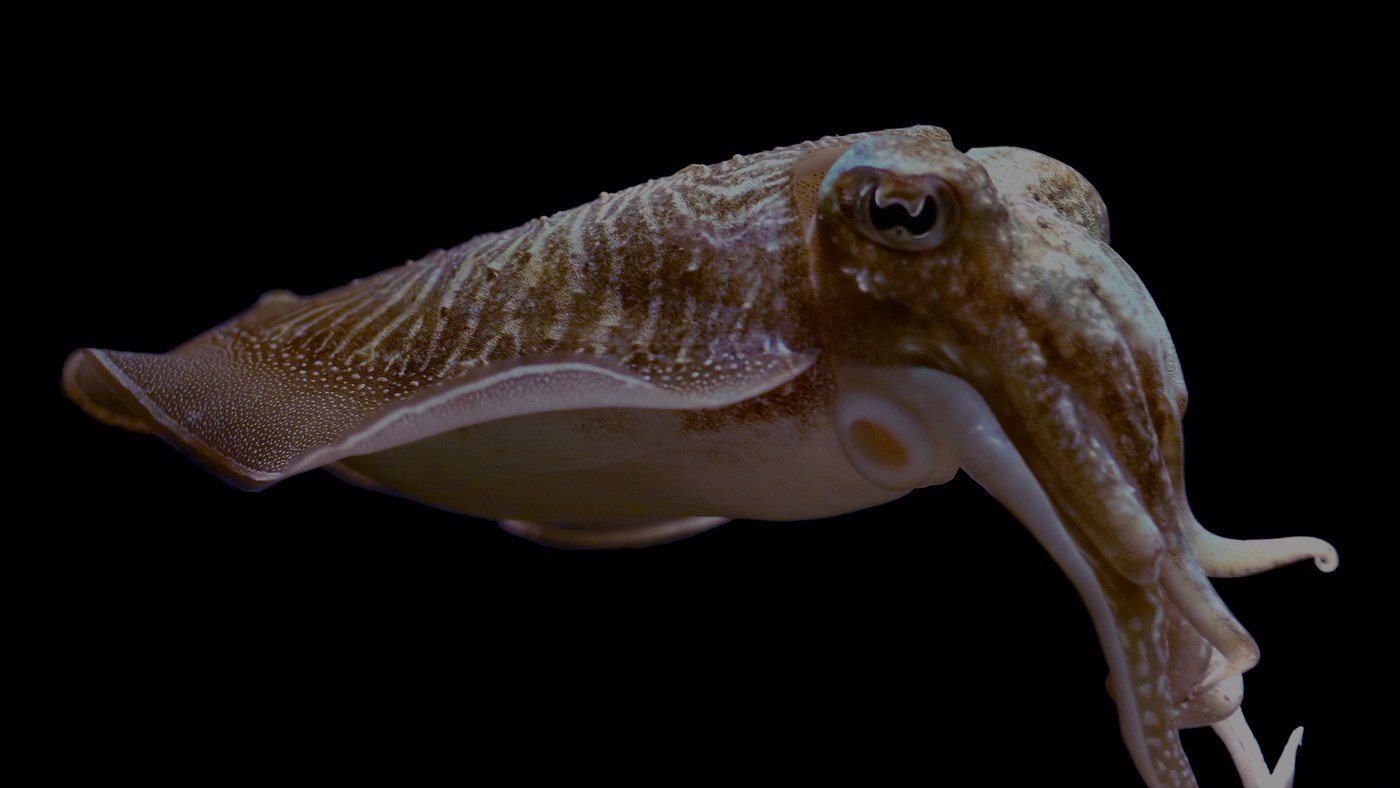
Hatchling European cuttlefish (Sepia officinalis) emerge from their eggs already capable of expressing most of the complex body patterns used by full-grown adults, according to seminal research by marine biologists Roger Hanlon and John Messenger. Tracking individuals from hatching through five months of age in both laboratory settings and the ocean, the researchers documented that these cephalopods bypass a lengthy larval phase, stepping out of their egg cases as fully formed miniature adults ready to swim, hunt, and disguise themselves immediately.1
Hanlon and Messenger categorized adult cuttlefish patterns into 34 chromatic, 6 textural, 8 postural, and 6 locomotor components. Juveniles under five months old exhibited almost the entire repertoire: 26 of the 34 color components, all of the textural and locomotor elements, and 6 of the 8 postural stances.1 While most juvenile cephalopods rely on vastly simpler disguises, the European cuttlefish relies on an innate repertoire. Viral social media videos showing tiny cuttlefish rapidly shifting colors over sand and seemingly "learning" to hide are therefore misleading, capturing the deployment of pre-wired neural programming rather than trial-and-error practice.
How does cuttlefish skin function like a living screen?
Cuttlefish skin operates like a biological display controlled directly by the brain through thousands of microscopic pigment sacs called chromatophores. Each chromatophore is encircled by tiny muscles controlled by motor neurons originating directly in the central nervous system. Secondary optical structures, such as light-reflecting iridophores and leucophores, develop later in juvenile growth and contribute significantly to adult patterning. Hanlon and Messenger observed that the specific brain regions managing these visual transformations are structurally sophisticated and functional at the moment of hatching.1
Visual feedback drives this physiological display. When visual background contrast shifts during controlled experiments, cuttlefish rapidly alternate between disruptive patterns, which break up their body outline, and uniform or mottled patterns, which blend into smooth surroundings. Against a light, featureless seabed, the animal maintains a neutral, single-toned appearance; faced with high-contrast checkerboard surfaces, dark spots and sharp lines emerge across its mantle. Skin appearance functions as a direct extension of the motor cortex, much like arm posture. Behavioral adjustments reflect fine-tuning an existing neural routine to match a specific substrate, rather than learning a new technique from scratch.1
The skin modifies texture alongside color. Tiny muscular projections called papillae can extend outward to transform smooth skin into a three-dimensional surface resembling coarse sand or jagged coral. A 2025 study demonstrated that dynamic lighting conditions, such as moving water caustics, can trigger these textural papillae even on flat substrates, prompting physical roughness to match fluctuating shadows overhead.4
How do pigment cells mature and change color over time?
Cuttlefish generate thousands of new skin chromatophores throughout their lives, continually expanding their display screen while systematically altering the color of existing cells as they mature. A 2018 study published in Nature tracked this cellular development, revealing that newly formed chromatophores emerge initially as pale yellow sacs before shifting over several days to orange, red, and eventually deep brown hues. As the cuttlefish expands in physical size, its brain dynamically rewires its neural mapping to maintain control over these constantly multiplying motor units.2
This dynamic cellular expansion complements the animal's innate camouflage system by continuously raising its display resolution over time. While the fundamental pattern language is functional at hatching, new color pixels are continually integrated into the existing framework. When a juvenile cuttlefish displays an imperfect match on camera, the delay stems from a smaller body size, a sparser cell grid, and the visual complexity of the seafloor, rather than a lack of cognitive understanding. Microscopic recordings by Sam Reiter and his team captured individual pigment cells born, maturing, and linking into the neural network in real time, proving that the brain maintains an actively updated motor map throughout development.2
Human observers often mistake a juvenile's imperfect color match for trial-and-error learning because the temporary result looks unrefined. In reality, the young cuttlefish is projecting adult pattern programs onto a display grid with significantly fewer pigment cells. As the animal grows, the pixel density of its skin increases, allowing it to render sharper contours and finer gradients. The process reflects hardware maturation rather than skill acquisition.2
Why does moving light alter cuttlefish camouflage patterns?
Cuttlefish actively shift their camouflage strategy in response to moving ripple patterns cast by sunlight, altering their body designs when exposed to dynamic illumination even on uniform surfaces. In a 2024 study led by researchers at the University of Cambridge, scientists recreated shallow-water light caustics over flat and checkerboard backgrounds in controlled laboratory settings. When exposed to dynamic light, cuttlefish adopted significantly stronger disruptive patterns on flat surfaces, aligning the intensity of their body markings directly with the peak visual contrast of the illuminated scene.3
This finding demonstrates that cuttlefish visual processing extends beyond simply copying static substrate features. Fluctuating overhead light alters the visual environment instantaneously, and the cuttlefish motor system adjusts its skin output in response. Whether this adjustment represents an adaptive counter-shading defense or an intrinsic feature of cephalopod visual processing remains a subject of ongoing study. The flickering transformations observed in young cuttlefish reflect complex sensory processing rather than random developmental errors.3
Which camouflage traits are innate and which develop later?
Cuttlefish camouflage relies on a dual-track system where pattern selection circuits in the brain are fully operational at birth, while skin resolution develops continuously as new pigment cells are added throughout life. Early mismatches in tone or texture stem from the physical constraints of a small body and limited chromatophore density rather than an absent biological program. By capturing continuous high-speed video of tens of thousands of dorsal skin chromatophores over multiple weeks, Reiter and colleagues confirmed in 2018 that young cuttlefish integrate new neural motor units daily to support their expanding display system.2
Notes and Sources
- R. T. Hanlon and J. B. Messenger, "Adaptive coloration in young cuttlefish (Sepia officinalis L.): the morphology and development of body patterns and their relation to behaviour," Philosophical Transactions of the Royal Society B 320 (1988): 437–487. DOI: 10.1098/rstb.1988.0087. ↩
- Sam Reiter et al., "Elucidating the control and development of skin patterning in cuttlefish," Nature 562 (2018): 361–366. DOI: 10.1038/s41586-018-0591-3. ↩
- Christian Drerup et al., "Cuttlefish adopt disruptive camouflage under dynamic lighting," Current Biology 34 (2024): 3258–3264. DOI: 10.1016/j.cub.2024.06.015. ↩
- Christian Drerup et al., "Visual contrast from background features and dynamic illumination contributes to three-dimensional camouflage in cuttlefish," Journal of Experimental Biology 228 (2025). DOI: 10.1242/jeb.249713. ↩