On the morning of Thursday, October 15, 2026, the doors at 68 Zurbano Street in Madrid swung open, welcoming visitors back to the Sorolla Museum after a two-year hiatus that began in October 2024.1 Those who stepped inside, however, did not immediately see the artist's home. Joaquín Sorolla's residence, where he lived from 1911 until his death, stands quietly just a few steps away at 37 Paseo del General Martínez Campos. The newly opened space is an adjacent building acquired by the Spanish Ministry of Culture.
According to ministry figures, the building's acquisition, construction work, and outfitting totaled 13,104,692 euros.1
- Which country's successful exhibitions made the expansion of Sorolla's Madrid home possible?
- Why was the painter's final canvas left unfinished on the garden easel?
- How many visitors did the family home welcome during its record-breaking year?
- Which window, opened in a wall and later bricked back up, is depicted in the opening exhibition's painting?
How did Joaquín Sorolla design the home and garden where he lived?
Sorolla was born in Valencia in 1863. After changing homes and studios across several Madrid neighborhoods starting in the 1880s, he envisioned a house with a garden where he could live and work under the same roof with his family. In 1905, he purchased the first plot of land for what is now the museum. Following the overwhelming success of his 1909 exhibitions in the United States, he commissioned architect Enrique María de Repullés y Vargas to design the project, redrawing the plans shortly after when an adjacent plot was also acquired. The house was completed in 1911, and the family moved in before the year ended.2
The ground floor featured three high-ceilinged studios illuminated from above, with separate doors opening directly into the garden. The house was equipped with both electricity and central heating. Numerous drawings preserved in the museum demonstrate that Sorolla was deeply involved in the design process. He mapped out the garden plan, selected its plants, and in his later years, made this very garden his most frequent painting subject.2
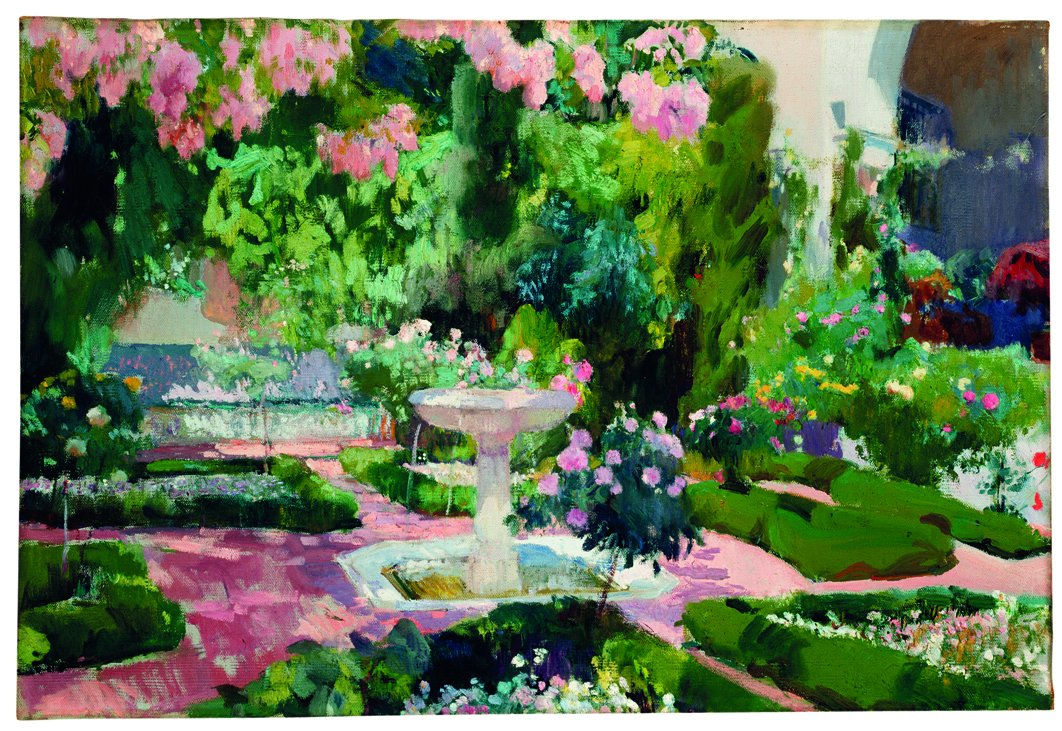
His artistic career also came to an end in that garden. On the morning of June 17, 1920, Sorolla was working on a portrait of Mabel Rick, the American wife of writer Ramón Pérez de Ayala. He fell on the steps leading up to the studio after suffering a stroke that left his left side paralyzed. Pérez de Ayala recounted that morning in an article published on October 7, 1923, in the Buenos Aires newspaper La Prensa. The painter had been reluctant to stop working, saying with tearful eyes after four trembling brushstrokes, "I cannot do it."3 The portrait remained unfinished on the easel. Sorolla never painted again and passed away on August 10, 1923, in Cercedilla, near Madrid.3
How many visitors did the Sorolla family home attract during its record year?
It was his wife, Clotilde García del Castillo, who transformed the house into a museum. Through her 1925 will, she bequeathed the home and her personal collection to the Spanish state on the condition that a museum be established in her husband's memory. The state accepted the legacy in 1931, the museum opened in 1932, and the painter's son, Joaquín Sorolla García, served as its first director.4 Today, the house is regarded as one of Europe's best-preserved artist residences. More than twelve hundred paintings in the collection remain under the same roof alongside the home's original furnishings and belongings.5
This layout was never intended to handle massive crowds. In 2023, the centenary year of Sorolla's death, the museum welcomed 344,799 visitors, a 40 percent increase from the previous year. For the first time in the museum's history, the 300,000 threshold was surpassed, making it second only to the National Archaeological Museum among the 16 state-run museums under the Ministry of Culture.6
What are the architectural features of the new Sorolla Museum annex?
The annex building was designed by the architectural firm Nieto Sobejano Arquitectos, led by Fuensanta Nieto and Enrique Sobejano. Spanning over 2,000 square meters, the new space features four temporary exhibition halls, an 80-seat auditorium, a consolidated storage facility housing more of the museum's 9,500 works in a single location, and a dedicated conservation and restoration workshop. The ministry notes that housing the storage and technical departments in the same building will greatly facilitate the preservation, examination, and repair of the artworks.1
Notes and Sources
- Spanish Ministry of Culture (October 14, 2026). "El Museo Sorolla abre mañana al público su nuevo edificio de ampliación". Costs, space, halls, storage, architectural principles, opening exhibition, and second phase. cultura.gob.es ↩
- Museo Sorolla, "The Building". Acquisition of plots, Repullés y Vargas project, studios, and garden. cultura.gob.es/msorolla ↩
- CER.es Colecciones en Red, Museo Sorolla inventory 01276, "Retrato de Mabel Rick, señora de Pérez de Ayala" (circa June 17, 1920). ceres.mcu.es; Quotes from Pérez de Ayala's testimony: ABC (August 10, 2023), "Sorolla, inédito en su centenario". abc.es ↩
- Museo Sorolla, "Historia del Museo Sorolla". Clotilde García del Castillo's 1925 will, 1931 acceptance, 1932 opening. cultura.gob.es/msorolla ↩
- Museo Sorolla, "La casa museo y los bienes culturales". cultura.gob.es/msorolla ↩
- Spanish Ministry of Culture (January 3, 2024). "Los 16 Museos Estatales dependientes del Ministerio de Cultura aumentan las visitas un 18% en 2023". cultura.gob.es ↩
- Museo Sorolla, "Tras la casa del artista. Arquitecturas del Museo Sorolla (1905-2026)", October 15, 2026 - January 10, 2027. cultura.gob.es/msorolla ↩
- El Diario de Madrid (August 22, 2026). "El Museo Sorolla de Madrid reabrirá en octubre de 2026 tras finalizar la primera fase de las obras de ampliación". Schedule submitted by the ministry to CERMI. eldiariodemadrid.es ↩
- Museo Sorolla, "Horarios" (As of October 20, 2026). cultura.gob.es/msorolla ↩