The Profile: Chen Jining’s Sudden Downfall Exposes the Risks of Political Ascent
Once viewed as a polished technocrat and potential future national leader, Shanghai Party Chief Chen Jining has been abruptly placed under corruption investigation. His unexpected fall highlights the shifting power dynamics and expanding reach of Xi Jinping's ongoing anti-corruption campaign.
P
Profile Desk
3 min read1 views
A Technocrat Fall From Grace
For years, Chen Jining epitomized the ideal modern Chinese official: highly educated abroad, scientifically grounded, and politically adept within the high-stakes machinery of the Chinese Communist Party (CCP). As the Party Secretary of Shanghai and a member of the 20th Politburo, the former academic was widely viewed as a rising star positioned for even greater national leadership in President Xi Jinping’s China. Yet, in November 2026, that trajectory fractured instantly when news broke that Chen had been placed under investigation by anti-corruption authorities, making him the fourth Politburo member to fall since 2025.
His abrupt downfall has reverberated across Beijing and foreign capitals alike. Shanghai’s leadership swiftly pledged its loyalty to Beijing following the news, underlining the political discipline demanded by the central authority. In a high-level purge that international observers view as the biggest leadership shakeup in decades, Chen’s sudden investigation signals that even top-tier political figures who successfully transitioned from technical expertise to elite governance remain exposed to the party's unrelenting disciplinary apparatus.
From Imperial College to the Beijing Mayoralty
Chen’s early career stood in sharp contrast to traditional party apparatchiks. Born in February 1964, he built a distinguished academic portfolio in environmental science. After completing his doctorate in environmental systems analysis at Imperial College London in 1992, he remained at the institution for postdoctoral research and served as an assistant researcher through 1997. His return to China in 1998 marked the start of a rapid academic rise at his alma mater, Tsinghua University in Beijing, where he served as vice chair of the Department of Environmental Science and Engineering, eventually becoming the university's president in 2012.
His technical rigor caught the attention of central leadership. In 2015, Chen transitioned directly into government as the Minister of Environmental Protection, bringing a disciplined administrative approach to China’s pressing pollution challenges. He moved into municipal leadership soon after, serving as Vice Mayor of Beijing from 2017 to 2018 and Mayor of Beijing from 2018 until 2022. By October 2022, his administrative success earned him the top posting in Shanghai—the nation's financial capital—and a coveted seat on the 20th Politburo of the CCP.
Style, Accomplishments, and Paradoxes
Supporters long praised Chen as a pragmatic, western-educated technocrat capable of managing complex economic hubs and executing sophisticated state strategies. Admirers highlighted his ability to navigate environmental policy reform while overseeing major international municipalities like Beijing and Shanghai. To global investors and diplomatic figures, he represented a sophisticated, steady hand at the helm of China's most vital financial gateway.
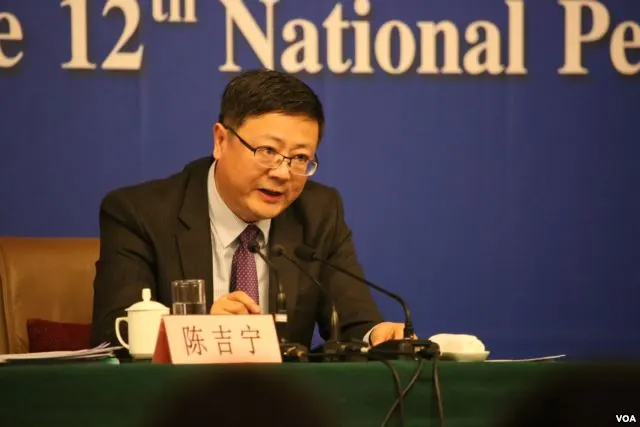
In November 2026, Chen Jining was placed under official investigation, marking the fourth Politburo member to fall since 2025 as Xi Jinping’s anti-corruption purges expand.
Chen Jining (Image: Wikimedia Commons)
Yet critics and political analysts note that within China's authoritarian system, technical competence offers no immunity from internal political shifts. Operating within a one-party framework where the CCP holds absolute authority over the government, judiciary, and society, elite administrators must continually balance local governance imperatives with absolute political alignment. Despite his reputation for clean governance and institutional expertise, Chen’s downfall underscores how thin the line remains between elite status and vulnerability under China's current political climate.
The Stakes and What to Watch Next
The investigation into Shanghai’s top official carries massive implications for China's administrative and economic stability. As the anti-corruption campaign escalates, the fall of a key Politburo figure demonstrates the expanding scope of Xi's purges across elite political ranks. It redefines the risk profile for technocrats who once believed administrative achievement and high-level patronage guaranteed their political survival.
In the coming weeks, political observers will watch closely for the formal charges leveled against Chen and the eventual appointment of his replacement in Shanghai. The reaction of the city's broader leadership and the financial sector will offer a clear gauge of how effectively Beijing manages the institutional shockwaves of removing one of its highest-profile city leaders.
Sources: This report draws on coverage by The New York Times, BBC, Reuters, Al Jazeera, The Guardian, WSJ, The Economist, NBC News. The wording is our own.