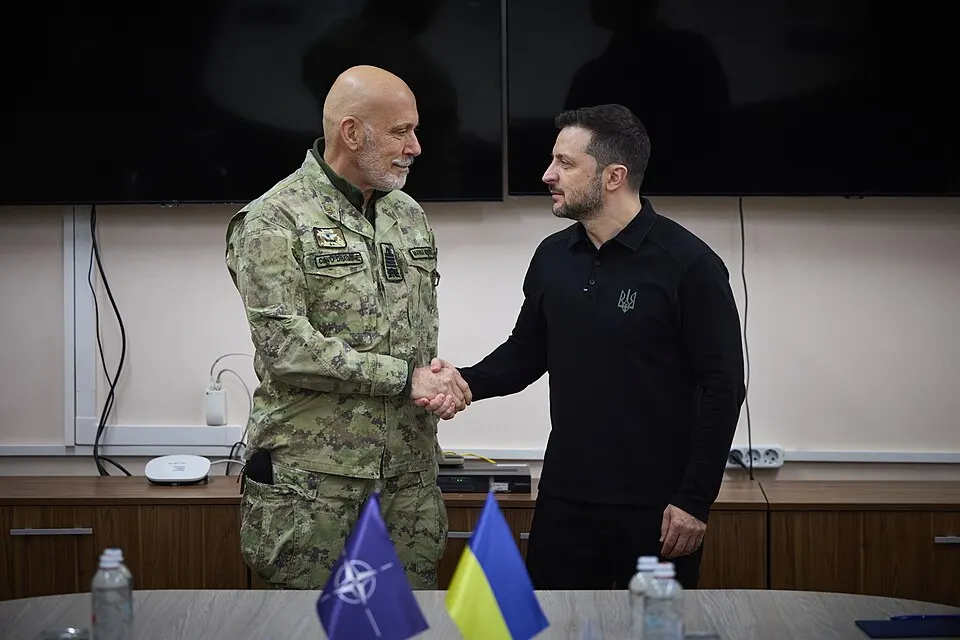
The Mediterranean Projection
For more than four years of full-scale war, Volodymyr Zelensky’s primary battleground has been the contested fields of eastern and southern Ukraine and the diplomatic corridors of Western capitals. This week, however, the Ukrainian president confirmed a dramatic expanding of Kyiv’s operational reach: an attack by Ukrainian naval drones targeting Russian military shipping at a naval base off the coast of Libya, thousands of miles from Ukraine's home ports.
Addressing the press, Zelensky confirmed that Ukrainian special operations forces launched seven drones from a mothership to strike Russian vessels off North Africa, sinking the Russian corvette Merkury in the port city of Benghazi and hitting the cargo vessel MV Angara. Zelensky praised the strike as an “exemplary Ukrainian operation in response to Russia’s war,” insisting that Russian forces face "no safe routes." The Kremlin quickly warned of an "escalation of tensions in the region," while Albania denied Russian allegations that the drones were launched from its territory. Coming alongside Ukrainian strikes on the Crimean Bridge—which Zelensky defended as a "fair response" to 109 separate Russian aerial attacks on Ukrainian bridges during recent meetings with Western officials, including the UK’s John Streeting—the Mediterranean operation signals a leader determined to hit Russian assets wherever they operate.
From Satirical President to Wartime Commander
Born on January 25, 1978, in Kryvyi Rih to a Russian-speaking Jewish family, Zelensky’s path to the presidency remains one of modern politics' most unusual arcs. He earned a law degree at the Kryvyi Rih Institute of Economics but ultimately bypassed the legal profession to pursue a career in comedy and entertainment. Co-founding the successful production company Kvartal 95, Zelensky produced films, cartoons, and television shows across Eastern Europe.
His defining cultural breakthrough came in 2015 with the television series Servant of the People. Zelensky played Vasyl Petrovych Holoborodko, a high school history teacher whose viral rant against political corruption unexpectedly propels him to the Ukrainian presidency. The show ran until 2019, capturing a public deeply weary of post-Soviet oligarchic political structures. Capitalizing on the show's massive popularity, Zelensky’s team launched an actual political party of the same name. In 2019, he ran for the real Ukrainian presidency and won in a landslide, taking office five years into the Russo-Ukrainian war that had begun with Russia's 2014 annexation of Crimea and the invasion of the Donbas region.

A Style Built on Rhetoric and High Stakes
Since the launch of Russia's full-scale invasion in February 2022, Zelensky has cultivated a distinct leadership style anchored in clear, accessible communication and personal presence. Rather than governing from isolated bunkers, he has regularly visited frontline Ukrainian troops in heavily contested zones and personally engaged world leaders in Western capitals to secure crucial military aid and financial support. His background in media has proved to be a formidable political tool, allowing him to frame Ukraine's resistance to international audiences with remarkable efficacy.
“Exemplary Ukrainian operation in response to Russia’s war.” — Volodymyr Zelensky
Yet his presidency faces intense scrutiny from both admirers and detractors. Supporters view him as an indispensable wartime communicator who unified a nation facing existential destruction and successfully persuaded international partners to provide advanced air defenses, tanks, and financial aid. Critics, however, have noted the continuous tension inherent in his governance: managing domestic political consolidation, sustaining war fatigue among citizens, and pushing Western allies for faster, less restricted weapons deliveries. While Zelensky has consistently called for a ceasefire and peace negotiations on Ukrainian terms, navigating the demands of international diplomacy while maintaining domestic morale remains a precarious balancing act.

The Road Ahead
The successful drone strike off Libya demonstrates how Zelensky's strategy has evolved from defensive survival to asymmetric projection across global maritime nodes. By striking Russian naval assets thousands of miles away, Kyiv aims to impose real costs on Moscow's global footprint and interdict its supply lines outside the Black Sea.
What to watch next is how Zelensky balances this ambitious military posture with shifting geopolitical realities. As Russian forces continue aerial assaults against Ukraine's domestic infrastructure, Zelensky's challenge will be keeping Western allies aligned behind his strategy while managing the diplomatic fallout of strikes reaching into international waters and third-party sovereign territories.
Sources: This report draws on coverage by BBC News, The Guardian, The New York Times, TIME, Time Magazine, The Moscow Times, The Boston Globe, New York Post. The wording is our own.