1855 - Thunderous Waters: David Livingstone Reaches Victoria Falls
On November 16, 1855, Scottish missionary and explorer David Livingstone became the first European to behold the grand waterfall on the Zambezi River, which he renamed Victoria Falls. Guided by local knowledge to a geological marvel known locally as Mosi-oa-Tunya, Livingstone documented a aquatic wonder that would capture the Victorian imagination. His encounter reshaped European perceptions of Southern Africa and marked a pivotal moment in the history of global exploration.
H
History Desk
5 min read0 views
On November 16, 1855, Scottish doctor and missionary David Livingstone became the first European to lay eyes on the majestic waterfall along the Zambezi River, which he named Victoria Falls in honor of Queen Victoria. Travelling through the heart of Southern Africa with the assistance of indigenous guides, Livingstone encountered a colossal curtain of falling water stretching 1,708 meters across. This historic encounter bridged European scientific inquiry with the vast landscapes of Southern Africa, solidifying Livingstone's reputation as one of the preeminent explorers of the Victorian era and forever altering how the Western world viewed the African interior.
Who was David Livingstone before his famed expedition?
David Livingstone was a Scottish doctor, Congregationalist minister, and pioneer Christian missionary working under the auspices of the London Missionary Society. Born into humble origins, David Livingstone embodied a working-class "rags-to-riches" narrative that deeply resonated with the Victorian public. His life was further anchored by his marriage to Mary Moffat Livingstone, a member of the prominent 18th-century Moffat missionary family. Over time, David Livingstone cultivated a multi-faceted identity as a scientific investigator, imperial reformer, advocate of British commercial expansion, and fierce anti-slavery crusader, eventually achieving an almost mythic status as a Protestant missionary hero.
Driven by a desire to open up trade routes and spread Christianity across the continent, David Livingstone mounted ambitious expeditions deep into Southern Africa. His journeys were designed to chart unknown rivers and establish networks that might replace the destructive slave trade with legitimate commerce. By the middle of the 1850s, David Livingstone had embarked on an extraordinary transcontinental journey along the Zambezi River basin, aiming to record the geography, fauna, and human settlements of regions previously unmapped by Europeans.
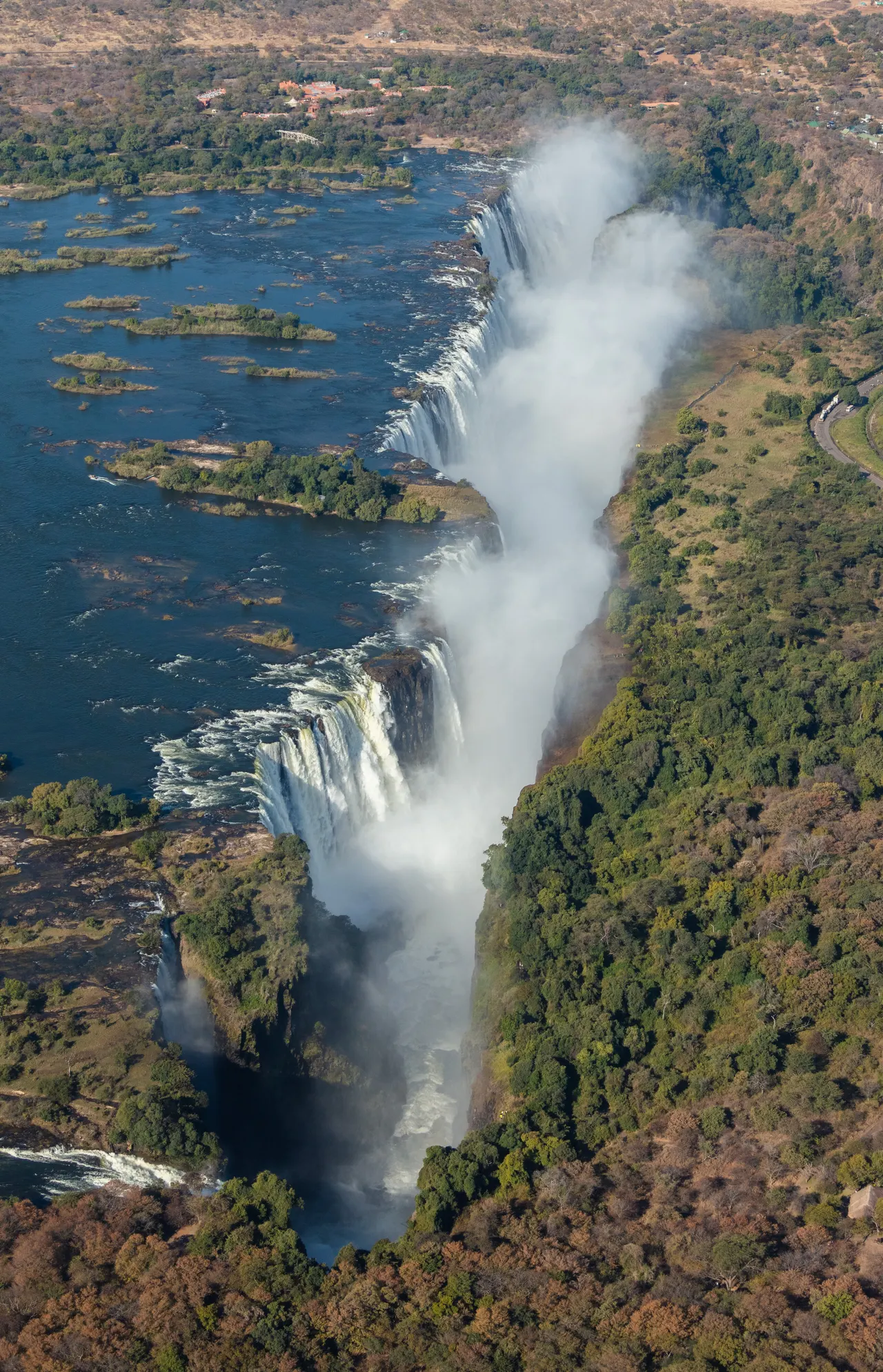
Cataratas Victoria, Zambia-Zimbabue, 2018-07-27, DD 04 (Source: Wikimedia Commons)
How did David Livingstone discover Victoria Falls on November 16, 1855?
As David Livingstone navigated the waters of the Zambezi River on November 16, 1855, he was guided by local inhabitants toward a spectacle known to indigenous communities as Mosi-oa-Tunya, or "The Smoke That Thunders." Approaching in a small canoe, David Livingstone observed towering columns of mist rising high into the air long before the roar of the cascade filled the valley. Stepping ashore on a small island perched at the very brink of the precipice, David Livingstone peered over the edge to behold an astonishing abyss where the river plunged dramatically into a narrow gorge below.
The monumental waterfall along the Zambezi River spans an immense width of 1,708 meters (5,604 feet), making Victoria Falls one of the largest and most impressive curtains of falling water in the entire world.
Africa Zambezi Relief Location Map (Source: Wikimedia Commons)
Overwhelmed by the sheer scale and beauty of the site, David Livingstone carved his initials into a tree on the island—a rare act of personal inscription during his travels. In his journals, David Livingstone praised the natural grandeur of the site, asserting that scenes so lovely must have been gazed upon by angels in their flight. Out of loyalty to his monarch, David Livingstone bestowed the name "Victoria Falls" upon the natural wonder, cementing the date of November 16, 1855, in the annals of world geographical history.
What was the immediate aftermath and long-term legacy of the encounter?
Following his arrival at Victoria Falls on November 16, 1855, David Livingstone continued his journey along the Zambezi River, carefully documenting the surrounding ecosystem. The region surrounding Victoria Falls possessed an extraordinarily high degree of biodiversity, boasting rich plant life and diverse animal species adapted to the perpetual spray created by the massive waterfall. David Livingstone's detailed records provided European scientific institutions with valuable insights into the ecological wealth of the African continent.
Victoria Falls - VicFalls3452 (Source: Wikimedia Commons)
Upon returning to Britain, David Livingstone was celebrated as a national hero. His accounts of Victoria Falls captivates a public eager for tales of adventure and discovery. The fame derived from the 1855 discovery elevated David Livingstone into a symbol of Victorian perseverance, scientific curiosity, and moral crusade. His reports encouraged further British interest in Southern Africa, serving as a catalyst for subsequent imperial, commercial, and missionary endeavors across the region.
Where do Victoria Falls and the legacy of David Livingstone stand today?
Today, Victoria Falls marks the natural border between two modern African nations: Zambia to the north and Zimbabwe to the south. The geographical footprint of the cascade remains vital to both landlocked nations. In Zambia, the nation's capital of Lusaka lies to the north-central part of the country, while its economic hubs in the Copperbelt Province and southern regions remain connected to the heritage of the Zambezi basin. For Zimbabwe, anchored by its capital city of Harare and its second-largest city of Bulawayo, Victoria Falls serves as a premier landmark along its northern boundary with the Zambezi River.
Victoria Falls - VicFalls3456 (Source: Wikimedia Commons)
Today, Victoria Falls forms a stunning natural border between the Republic of Zambia and the Republic of Zimbabwe, drawing global visitors to the banks of the Zambezi River.
The area surrounding Victoria Falls remains a celebrated global icon of natural beauty and biodiversity, attracting thousands of travelers who come to witness the same 1,708-meter-wide cascade that mesmerized David Livingstone in 1855. The historical encounter on November 16 stands as a defining moment in the history of modern geography, representing the intersection of indigenous knowledge, European exploration, and the enduring wonder of the natural world.
Did you know? David Livingstone's wife, Mary Moffat Livingstone, belonged to the Moffat family, one of the most prominent 18th-century Christian missionary dynasties operating in Southern Africa.
Did you know? Standing at a breathtaking width of 1,708 meters (5,604 feet), Victoria Falls is widely recognized as one of the largest waterfalls on the planet.
Watch: What David Livingstone Saw at Victoria Falls in 1855 Left Him Speechless | History for Sleep