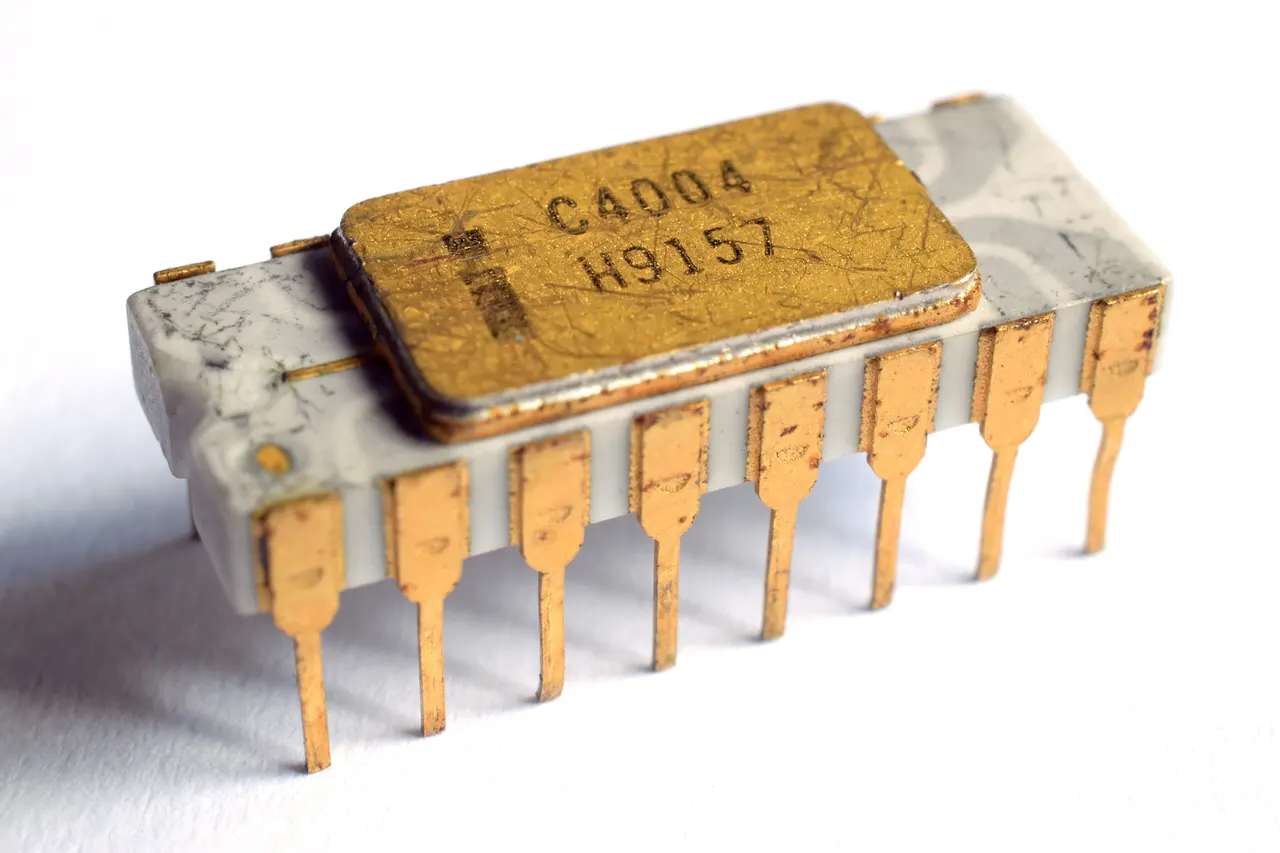
On November 15, 1971, Intel Corporation unveiled the 4004, a development that fundamentally altered the trajectory of modern technology. Designed by a team including Marcian Hoff, Federico Faggin, and Masatoshi Shima, this 4-bit microprocessor served as the central processing unit for the Busicom 141-PF printing calculator. By successfully condensing the complex arithmetic and control logic of a computer onto a single silicon chip, the Intel 4004 proved that general-purpose computing could be both affordable and compact, triggering a digital revolution that would eventually place powerful processing capabilities into every home and pocket.
How did a calculator company spark a technological leap?
The genesis of the Intel 4004 began in 1969, when the Japanese company Busicom Corp. approached Intel to design a set of seven integrated circuits for a new line of electronic calculators. Busicom wanted a machine that could outperform the competition by utilizing integrated circuits to replace bulky printed circuit boards. However, the initial proposal for seven separate chips proved too complex and expensive for Intel to manufacture efficiently. Intel engineer Marcian Hoff realized that instead of building a static circuit for a calculator, Intel could create a general-purpose processor that used software stored in memory to perform tasks. This shift from hard-coded logic to programmable instructions changed the nature of the device from a mere calculator component into a flexible microprocessor.
Why was silicon gate technology the secret to success?
The practical realization of the Intel 4004 was made possible through the innovative use of MOS silicon gate technology (SGT), a method championing the use of poly-silicon over traditional metal gates. Intel hire Federico Faggin, who had previously pioneered SGT at Fairchild Semiconductor, utilized this method to integrate 2,300 transistors onto a single chip. Faggin also introduced two critical breakthroughs: the “bootstrap load” and the “buried contact.” These techniques allowed for higher circuit density and reduced energy loss, enabling the Intel 4004 to operate at speeds five times faster than existing MOS technology. Without these specific architectural innovations, the dream of a single-chip CPU would have remained physically impossible at that time.

The Intel 4004 contained 2,300 transistors on a single chip, utilizing silicon gate technology to double circuit density and halve costs compared to previous aluminum gate designs.
What role did the collaboration between Intel and Busicom play?
The partnership was anchored by the work of Busicom engineer Masatoshi Shima, who moved to the United States to oversee the implementation of the chip design. Shima worked closely with Federico Faggin to translate the theoretical concepts into the operational 4004. While Marcian Hoff provided the initial vision for a programmable processor, Shima was instrumental in ensuring the chip could meet the specific demands of the Busicom 141-PF, including handling binary-coded decimal (BCD) values and keyboard inputs. Their combined efforts resulted in a functional prototype delivered in March 1971, which paved the way for the commercial launch of the chip later that autumn.
The impact of the 4004 was immediate and far-reaching. Following the success of the 141-PF calculator, the architecture was repurposed for a variety of business machines, including teller machines, cash registers, and billing systems, with companies like NCR selling over 100,000 units. The Intel 4004 proved that the manufacturing of microprocessors could be scaled commercially, establishing Intel as a leader in the semiconductor industry and setting the stage for the 8-bit successors that would follow, such as the 8008 and the 8080.

Today, the legacy of the 4004 is felt in every microprocessor that powers our modern existence. The shift from multiple-chip architectures to the single-chip CPU allowed for the democratization of computing power, moving beyond the reach of only government and university research labs. By prioritizing a design that favored random-access memory and subroutine-based programming, the Intel 4004 defined the essential blueprint for the digital processors that now drive the global economy, the internet, and personal consumer technology.
Did you know that the Intel 4004 was originally priced at $60, which would be equivalent to $477 in 2025?

Did you know that the first fully operational 4004 prototype is currently held in the collection of the Computer History Museum?
Did you know that the Intel 4004 project was facilitated by Sharp engineer Tadashi Sasaki, who had long dreamed of shrinking computers to fit into a pocket?

Watch: 3 Minutes On... The Intel 4004 Microprocessor
From the 3 Minutes On... channel.
Sources and further reading: Wikipedia — Intel 4004, Intel, Microprocessor (CC BY-SA). Images: Wikimedia Commons.