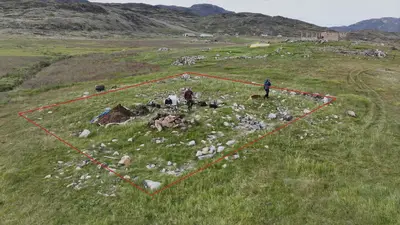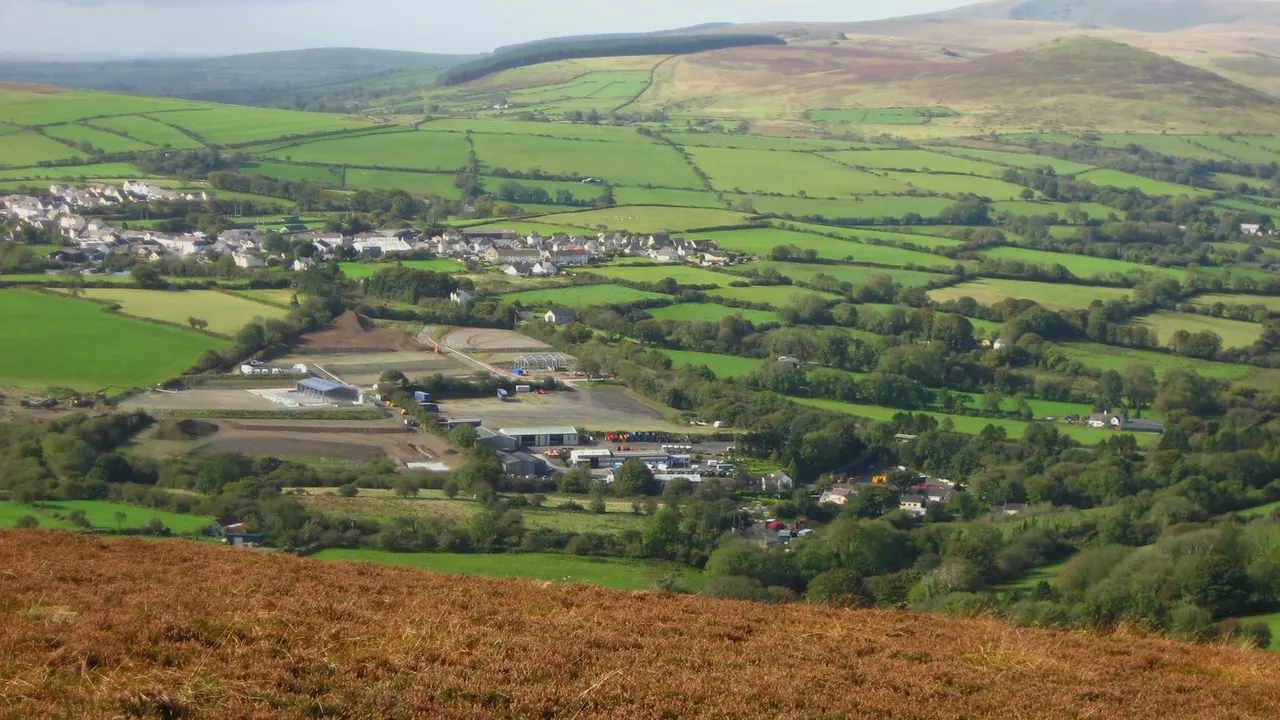
In 2024, archaeologist Mark Merrony of the University of Oxford identified a rectangular, rounded-corner earthwork in a grass-covered field in Pembrokeshire, western Wales, through satellite imagery. Upon cycling to the site, he discovered a hexagonal, pointed roof tile protruding from the soil, consistent with Roman craftsmanship, followed by further ceramic fragments.15
The field is located 3.5 kilometers southwest of Frenni Fawr, the easternmost peak of the Preseli Hills. This 395-meter-high summit is explicitly mentioned in a medieval Welsh romance, in which the Roman emperor travels to the hill to hunt and pitches his tent.2
- The preservation of the legend in two distinct medieval manuscripts.
- Why the two manuscripts name the hill differently and how a 19th-century translation influenced modern perceptions.
- How the recovery of two coins from the site correlates with the legend.
- The potential identification of the fort’s historical context and upcoming publication of findings.
Where is the legend of the Roman emperor's dream-inspired camp recorded?
The legend is titled Breuddwyd Macsen Wledig, or "The Dream of Macsen Wledig," and remains one of the eleven medieval Welsh narratives collectively known as the Mabinogion. In the tale, the Roman emperor Maxen falls asleep during a summer hunt after his men protect him from the heat with their shields. He dreams of crossing a vast mountain and traveling by ship to an island, where he discovers a castle containing two youths playing chess, an older man carving pieces from ivory, and a young woman seated on a chair of red gold. Upon waking, he becomes inconsolable. After an initial failure, messengers successfully locate the castle in Arfon at Aber Sain. The woman, Elen, insists that the emperor come himself if he truly loves her. Maxen eventually conquers the island, marries Elen, and establishes three key strongholds for her: Arfon, Caerleon, and Carmarthen. The narrative specifies that the emperor later hunts near the hill and sets up his camp, which is known as Cadeir Maxen, or "Maxen's Chair." These events are said to have inspired the construction of a network of Roman roads in Wales, still referred to today as Sarn Helen.4
Why do the two primary medieval manuscripts refer to the emperor's camp by different names?
The full text of the story exists in two distinct manuscripts: the White Book of Rhydderch, written circa 1350 and held at the National Library of Wales in Aberystwyth as Peniarth 4, and the Red Book of Hergest, written circa 1400 and held at Jesus College, Oxford, as MS 111. According to the "Welsh Prose 1300-1425" project at Cardiff University, the two manuscripts utilize different names for the hill.3 In the White Book (folio 47v), the emperor travels to Frenni Fawr. However, in the Red Book (folio 173v), the text uses Brefi Vawr. In medieval Welsh, the letters 'v' and 'f' can represent similar sounds, but the primary discrepancy lies between the 'n' and 'v' characters, leading to divergent readings. Lady Charlotte Guest’s 1838–1849 English translation, which introduced the Mabinogion to a wider audience, utilized a copy of the Red Book and translated the location as "the top of Brevi Vawr."4 Merrony’s current research is based on the spelling found in the White Book.
What physical evidence supports the existence of a Roman fort at the site?
Following geophysical surveys, Merrony conducted excavations in September 2026, opening five trenches measuring 10 by 2 meters. The fort occupies a 180-by-150-meter space, featuring the classic "playing card" design characteristic of Roman military encampments, including rounded corners. The layout includes a central headquarters building facing east toward potential threats and a larger commander’s residence to the south, suggesting an occupancy of approximately 500 soldiers.2 The team recovered evidence of compacted clay floors, wheel ruts, an oven, a structure consistent with a granary, and a road. Notable artifacts include a lead spindle whorl, an iron stylus for wax tablets, a carpenter’s axe, a gaming piece, and two late fourth-century coins.12
Notes and Sources
- Merrony, M. (2026). "I discovered a Roman fort in Wales: it may hold the key to the ancient Welsh legend of Macsen Wledig." The Conversation, 15 October 2026.
- Alberge, D. (2026). "Roman fort found in Wales could prove myth of emperor's camp is real." The Guardian, 12 October 2026.
- Welsh Prose 1300-1425, Cardiff University. White Book of Rhydderch (NLW Peniarth 4), folio 47v; Red Book of Hergest (Oxford, Jesus College MS 111), folio 173v.
- Guest, C. (trans.) (1838-1849). The Mabinogion, "The Dream of Macsen Wledig". Project Gutenberg ebook #5160.
- Bowdidge, S. (2024). "New find hints Wales fully integrated into Roman Britain." BBC News, 2 August 2024.
- Solly, M. (2026). "Legend Has It That This Roman Emperor Established a Camp in Wales." Smithsonian Magazine, 16 October 2026.
- Wolfson College, Oxford (2026). "Roman fort discovery by Wolfson Fellow sheds new light on Welsh legend." 14 October 2026.