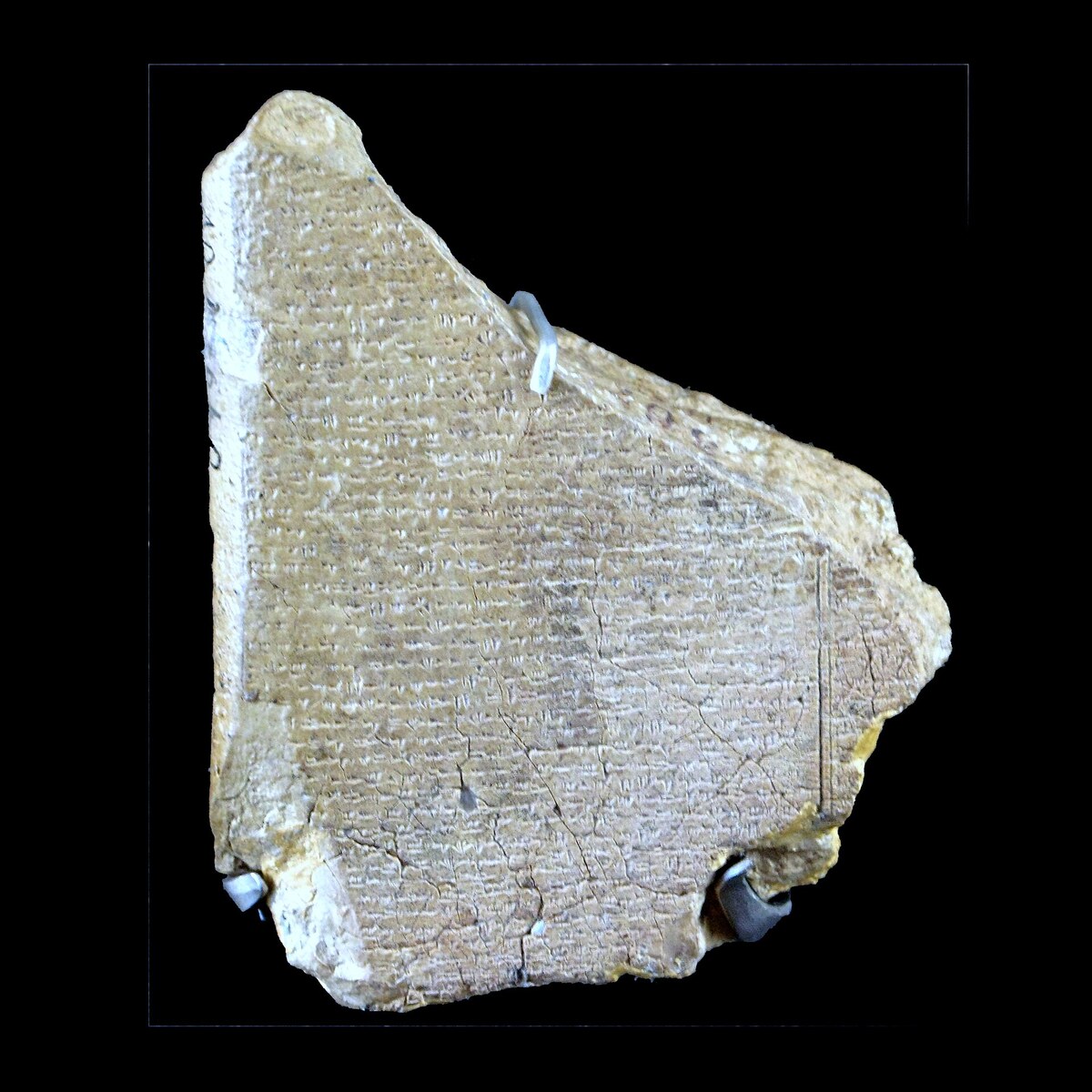
In 1887, excavations near the modern-day village of El-Amarna uncovered hundreds of clay tablets.1 The site belonged to Akhetaten, the short-lived capital of the Pharaoh Akhenaten. What appeared at first to be mundane administrative records evolved into something far more significant: the diplomatic archive of the Eastern Mediterranean during the 14th century BCE.
The archive contains approximately 380 letters. Most of these texts were written not in Egyptian hieroglyphs, but in Akkadian cuneiform.2 This alone provides a powerful clue: the royal court employed a common diplomatic language for its foreign relations. Even with officials who did not share a native tongue, the states of that era could meet within the same protocol universe. The language of the archive is Akkadian, but the address is the Egyptian court.
- The discovery of the Amarna tablets and their significance as a centralized state archive.
- How the Akkadian diplomatic language established a multi-actor communication network centered on Egypt.
- Shared signs of crisis found in urgent requests for aid from cities like Byblos, Jerusalem, and Hazor.
- Why these texts move historical record-keeping beyond the lives of individual kings.
What makes the Amarna archive a record of systemic crisis?
What makes this collection particularly compelling is that the letters were not exchanged solely between the great powers. While kingdoms such as Babylonia, Mitanni, and Alashiya negotiated gifts, marriage contracts, and gold, the rhythm of the tablets is dictated by the smaller city-state governors in the Levant. One day they reported bandit raids, the next, attacks from neighboring cities or acute shortages of soldiers and grain.3
The letters of Rib-Hadda, the governor of Byblos, are particularly striking in this regard. In successive tablets from the same correspondent, the tone shifts drastically. Initial texts maintain diplomatic courtesy, but later lines descend into the language of emergency alarms. The frequency of repetition also increases; requests for help are not made just once, but repeatedly. This repetition suggests that the time required to receive a response from the central authority was increasing.
Why is this centralized network so fragile?
The Amarna texts follow a predictable pattern. The opening sentence addressed to the Egyptian king is written in a nearly ceremonial order, followed by reports of security failures on the ground. This structure demonstrates that while local governors derived their legitimacy from the center, they were left to navigate the local violence themselves. While the political hierarchy functioned as a single center, the risk distribution appeared highly fragmented.
This tension is clearly visible in the Jerusalem letters, specifically those numbered EA 286 to EA 290.4 Abdi-Heba declared his loyalty while simultaneously pleading for troops to handle regional conflicts. A similar intensity appears in the correspondence from Hazor.5 These are not isolated city stories, but rather entries from a shared political climate, recorded from different corners of the region.
For this reason, reading the Amarna tablets merely as an archaeological inventory is insufficient. Their true value lies in the shared phrases across the correspondence. By mapping where grain shortages occurred, where militia pressure grew, or where expected military support from the center was delayed, one finds that these regions were under simultaneous, systemic stress.
What do the tablets reveal about administrative history?
In the Akkadian texts, it is not just the content but the style that conveys information. While the great kings wrote to each other in a balanced tone, local city governors used a register of lower status. The repetition in address formulas, lists of tribute, and gift inventories demonstrates that diplomatic distance was calculated with precision. Even between two letters written at the same time, the choice of words reveals the sender's political positioning.
Another detail is the standardization of the medium. The dimensions of the tablets, the method of working the clay, and the seal impressions point to the existence of a specific bureaucratic order. Texts arriving at the court were not simply read and discarded; they were recorded, classified, and compared against previous correspondence. While this system was not as rigid as modern archival discipline, it clearly shows that this was far from a disorganized network of communication.
Although some letters in the collection are burned, broken, or incomplete, context analysis often allows researchers to connect specific tablets to chains of events. Because pressure in one city often corresponded to changes in prices, migration, or demands for soldiers in another, the archive functions like a record of early warning systems. The Amarna letters serve as a laboratory for observing how complex networks behave during moments of crisis.
Why do we continue to return to these tablets today?
The Amarna archive exposes a fundamental problem in classical history: we know the names of the kings, but we often overlook those who carried the daily burden of administration. These tablets fill that void, containing everything from dry tax tables to desperate, panic-stricken cries for help. Furthermore, the methodology is evolving. Digital cataloging and comparative linguistic analysis allow for the re-evaluation of different readings of the same letters.6 A single misread sign can change the intended recipient or the political tone, ensuring that Amarna remains a living field of research rather than a closed archive. The true value of the Amarna archive is its ability to lay out the rhythm of a crisis by placing pleas for help from different cities side by side. This 14th-century BCE dossier continues to be tracked with concrete records, such as EA 227 in the British Museum, which remains accessible online as part of this integrated communication network.7
Notes and Sources
- The Amarna Project (University of Oxford), discovery context and field history of the 1887 findings; Tell el-Amarna excavation archives. ↩
- William L. Moran (ed. and trans.), The Amarna Letters, Johns Hopkins University Press, 1992. Introduction and text corpus. ↩
- Raymond Cohen and Raymond Westbrook (eds.), Amarna Diplomacy, Johns Hopkins University Press, 2000; protocol for correspondence between great powers. ↩
- Moran, 1992, EA 286-290; Abdi-Heba letters and patterns of requests for military support. ↩
- British Museum Collection Online, tablet records associated with Hazor and Amarna correspondence (EA series descriptions). ↩
- Ludwig-Maximilians-Universität München, Corpus der keilschriftlichen Texte aus Amarna (digital text comparison dataset). ↩
- British Museum, EA 227 (collection record linked to the Abdi-Heba correspondence group) and related object description. ↩