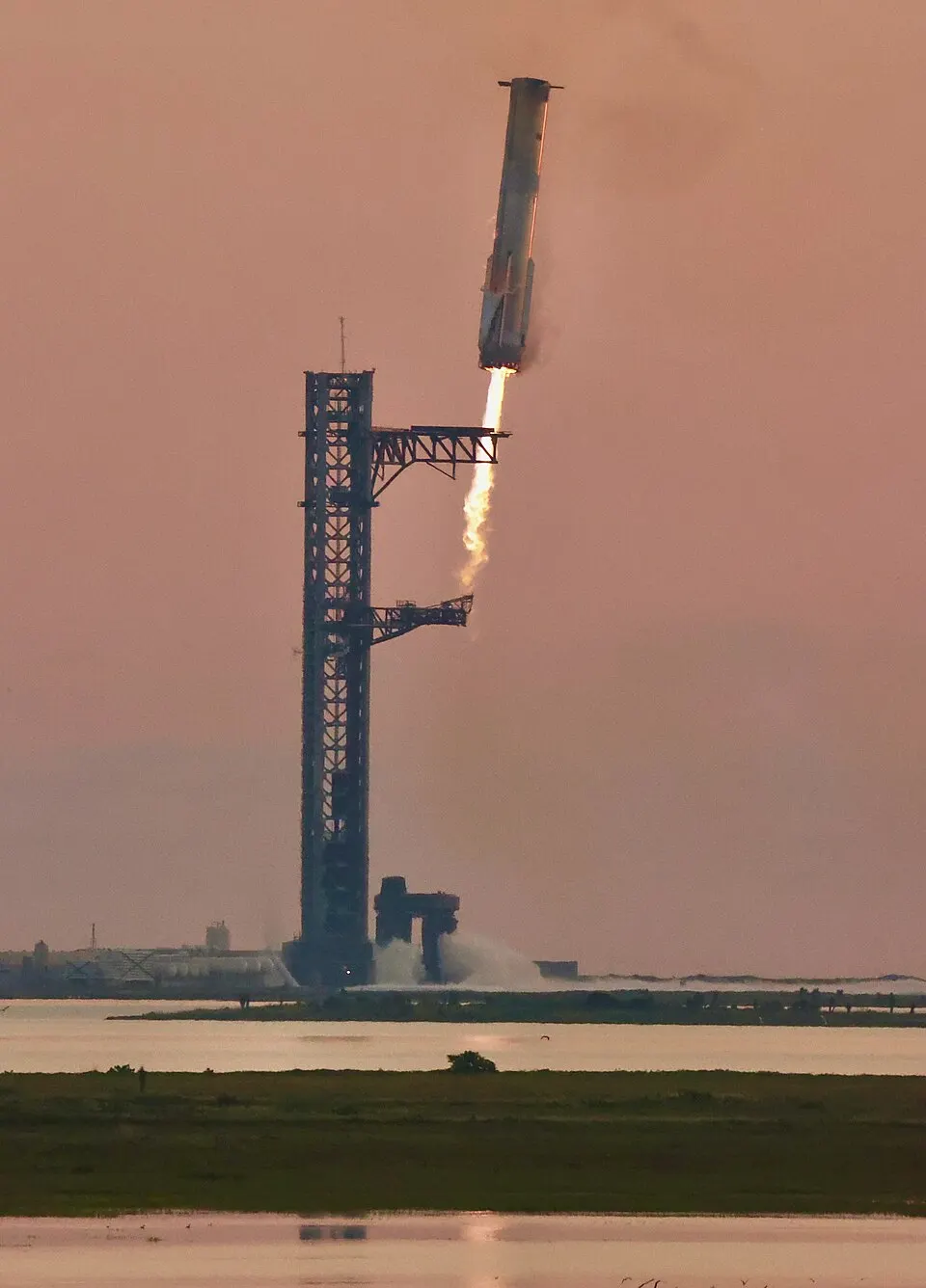
SpaceX successfully captured the upper stage of its Starship megarocket on Saturday, November 14, 2026, marking the first time the spacecraft has been recovered mid-air by the mechanical “chopstick” arms of the launch tower at the company’s Starbase facility in Texas. The vehicle, known as Ship 42, completed its return to the launch site approximately 22.5 hours after liftoff, performing a vertical landing into the grasp of the gantry arms. This milestone follows the 15th test flight of the world’s most powerful rocket, which had launched on Friday, November 13, in an ambitious attempt to demonstrate full reusability of both the Super Heavy booster and the Ship upper stage.
How did the mission unfold?
The mission commenced with the launch of the 407-foot tall Starship system from Starbase on Friday afternoon. While the flight successfully delivered 26 next-generation Starlink V3 broadband satellites into orbit, the attempt to recover the Super Heavy booster was unsuccessful. Shortly after separation, the booster’s guidance system identified an issue, leading to a diversion toward the Gulf of Mexico, where it exploded before impact. Despite this early-mission setback, the Starship upper stage continued its flight, successfully completing 14 orbits around Earth. During its return to the Texas coast on Saturday, the spacecraft managed to endure the intense heat of atmospheric reentry, with its heat-shield tiles appearing to function as intended. The final descent involved a precision maneuver where the ship flipped to an upright position and engaged three of its six methane-fueled Raptor engines to slow its velocity, allowing the “Mechazilla” mechanical arms to secure the craft before engine shutdown.
"One of the most incredible and historic engineering feats of all time has just happened right in front of our eyes," said SpaceX commentator Jessie Anderson, as reported by Space.
What is the significance of this achievement for the company?
The successful capture of the Starship upper stage represents a major advancement in SpaceX’s broader initiative to create a fully reusable orbital launch vehicle. Company founder Elon Musk has long maintained that establishing rapid and economical reusability is essential for lowering the financial barriers associated with deploying payloads to Earth orbit, the Moon, and beyond. In the near term, the operational efficiency of the Starship system is vital for expanding the Starlink constellation, which serves as a primary profit center for the aerospace firm. Looking further ahead, the company is under contract with NASA to utilize the Starship architecture for the Artemis program, which includes transporting cargo and astronauts to the lunar surface. The long-term vision articulated by Musk includes utilizing a fleet of these spacecraft to establish a human presence on Mars.
How did onlookers and officials respond?
The atmosphere at the Texas launch site was celebratory, with crowds of SpaceX employees and observers cheering as the vehicle settled into the launch tower arms. The event was streamed live, with company staff expressing intense relief and excitement throughout the landing process. NASA officials also weighed in on the success; as reported by NBC News, NASA Administrator Jared Isaacman remarked via the social media platform X that the feat was "almost magic," noting that the successful recovery was "making more believers by the day." While the booster explosion on Friday was noted as a disappointment, the company emphasized that the data collected remains invaluable for improving future iterations of the hardware.
What is still unclear and what happens next?
While the successful capture of the upper stage has been confirmed, SpaceX has not yet provided specific details regarding the root cause of the Super Heavy booster's guidance issue, though Elon Musk indicated on X that it was related to a "slight underperformance of engines." It remains unclear when the next test flight will occur or how the company plans to modify its recovery protocols for the booster stage in subsequent missions. Furthermore, while the company has outlined an ambitious schedule for future satellite deployments and crewed lunar missions, no concrete dates for these specific launches were released in the immediate aftermath of Flight 15. Engineers are currently continuing their investigation into the booster’s performance, while the upper stage undergoes post-flight inspections to determine if the vehicle can be cleared for future use. The company maintains that the loss of the booster will not disrupt its current timeline for achieving high-volume, fully reusable flight operations.
Sources: This report draws on coverage by Space, BBC News, CNBC, NBC News, CBS News, France 24, Facebook, AOL.com. The wording is our own.