Long before dawn breaks over the Celebes Sea, the harbor at the southern tip of Mindanao comes alive with a rhythmic, thunderous energy. Giant handline fishing boats, their hulls worn smooth by weeks in deep open water, slide into port laden with one of the ocean’s most sought-after ocean wanderers: yellowfin tuna. On the slick tiles of the fish port, silver-scaled giants weighing over a hundred pounds are unloaded, graded, and auctioned in a high-stakes choreography of hand signals and sharp negotiation. It is a spectacle of sheer scale and sensory intensity—one that recently captured global imagination when food travel creator Mark Wiens documented a Mindanao seafood journey in a video tour that has drawn over 2.2 million views.
The Pulse of the Southern Port
Mindanao, the second-largest island in the Philippine archipelago and home to over 26 million people, occupies a unique place in maritime Southeast Asia. Situated at the crossroads of ancient trade routes and rich equatorial fishing grounds, its southern coastline has evolved into the undisputed tuna capital of the region. Here, the economy does not merely touch the sea; it is entirely anchored to it. Thousands of families rely on the industry, from the brave crews navigating deep-sea handline vessels to the dockworkers, ice suppliers, canneries, and street vendors who turn the daily harvest into the island's economic lifeline.
Unlike industrial trawling, much of the prized catch landed in Mindanao is still brought in using traditional handline methods. Small crews venture hundreds of miles offshore, waiting patiently in the dark with single lines dropped into the depths. This rigorous, highly skilled practice yields high-grade fish destined for international sushi markets in Tokyo, Los Angeles, and Western Europe, while simultaneously powering the local economy.
A Culinary Identity Forged by the Sea
The culinary traditions of the Philippines are a rich tapestry woven from more than a hundred ethnolinguistic groups—including the Visayan, Tagalog, Kapampangan, and Maranao communities—evolving from an indigenous maritime base enriched by centuries of Chinese, Spanish, and American influences. In Mindanao, this broad culinary landscape narrows into a passionate, hyper-local obsession with fresh tuna.

Where other regions might reserve tuna for special occasions, in southern Mindanao, every part of the fish is celebrated and transformed. Nothing goes to waste. The prized loins become kinilaw, the ancient Filipino precursor to ceviche, where raw cubes of fish are cured not in heavy citrus, but in native palm vinegar, local lime, ginger, chalots, and coconut cream. The acidity cooks the tender flesh instantly, creating a bright, creamy, and fiery dish that tastes entirely of the sea.
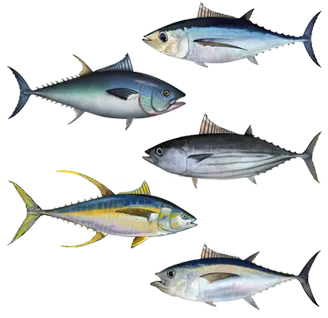
The Thunnini tribe comprises 15 distinct species across five genera, ranging from small bullet tuna to massive pelagic predators that can live for decades and travel thousands of ocean miles.
From Dockside Grills to Every Table
Walk through any night market in southern Mindanao, and the air is thick with the sweet, savory smoke of hardwood charcoal. The local food culture is uniquely defined by its head-to-tail appreciation of the fish. Huge tuna tails, rich in gelatin and fat, are braised slowly or seared over open flames. The jaw, known locally as panga, is prized for its succulent, tender meat and grilled with a simple glaze of soy sauce, calamansi, and banana ketchup.
Even the offal finds a honored place on the plate. Gisado (sautéed) tuna sperm sacs, grilled tuna belly (tiyan), and spicy tuna heart stew showcase a nose-to-tail philosophy born of deep respect for the catch. It is a cuisine that relies on absolute freshness; when fish is landed just hours before it hits the grill, minimal seasoning is required to let the rich, buttery flavor of the Thunnini shine through.

Preserving a Heritage on the High Seas
For the communities along Mindanao’s coast, the tuna industry is far more than a trade—it is a cultural anchor. It dictates the rhythm of daily life, influences local festivals, and binds diverse ethnolinguistic groups together over shared meals by the water. As global demand for high-quality seafood continues to rise, the fishermen of Mindanao continue to push out into the dark, deep waters of the Pacific, maintaining a centuries-old relationship with the ocean that feeds both their island and the world.