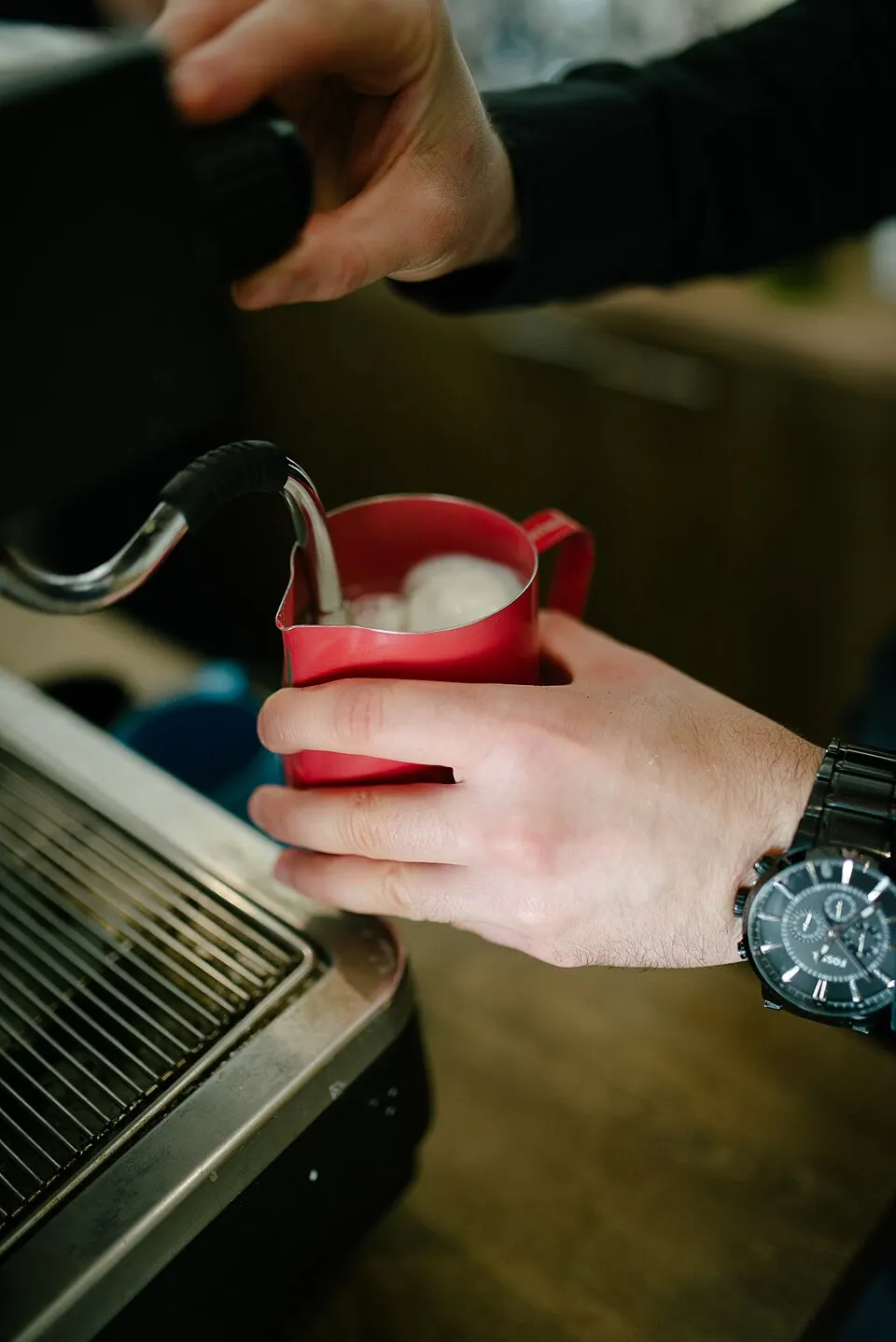
At 7:45 AM in a narrow storefront on Manhattan’s West Side, the air is a thick, humid cocktail of roasted beans, steamed oat milk, and the frantic electrical hum of industrial grinders. Outside, the sidewalk is a river of wool coats and rushing commuters, but inside, the rhythm is dictated by the rhythmic tamp-tamp-whoosh of a high-end espresso machine. Here, the barista is not merely a service worker; they are a conductor, an athlete, and a high-stakes negotiator. In this cathedral of caffeine, the distance between a perfect morning and a derailed schedule is measured in precisely eight seconds—the time it takes to pull a shot that meets the standard of the city’s most discerning palates.
New York City has always been defined by its appetite for speed, but the modern coffee culture has added a layer of complexity to the chaos. It is no longer enough to serve a fast cup of "joe." The contemporary New Yorker demands the nuance of a light-roasted Ethiopian Yirgacheffe or the silken micro-foam of a flat white, and they want it with the same efficiency as a subway swipe. This collision of artisan craft and industrial-scale demand has turned the local coffee shop into a fascinating theater of urban survival, a phenomenon so captivating that a video tour of a high-volume NYC shop has recently drawn 3 million views, as global audiences tune in to watch the domestic equivalent of a high-speed pit stop.
The Architecture of the Rush
To understand the mechanics of the morning rush, one must look at the layout of the bar. Every inch is optimized for "flow." The path from the point-of-sale terminal to the milk fridge to the espresso machine is a calculated geometry designed to minimize footsteps. In the industry, this is known as the "work triangle," and during the 8:00 AM peak, any deviation from this path results in a literal pile-up. Baristas move in a coordinated dance, sliding past one another with a constant chorus of "behind," "hot," and "sharp." It is a high-octane choreography where a spilled pitcher of milk isn't just a mess—it is a catastrophic system failure that can back up a queue out the door and halfway down the block.
The pressure is compounded by the diversity of the orders. Unlike the uniform drip-coffee days of the mid-century, today’s barista must manage a mental database of hundreds of permutations. Keto-friendly lattes, extra-hot decaf cortados, and pour-overs that require a steady, circular hand must all be executed simultaneously. There is a psychological toll to this precision; the barista must maintain a mask of calm hospitality while their hands move at a frantic pace, managing the expectations of a customer base that views a two-minute delay as a personal affront to their productivity.

The modern high-volume espresso machine can reach pressures of nine bars—roughly three times the pressure in a car tire—requiring the barista to manage volatile machinery while maintaining the delicate touch of a chemist.
A Cultural Microcosm in a Paper Cup
Historically, the New York coffee shop served as the "third place," a term coined by sociologist Ray Oldenburg to describe spaces between home and work where community is built. In the 1950s, this meant the Greek diners with their iconic blue-and-white Anthora cups. In the 1990s, it was the sprawling sofas of the Central Perk era. Today, the space has tightened. Real estate prices have squeezed the "third place" into a sleek, standing-room-only laboratory of efficiency. Yet, the cultural significance remains. The coffee shop is the only place where a billionaire hedge fund manager and a bicycle courier stand in the same line, bound by the same physical need for a morning jolt.
This democratization of the luxury experience is what fuels the obsession. A five-dollar latte is perhaps the most affordable high-status good in the city. When a barista pours a perfect rosetta into the foam, they are providing a brief moment of aesthetic beauty in an otherwise gritty commute. It is a fleeting luxury, a sensory anchor in a day that is otherwise dominated by screens and spreadsheets. For many New Yorkers, the interaction with their barista is the first human contact of the day, making the emotional labor of the job as vital as the caffeine itself.
The Science of Survival
Behind the counter, the science is relentless. Baristas must constantly "dial in" their espresso, adjusting the grind size to account for changes in humidity and temperature as the shop fills with people. If the air gets too damp from the steam wands, the beans swell, and the water flows too slowly, resulting in a bitter, over-extracted mess. Consistency is the holy grail. To achieve it, shops employ digital scales and timers for every single drink, turning the art of the pour-over into a repeatable laboratory experiment. It is a paradox of modern life: we seek out the "hand-crafted," yet we demand the mechanical reliability of a Swiss watch.

As the clock nears 10:30 AM, the frantic energy finally begins to plateau. The floor is covered in a fine dust of coffee grounds, and the baristas, their aprons stained with the day’s battles, finally find a moment to breathe. They have fueled the opening bell of the Stock Exchange, the first periods of the city’s schools, and the creative sprints of a thousand freelancers. In the relentless machinery of New York City, the coffee shop is the engine room, and the eight-second pour is the spark that keeps the whole magnificent, chaotic system from grinding to a halt.