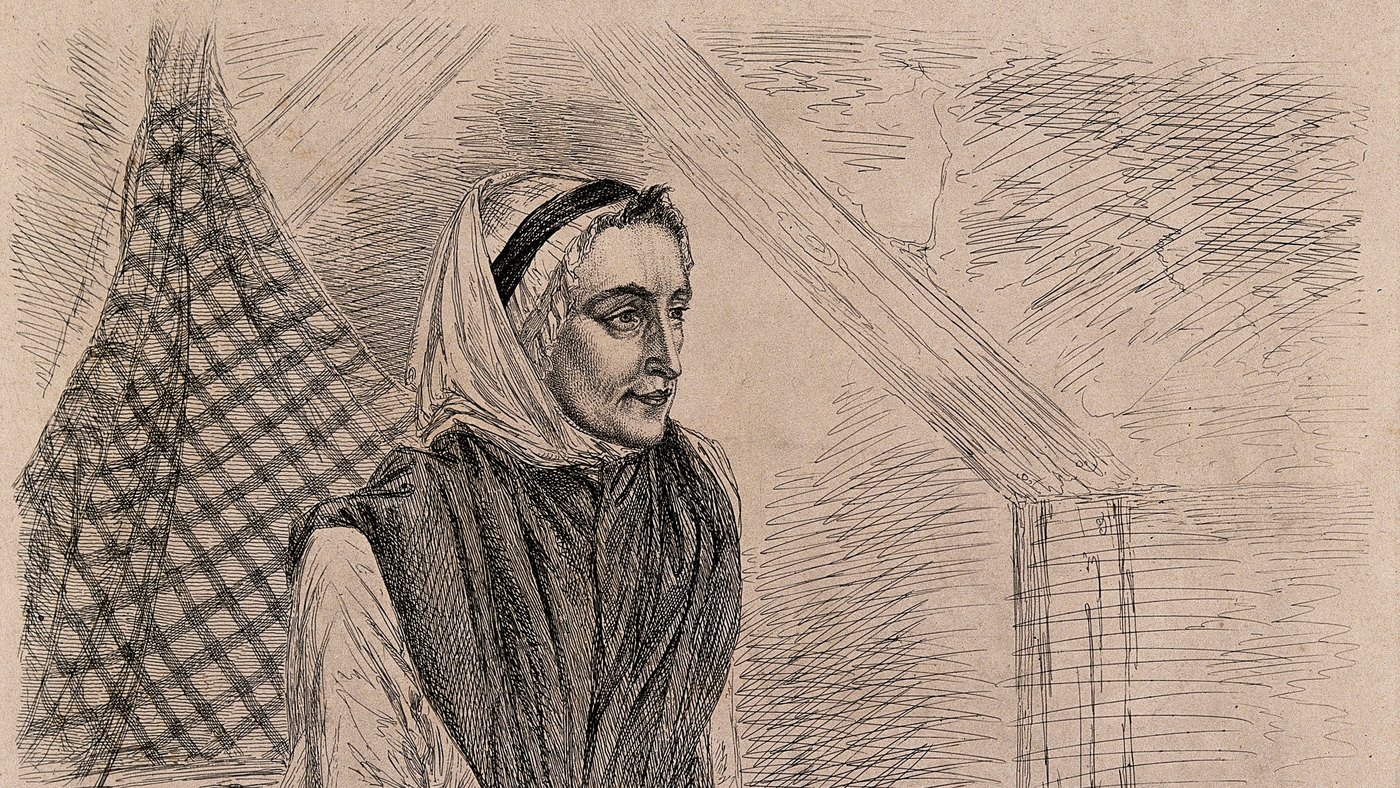
At twenty minutes past two on Wednesday, April 21, 1813, three men ascended to the upper room of a house in Tutbury: the baronet Sir Oswald Mosley, the Derby physician William Garlike, and the clergyman Legh Richmond. They meticulously inspected the walls, the flooring, and the ceiling, cleared out all unnecessary items, and moved Ann Moore onto a fresh bed stuffed with straw under their direct supervision. A cord was stretched across the middle of the room, behind which only the designated guards could pass.1
Moore had claimed to have swallowed no solid food since the spring of 1807 and not a single drop of liquid since the autumn of 1808. This marked her second formal surveillance, and on this occasion, the committee had brought a specialized weighing machine from Derby.1
How did a skeptic physician's 16-day surveillance initially clear Ann Moore?
Ann Moore was born in the village of Rosliston, Derbyshire, in 1761. She moved to Tutbury around 1800 to work in cotton spinning. By late 1806, rumors began to circulate that she was refusing food, and by 1807, she had become bedridden.2 The committee's report notes that she lived in extreme poverty at the time and that her initial claims of fasting brought her nothing but hostility from the town.1 In September 1808, a surgeon from Lane End named Robert Taylor initiated a surveillance. Taylor was deeply skeptical. Local dignitaries kept watch over Moore in four-hour shifts.2 Her 11-year-old daughter was barred from the house during this period, but a glass of water remained by the bedside. In a report dated September 28, Taylor concluded that despite 16 days of strict observation and 13 days of total liquid abstinence, Moore appeared healthier than when the process began.3 This report resonated in medical journals, leading some to theorize she was nourished by air, while others searched for esophageal diseases.2 Over the next four years, visitors from across the country visited her attic, often leaving money behind. According to the Dictionary of National Biography, Moore had invested 400 pounds in government bonds by 1812.2
Why did Ann Moore object to the scale and was she justified?
Alexander Henderson, a physician at the Westminster General Dispensary in London, visited Moore in 1812. In a 52-page pamphlet published in early 1813, he enumerated the contradictions in her narrative and compared her case to that of Anna Maria Kinker, who had been exposed for a similar fraud in Osnabrück in 1800.42 He argued that the 1808 surveillance proved only 16 days of fasting, as a human could feasibly survive on water alone for that duration.1 Richmond also visited Moore in November 1812 and proposed a second, more rigorous observation. Moore consented, provided she was treated with humanity and respect. The committee formed on March 31, 1813, selecting watchers from the clergy, medical profession, and local magistracy.1 At a meeting on April 20, it was suggested that her bed be placed on a Merlin weighing machine. Moore objected, and Richmond recorded her reasoning: if she lost weight, it would be attributed to starving, and if she gained weight, it would be claimed she was receiving secret food despite the guards. She would be guilty regardless. She eventually deferred the decision to the committee.1 Her objection was scientifically sound, as even a body consuming no food loses weight through metabolic processes like exhaling carbon dioxide and water vapor, and through perspiration. The committee aimed to determine the rate of loss to estimate how much weight someone claiming to have fasted for years should have lost.
What did the high-precision machine record in four days, and what ultimately exposed her?
The machine arrived on the morning of Monday, April 26. The bed was placed upon it, every item on the bed was inventoried, and the weight was recorded every 12 hours. Richmond noted that the machine was sensitive enough to detect one-fourteenth of a dram, or approximately 0.13 grams, under a load of 400-450 kilograms.1
Notes and Sources
- Richmond, L. (1813). A Statement of Facts, Relative to the Supposed Abstinence of Ann Moore, of Tutbury, Staffordshire; and a Narrative of the Circumstances which Led to the Recent Detection of the Imposture. Burton-on-Trent: J. Croft. archive.org/details/statementoffacts00rich
- Seccombe, T. (1894). "Moore, Ann". Dictionary of National Biography, vol 38, pp. 339-340. London: Smith, Elder & Co.
- Taylor, R. (1808). Report dated September 28, 1808, regarding the case of Ann Moore, Lane End.
- Henderson, A. (1813). An Examination of the Imposture of Ann Moore, Called the Fasting Woman of Tutbury. London: J. Moyes, Underwood and Blacks.
- Hammond, W. A. (1879). Fasting Girls: Their Physiology and Pathology. New York: G. P. Putnam's Sons.
- Stewart, W. K. and Fleming, L. W. (1973). "Features of a successful therapeutic fast of 382 days' duration". Postgraduate Medical Journal, 49(569), 203-209.