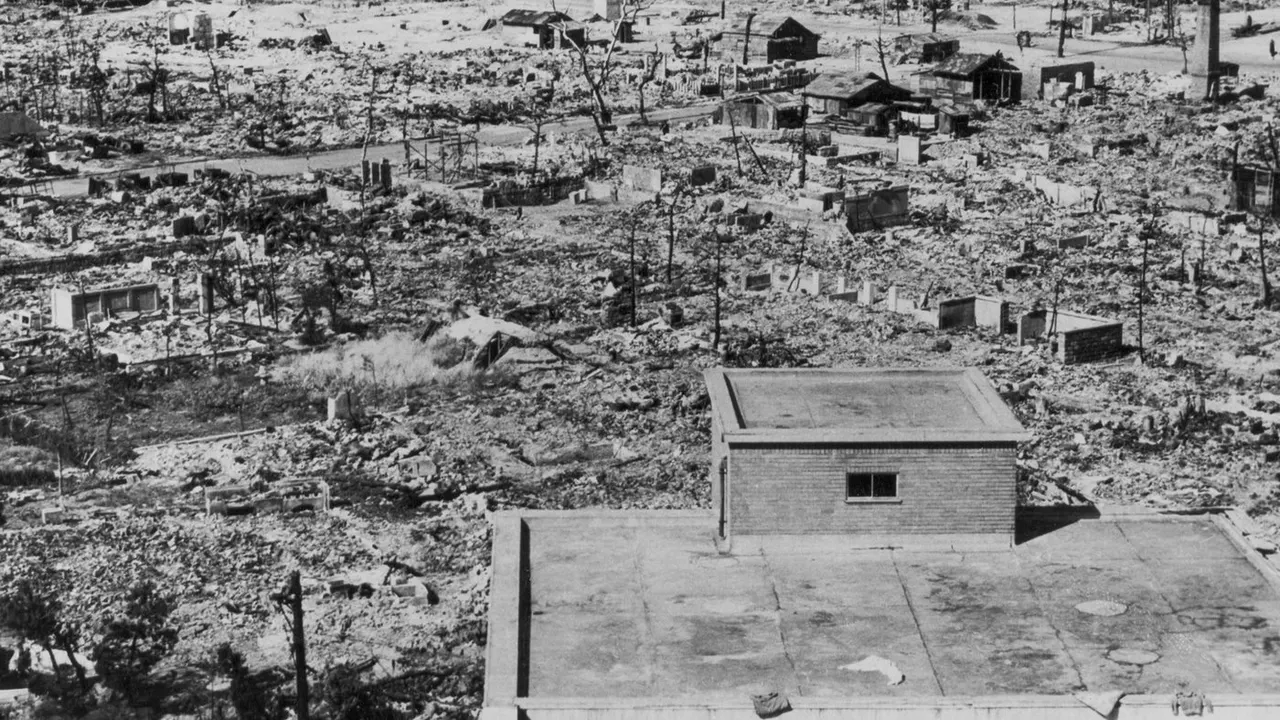
Tsutomu Yamaguchi, a 29-year-old engineer for Mitsubishi, became the only person officially recognized as a survivor of both the Hiroshima and Nagasaki atomic bombings in August 1945. On the morning of August 6, Yamaguchi was preparing to leave Hiroshima after a three-month assignment. While walking toward the station, he realized he had left his personal hanko—a seal used in place of a signature—at the office. He returned to retrieve it, and he was roughly 3 kilometers from the center of the city when the Little Boy bomb detonated 580 meters above ground at 8:15 a.m.
- How a wounded man ended up at ground zero of a second atomic bomb within three days.
- Why Hiroshima was removed from his official health record in 1960.
- The radiation exposure levels at a 3-kilometer distance compared to the city center.
- The findings from a 75,000-person study regarding the children of survivors.
How did Tsutomu Yamaguchi travel from Hiroshima to Nagasaki in three days?
The blast threw Tsutomu Yamaguchi to the ground, resulting in ruptured eardrums, temporary blindness, and burns to the upper left side of his torso. After seeking shelter and reuniting with two colleagues who also survived, he spent the night in a bomb shelter. The next day, the group walked through the devastated city to the station and boarded a train to Nagasaki, his hometown located approximately 300 kilometers to the west. On the morning of August 9, despite his injuries, Yamaguchi reported to his workplace at the Mitsubishi shipyards. As he was explaining the immense destructive power of the bomb to his supervisor, the Fat Man bomb detonated at 11:02 a.m. at a distance of about 3 kilometers away. Although thrown to the ground again, he suffered no new injuries. Following the announcement of Japan's surrender on August 15, he reunited with his wife, Hisako, and their infant son, Katsutoshi. While approximately 140,000 people died in Hiroshima and over 70,000 in Nagasaki, Yamaguchi survived, though he suffered from a high fever for a week in his home shelter.

Why was the record of the Hiroshima bombing removed from his medical file?
Following the war, Tsutomu Yamaguchi worked as a translator for occupying forces, a teacher, and eventually returned to his career as a tanker designer for Mitsubishi. In 1957, Japan began issuing health booklets to survivors, providing monthly stipends and free medical care. Yamaguchi’s booklet noted his presence within 3 kilometers of both explosions. However, when he renewed the document at the Nagasaki city office in 1960, the entry for Hiroshima was deleted. The city refused to correct the record for years, arguing the second entry would not change his benefits, and Yamaguchi initially did not push the issue. The situation changed following the death of his son, Katsutoshi, in 2005, which prompted Yamaguchi to share the history he had long kept private. In 2006, he appeared in the documentary Niju Hibaku (Twice Bombed), which was screened at the United Nations. In January 2009, he reapplied for recognition, and on March 24, 2009, the city of Nagasaki officially recognized him as a survivor of both attacks. He became the first and only person to be formally acknowledged in this manner. He told the Mainichi newspaper that the government's official record confirmed his double exposure, allowing him to pass the history of the atomic bombs to the younger generation.

How much radiation is received at a distance of three kilometers?
The fact that Tsutomu Yamaguchi survived both bombings and lived to the age of 93 may seem to contradict the known lethality of radiation. The Radiation Effects Research Foundation (RERF) has tracked 120,321 individuals in its Life Span Study since 1950, calculating individual doses based on location and shielding. At 1 kilometer from the hypocenter, an unprotected individual received approximately 7 gray in Hiroshima and 10 gray in Nagasaki. At 2.5 kilometers, this drops to 13 and 23 milligray respectively. Since a milligray is one-thousandth of a gray, the 3-kilometer distance where Yamaguchi stood places him well outside these high-exposure zones. His burns were primarily caused by the thermal flash rather than radiation. Cancer registration data suggests that at this distance, the risk of cancer is only marginally higher than in the general population. Yamaguchi struggled with cataracts, leukemia, and eventually stomach cancer in his later years, though it is impossible to determine whether these were strictly radiation-induced or due to age and other lifestyle factors.
What does the study of 75,000 children reveal about hereditary risks?
Hisako, Yamaguchi's wife, also survived the Nagasaki bombing and died of cancer in 2008. The couple had two daughters, Naoko and Toshiko, in the early 1950s, and the family often attributed their health issues to the parents' exposure to radiation. However, the RERF conducted a massive study of 75,327 children born between 1946 and 1984, following them for an average of 54 years. The study found no significant link between the parents' radiation dose and the risk of cancer or other fatal diseases in their children. In December 2009, director James Cameron visited Yamaguchi to discuss a potential film project. Nine months after his official recognition, Tsutomu Yamaguchi passed away on January 4, 2010, at the age of 93.
Notes and Sources
- J. McCurry, "A little deaf in one ear: meet the Japanese man who survived Hiroshima and Nagasaki", The Guardian, 2009.
- "Tsutomu Yamaguchi" (obituary), The Daily Telegraph, 2010.
- J. McCurry, "Hiroshima and Nagasaki survivor dies aged 93", The Guardian, 2010.
- Associated Press, "Survivor of Both A-Bombs Is Certified", The New York Times, 2009.
- K. Ozasa, E. J. Grant, K. Kodama, "Japanese Legacy Cohorts: The Life Span Study Atomic Bomb Survivor Cohort and Survivors' Offspring", Journal of Epidemiology, 2018.
- Radyasyon Etkileri Araştırma Vakfı (RERF), "Solid cancer risk among atomic bomb survivors".
- D. L. Preston et al., "Solid Cancer Incidence in Atomic Bomb Survivors: 1958-1998", Radiation Research, 2007.
- E. J. Grant et al., "Risk of death among children of atomic bomb survivors after 62 years of follow-up: a cohort study", The Lancet Oncology, 2015.