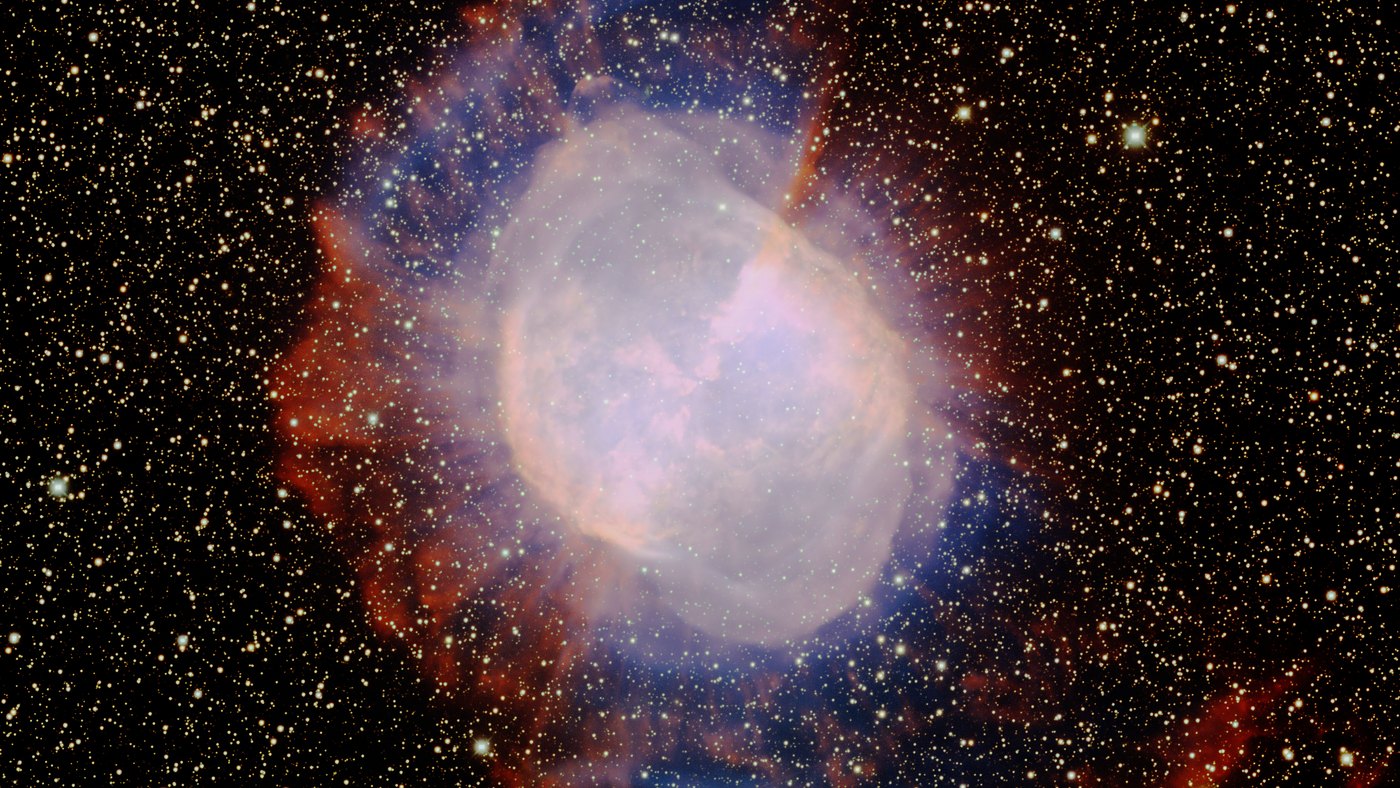
American astrophotographer Andrew McCarthy recently unveiled a 30-hour composite image of the Dumbbell Nebula, cataloged as M27, located in the constellation Vulpecula. Captured using a 17-inch telescope, the image has been titled "The Fate of Sol," highlighting the inevitable conclusion of our star's lifecycle. While the comparison is scientifically sound, astronomers note that the cloud left behind by our Sun will be significantly fainter than the vibrant display seen in M27, a point that remained under academic debate until as recently as 2018.
- An explanation of the gases responsible for the nebula's colors and the reality behind these captured wavelengths.
- A visualization of the Sun's growth during its red giant phase and the prospects of Earth's survival.
- A comparison of two major scientific models published a decade apart regarding the Sun's eventual expansion.
- Insights into how recent Webb Telescope imagery of nebulae is refining our understanding of dying stars.
What do we see in the image?
M27 was first documented by French astronomer Charles Messier on July 12, 1764, marking the first discovery of a planetary nebula. The name is a historical misnomer; in the 1780s, William Herschel observed these objects through small telescopes and, seeing faint, round disks reminiscent of Uranus, categorized them as "planetary." They have no physical association with planets. M27 is situated approximately 1,270 light-years from Earth. The visible cloud consists of the outer layers shed by a dying star, while the central point of light is the exposed, ultra-hot stellar core. Ultraviolet radiation from this core ionizes the surrounding gas, causing it to glow. McCarthy utilized specific filters to isolate hydrogen, oxygen, and sulfur, mapping them to color channels: blue hues represent oxygen, while oranges signify hydrogen and sulfur. Technically, these colors are representative rather than "true" in the human visual sense; in reality, the orange zones would appear as deep crimson. Current data suggests the nebula is roughly 9,800 years old, calculated by its expansion rate of 31 kilometers per second. Its central core, with an estimated mass of 0.56 solar masses, is strikingly similar to projections for the Sun's own future core.
How large will the Sun grow?
The Sun is 4.6 billion years old and currently stable, fusing hydrogen in its core. In 2008, researchers Klaus-Peter Schröder of the University of Guanajuato and Robert Connon Smith of the University of Sussex modeled the Sun's future, accounting for mass loss through solar winds. Their model predicts that at 10 billion years, the Sun will be 37 percent larger and 84 percent brighter than today. As hydrogen in the core depletes, the Sun will enter its red giant phase, expanding significantly. At its peak roughly 12.17 billion years into its life, its radius will reach 256 times its current size, or approximately 1.2 astronomical units, surpassing the current distance between Earth and the Sun.
During this expansion, the Sun will shed about a third of its mass, causing the orbits of the planets to widen. Whether Earth can escape engulfment has been a subject of intense scrutiny. Schröder and Smith incorporated tidal effects into their model, finding that the Sun's gravitational bulge will exert a drag on Earth, pulling it inward. Consequently, the planet is likely to be consumed about 7.59 billion years from now, roughly 500,000 years before the Sun reaches its red giant peak. Mercury and Venus will have been lost even earlier, 3.8 million and 1 million years prior, respectively. For life, the window is much shorter; the Sun's steadily increasing luminosity will render Earth uninhabitable in approximately one billion years.
Notes and Sources
- Matt Growcoot (October 5, 2026). "Eerie Photo Shows How Our Sun Will Die". PetaPixel.
- SIMBAD Astronomical Database, "M 27" record (distance: 389 parsecs). Centre de Données astronomiques de Strasbourg.
- C. R. O'Dell et al. (2002). "Knots in Nearby Planetary Nebulae". The Astronomical Journal 123: 3329-3347.
- G. Fritz Benedict et al. (2003). "Astrometry with the Hubble Space Telescope: A Parallax of the Central Star of the Planetary Nebula NGC 6853". The Astronomical Journal 126: 2549-2556.
- K.-P. Schröder, Robert Connon Smith (2008). "Distant future of the Sun and Earth revisited". Monthly Notices of the Royal Astronomical Society 386: 155-163.
- K. Gesicki et al. (2018). "The mysterious age invariance of the planetary nebula luminosity function bright cut-off". Nature Astronomy 2: 580-584.
- University of Manchester (May 7, 2018). "What will happen when our sun dies?", press release.
- ESA/Webb, NASA, STScI (January 20, 2026). "Intricacies of the Helix Nebula revealed by Webb".
- ESA/Webb, NASA, STScI (August 10, 2026). "Lion Nebula roars to life for Webb".
- Cover image: M27, Kitt Peak National Observatory Mayall 4-meter telescope. T.A. Rector (University of Alaska Anchorage), H. Schweiker (WIYN, NOIRLab/NSF/AURA).