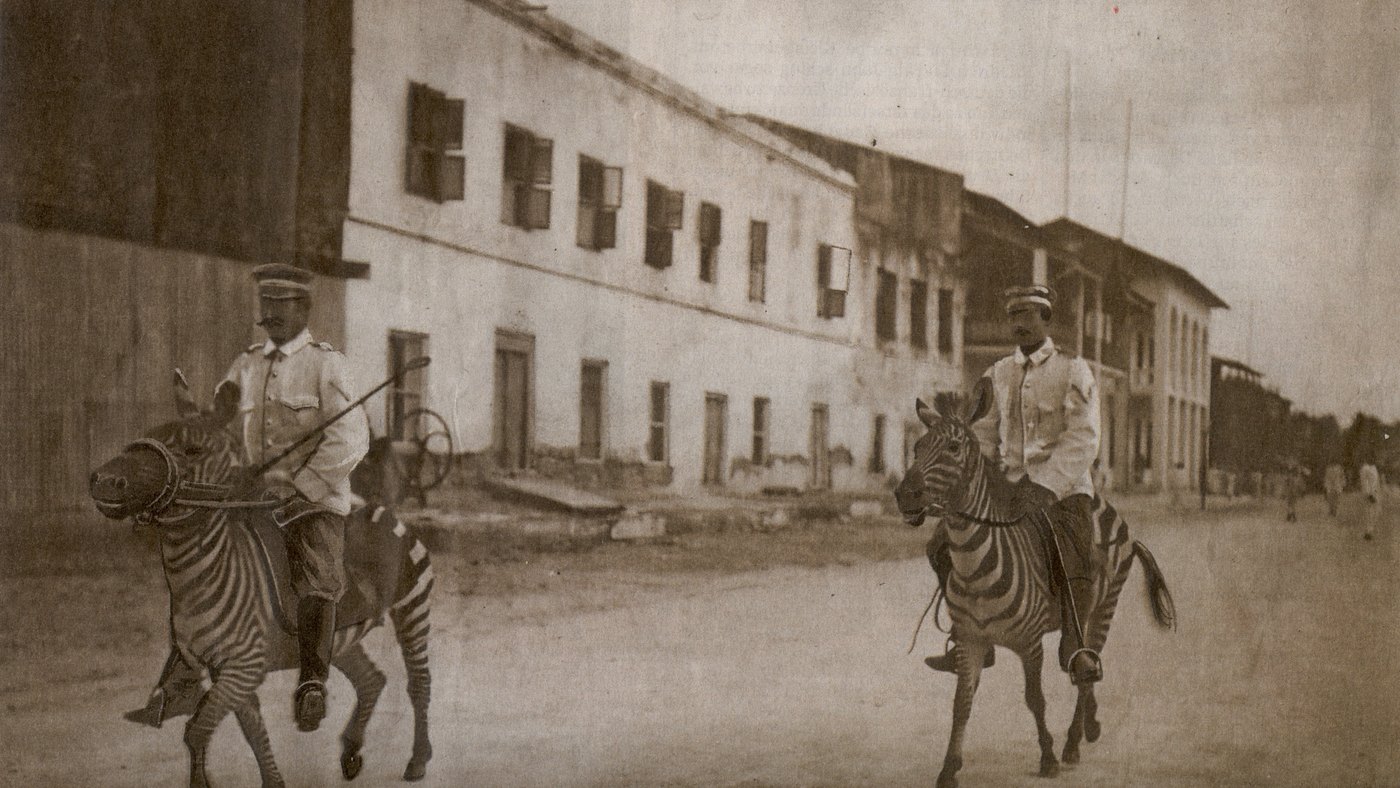
Zebras have never been successfully domesticated because they possess a combination of aggressive temperament and physiological traits that make them fundamentally incompatible with human control, unlike their close relative, the horse. In December 1901, Fritz Bronsart von Schellendorff, who operated a zebra farm in German East Africa, wrote to Kaiser Wilhelm II proposing that zebras be used by the colonial military. He argued that these animals would be invaluable as beasts of burden, particularly for artillery units, because they were immensely strong and entirely immune to many local diseases.12
Two months later, the Kaiser ordered the colonial Schutztruppe to purchase eight zebras from the farm to test their utility. Officers struggled for a long time to train the stubborn animals for riding. The most positive report they could relay to Berlin was that one zebra had managed to jump over an obstacle.2
- Why a British zoologist’s carriage-pulling zebras did not qualify as domestication.
- How many of the world’s 148 large mammal candidates were domesticated and why Africa remains absent from this list.
- The distinct evolutionary paths of the horse and the zebra.
- The failed hopes of colonial powers and the legacy of a zebra that died in Berlin in 1903.
Can a zebra be trained to pull a carriage?
England had already seen that a zebra could be harnessed to a carriage. In the summer of 1895, zoologist Walter Rothschild trained four plains zebras to pull a carriage and showcased them at the Tring Agricultural Show. According to contemporary press accounts, the animals were groomed, shod, and fed just like horses.3 In 1898, Rothschild famously drove a carriage pulled by three zebras and one horse to Buckingham Palace.4
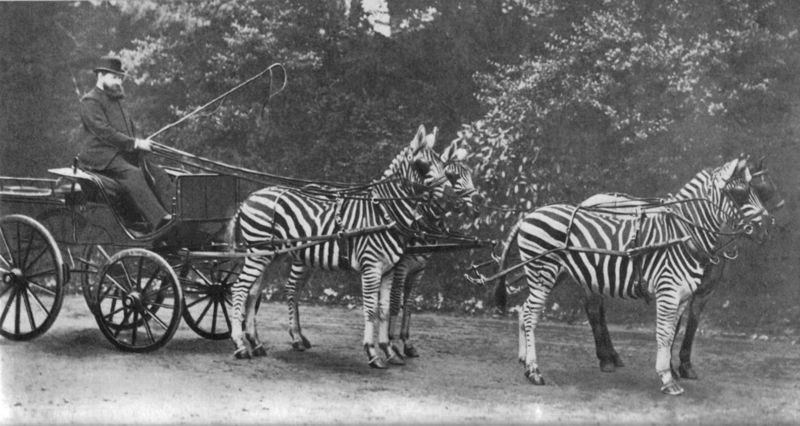
What Rothschild achieved was taming, not domestication. Taming involves conditioning an individual animal to accept humans, but its offspring will still be born wild. Domestication, by contrast, involves selecting and breeding a species over generations, leaving a permanent imprint on its genes.
In horses, this genetic imprint has been scientifically verified. In 2021, a team led by Pablo Librado and Ludovic Orlando compared 273 ancient horse genomes in the journal Nature. They found that modern domestic horses descended from ancestors in the lower Volga and Don basins, spreading rapidly across Eurasia after 2200 BCE. One of the strongest signals of selection in this lineage appeared around the ZFPM1 gene, which in mice is associated with anxiety, fear, and aggression. Researchers interpreted this as evidence that calmer, stress-resistant horses were favored by early humans.5 Rothschild’s zebras lacked such a selective history.
Why did so few large mammals become domesticated?
In his 1997 book Guns, Germs, and Steel, geographer Jared Diamond provided a census of large mammals. He identified 148 species of wild terrestrial herbivores weighing over 45 kilograms as candidates for domestication, yet only 14 were successfully domesticated in prehistory. Of the 51 potential candidates in sub-Saharan Africa, none were domesticated.6
According to Diamond, a species must meet several criteria to be domesticated: efficient diet, fast growth, ability to breed in captivity, a pleasant disposition, a lack of tendency to panic, and a hierarchical social structure. The zebra failed primarily due to its temperament. Diamond notes that a zebra, when it bites, does not release its grip, and when cornered, it is skilled at avoiding lassos by ducking. The book also notes that zebras injure more zookeepers in the United States each year than tigers, though data supporting this specific comparison is not provided.6
The social structure requirement does not disqualify the plains zebra. According to field studies by Princeton University’s Daniel Rubenstein, plains zebras live in stable groups consisting of a single stallion and several mares, much like wild horses. The Grevy’s zebra of the north is different; males defend solitary territories around water or grazing patches, and females move fluidly between groups.7
Notes and Sources
- Greiner, A. (2021). "Bio-Engineering across Empires: Mapping the Global Microhistory of Zebra Domestication in Colonial East Africa". Journal of World History 32(1), 127-159. doi:10.1353/jwh.2021.0006
- Grothe, S. (26 April 2021). "Deutsche Kolonialisten: Das Zebroid, des Kaisers Geheimwaffe". Der Spiegel. Based on Greiner's archival research. spiegel.de
- "A Rothschild Equipage". The Penny Illustrated Paper, 14 September 1895. hertfordshire-genealogy.co.uk
- Natural History Museum, London. "Zebra-drawn trap of Lord Lionel Walter Rothschild (1868-1937)", visual archives, record 6250. nhmimages.com
- Librado, P., Khan, N., Fages, A. et al., Orlando, L. (2021). "The origins and spread of domestic horses from the Western Eurasian steppes". Nature 598, 634-640. doi:10.1038/s41586-021-04018-9
- Diamond, J. (1997). Guns, Germs, and Steel: The Fates of Human Societies. W. W. Norton, New York. Chapter 9, "Zebras, Unhappy Marriages, and the Anna Karenina Principle", Table 9.2.
- Rubenstein, D. I. (1986). "Ecology and sociality in horses and zebras". D. I. Rubenstein, R. W. Wrangham (eds.), Ecological Aspects of Social Evolution: Birds and Mammals, pp. 282-302. Princeton University Press. doi:10.1515/9781400858149
- Todd, E. T., Tonasso-Calvière, L., Chauvey, L. et al., Orlando, L. (2022). "The genomic history and global expansion of domestic donkeys". Science 377(6611), 1172-1180. doi:10.1126/science.abo3503
- Barnard, B. J. H., Bengis, R., Keet, D., Dekker, E. H. (1994). "Epidemiology of African horsesickness: duration of viraemia in zebra (Equus burchelli)". Onderstepoort Journal of Veterinary Research 61(4), 391-393. PubMed 7501371
- Hagenbeck, C. (23 June 1903). Letter to James Cossar Ewart. University of Edinburgh, Centre for Research Collections, Coll-14/9/9/63. collections.ed.ac.uk
- Ewart, J. C. (1899). The Penycuik Experiments. A. and C. Black, London. doi:10.5962/bhl.title.57340