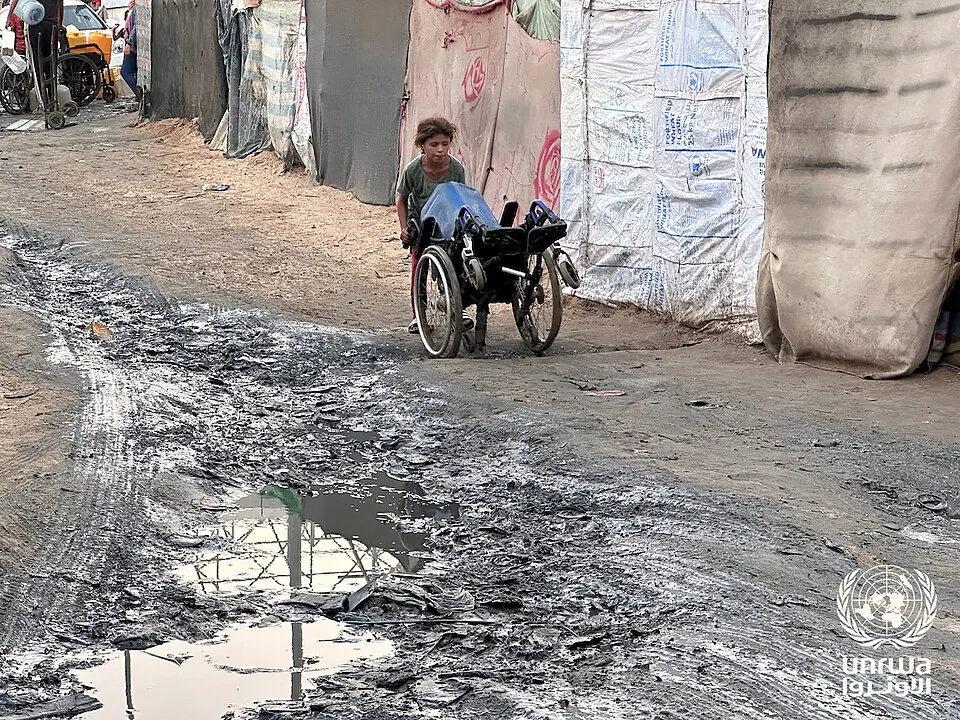
A severe winter storm in the Gaza Strip has left tens of thousands of displaced Palestinians without shelter following heavy rainfall that flooded encampments and caused a sand dune collapse in Deir al-Balah. According to humanitarian organizations including UNICEF and the International Organization for Migration (IOM), the extreme weather has killed at least five people—four children and one woman—while roughly 940,000 individuals are currently residing in areas highly susceptible to flooding. Aid agencies warn of a growing health crisis as 150,000 essential tents remain outside the territory awaiting Israeli approval for entry, forcing families to remain in waterlogged, makeshift structures made of wood and tarpaulins.
What is the scale of the humanitarian impact?
The humanitarian impact of the recent storms is widespread, with Gaza authorities and the United Nations reporting that thousands of families have lost their remaining belongings to floodwaters and sewage. In Gaza City and the central regions, displaced residents described waking up in the middle of the night to find their mattresses soaked and their fragile tents tearing under high winds. The situation is exacerbated by a lack of electricity, which has prevented storm water pumping stations from functioning, leading to the contamination of living areas with overflow. Organizations such as Medical Aid for Palestinians (MAP) have expressed alarm over a projected surge in respiratory infections and hypothermia, particularly among children and the elderly who lack dry clothing or heating.
"Watching them suffering in the cold is heartbreaking," Raed Jamal, a displaced Palestinian whose children fell ill after their tent was flooded, told The Guardian.
Why is there a shortage of adequate shelter?
The shortage of adequate shelter in Gaza stems from restrictions on the entry of durable materials and pre-fabricated housing. While the Prime Minister’s Office of Israel insists that winter supplies are being permitted into the territory, humanitarian groups like Shelterbox report that standard emergency tents have been blocked from entering for nearly two years. NewsCord and The Times of Israel noted that Israel maintains a ban on mobile homes, citing security concerns and stating that full reconstruction cannot occur until Hamas is disarmed. This policy has forced aid groups to rely on wooden pallets and plastic sheeting, which are insufficient to withstand the region's winter climate. Furthermore, UNICEF has accused Israel of blocking repairs to critical drainage basins, significantly increasing the risk of lethal flooding in densely populated camps.

How are medical and aid organizations responding?
Medical and aid organizations are attempting to provide emergency relief, but their efforts are hampered by movement restrictions and a lack of supplies. Doctors Without Borders (MSF) reported that even in the West Bank, healthcare actors continue to face significant travel constraints that impede crisis response. Within Gaza, medical teams are treating patients in overcrowded and damp conditions that facilitate the spread of disease. The health crisis is further complicated by the long-term detention of medical personnel; The Guardian reported that an independent medical review has raised urgent concerns for the life of Hussam Abu Safiya, a Gaza doctor held by Israel for 23 months without charge, who reportedly requires immediate medical intervention himself.
What is the background of this crisis?
The Gaza Strip is a small Palestinian territory bordered by Israel, Egypt, and the Mediterranean Sea. Following the destruction of permanent housing during the ground invasion that began in late 2023, the vast majority of the population has been displaced into makeshift camps. Humanitarian aid—defined as material assistance to save lives and alleviate suffering—is the primary source of survival for those in the enclave. However, the reliance on temporary solutions has proven catastrophic as Gaza enters its second winter of the conflict. Earlier this month, the Trump administration’s Board of Peace criticized the current response to the flooding as insufficient, while diplomatic efforts to reach a peace plan remain stalled.

What is still unclear?
It remains unclear when, or if, the 150,000 tents currently held at the border will be granted clearance by Israeli authorities to enter Gaza. While the Israeli government claims winter goods are moving through crossings, they have not provided a specific timeline for the approval of more durable shelter materials or the repair of water infrastructure. Additionally, there is no consensus on the exact number of casualties caused by the recent sand dune collapse in Deir al-Balah beyond the five deaths confirmed by local sources and the PCHR. Future dates for the resumption of peace negotiations or the implementation of proposed humanitarian corridors have not been established, leaving the displaced population to face the remainder of the winter in deteriorating conditions.
Sources: This report draws on coverage by The Guardian, Middle East Eye, France 24, Facebook, International Organization for Migration, NBC News, Reuters, unicef usa. The wording is our own.