On November 9, 1799, Napoleon Bonaparte seized political control in France through the Coup of 18 Brumaire, marking the collapse of the Directory and his own ascension to First Consul. This orchestrated power struggle took place in Paris and the Château de Saint-Cloud, fundamentally altering the trajectory of the French Republic and signaling the end of the revolutionary era. It remains a watershed moment in history, as it provided the platform for Napoleon to consolidate authority, eventually leading to his reign as Emperor of the French.
What triggered the uprising?
The French Republic had been exhausted by years of war with major European powers and was suffering under the ineffective governance of the Directory. Emmanuel Joseph Sieyès, a powerful director who despised the existing 1795 Constitution, sought a military partner to help execute a coup that would restore order. After the death of his first choice, General Joubert, at the Battle of Novi, Sieyès turned to the rising star Napoleon Bonaparte. With the population disgruntled by unfair tax systems and the rising price of food, the political climate was primed for a drastic change in leadership.
How did Napoleon navigate the path to power?
Napoleon arrived in Paris on October 16, 1799, and immediately began navigating a complex web of political alliances. He held secret discussions with key figures like Talleyrand and Fouché, eventually securing an alliance with Sieyès. While the plot was initially scheduled for November 7, Napoleon’s superstition regarding Fridays and lingering hesitation among the conspirators delayed the operation by 48 hours. By November 9—or 18 Brumaire in the Republican calendar—the inner circle of conspirators was ready to mobilize the military to enforce their agenda.
The Coup of 18 Brumaire is widely viewed by historians as the definitive end of the French Revolution, clearing the path for Napoleon’s future coronation as Emperor.
The morning of November 9 began with precise military precision as Napoleon ordered members of the Council of Elders to meet at the Tuileries. Under the guise of a looming Jacobin conspiracy, Sieyès convinced the Council to relocate the National Assembly to the Château de Saint-Cloud, granting Napoleon authority over the security of the legislative bodies. Meanwhile, key directors were manipulated or pressured; while Sieyès and Ducos resigned, others like Gohier were placed under house arrest after refusing to step down. Napoleon, now Commander-in-Chief of the Paris area, ensured that any potential opposition was isolated.

Why did the coup nearly fail at Saint-Cloud?
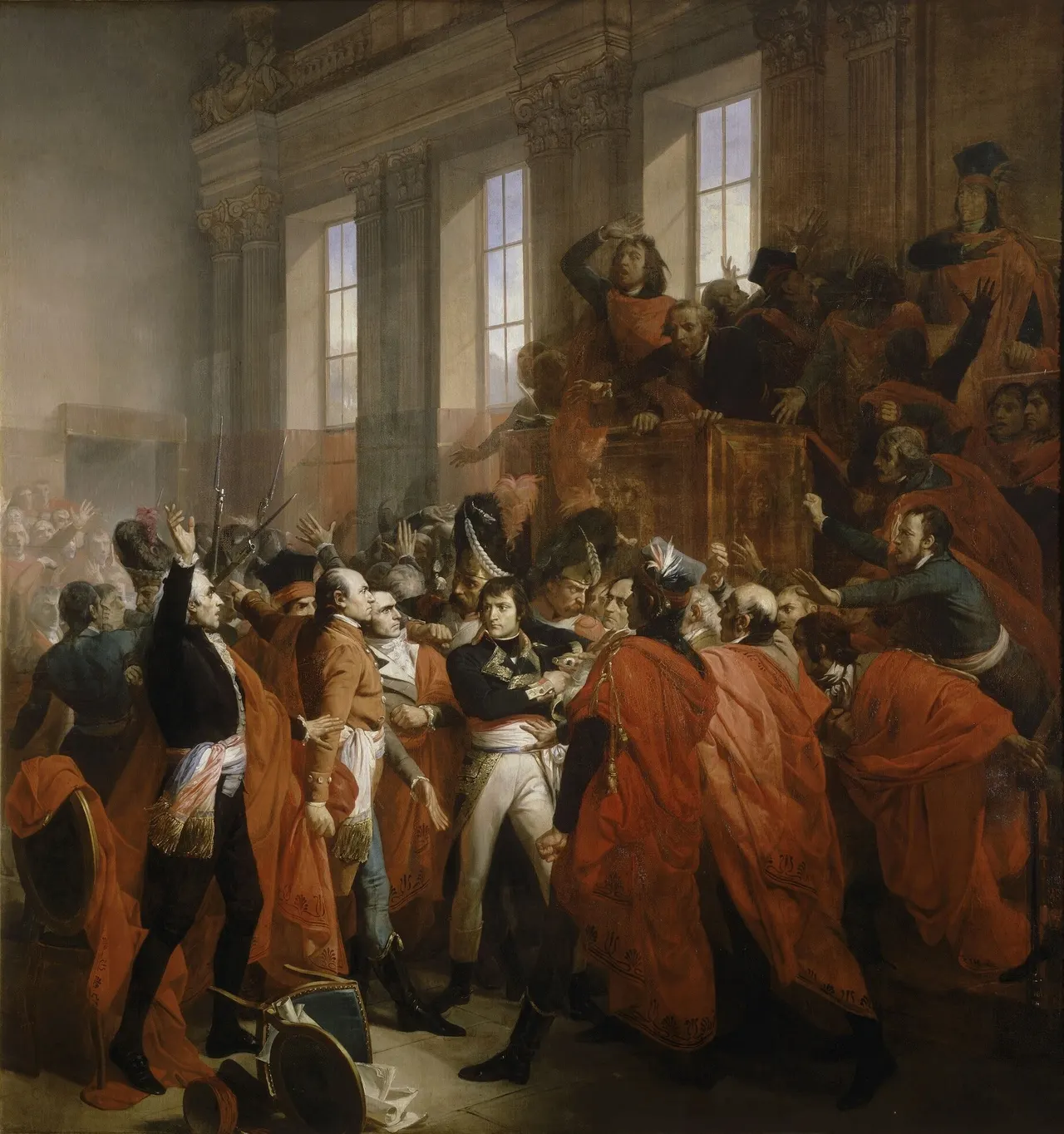
The transition to the Château de Saint-Cloud proved chaotic because the venue was ill-prepared, forcing members of the Council of Elders and the Council of Five Hundred to mingle in a confined space. When Napoleon entered the Council of Elders to address the assembly, he was met with hostility and accusations of being a tyrant, causing him to stumble through a rambling, ineffective speech. The situation intensified when he entered the Orangery to face the Council of Five Hundred; the deputies, seeing the presence of soldiers and sensing an illegal takeover, shouted for his removal and attempted to seize him. Napoleon, dazed and bleeding, was only saved by the rapid intervention of Murat and Lefebvre.
The coup was ultimately saved by Lucien Bonaparte, who took the initiative to rally the guards, claiming that his brother had been attacked by the deputies. Using this narrative of victimization to stir the soldiers, the chamber was forcibly cleared. By 2:00 am on November 10, a small quorum of remaining members officially dissolved the Directory and swore their allegiance to a new triumvirate of provisional consuls: Napoleon, Sieyès, and Ducos. This act of force successfully dismantled the old government and installed a new, more centralized administration.
In the aftermath, Napoleon moved quickly to secure his dominance. He effectively sidelined Sieyès by criticizing his constitutional drafts, eventually adopting his own structure which featured four separate assemblies—the Corps législatif, a Senate, a Tribunate, and a Council of State—that were designed to check one another while keeping the ministers accountable solely to the Consul. This arrangement solidified his grip on the nation and set the stage for his absolute authority. By December 12, the new order was essentially codified, cementing his transition from revolutionary general to the supreme ruler of France.

Napoleon’s coup was largely bloodless on the first day, relying on intimidation and the presence of 6,000 soldiers rather than direct combat.
The name 18 Brumaire refers to the date in the French Republican calendar, which was a short-lived system used to signify the transition away from religious and royalist traditions.
Napoleon was superstitious about Fridays, which is why he delayed his original plans for the coup by 24 hours to ensure he launched the maneuver on a Saturday.
Watch: Napoleon Seizes Power - The Brumaire Coup
From the Epic History channel.
Sources and further reading: Wikipedia — Coup of 18 Brumaire (CC BY-SA). Images: Wikimedia Commons.