On November 13, 1927, the Holland Tunnel officially opened to vehicular traffic, marking the completion of the world's first underwater mechanically ventilated highway tunnel. Connecting Jersey City, New Jersey, to Lower Manhattan in New York City beneath the silt and waters of the Hudson River, the project established a permanent vehicular link between the two states. Named in honor of its initial chief engineer, Clifford Milburn Holland, the dual-tube masterpiece redefined modern civil engineering and set a global standard for urban transportation infrastructure.
Before the arrival of the tunnel, crossing the Hudson River between Manhattan and New Jersey relied entirely on ferries. As automobile ownership soared during the early 20th century, the waterborne transit system strained under immense pressure. Vehicles faced agonizing delays, waiting in long queues at ferry terminals along both shorelines. Plans for a fixed crossing date back to 1906, but intense debate over costs, structural feasibility, and logistics dragged on for more than a decade. Opponents questioned whether a bridge or a tunnel was more practical, given the immense breadth of the river and the vast shipping traffic navigating New York Harbor.
In 1919, officials formally approved a subterranean tunnel beneath the Hudson River in lieu of a bridge. Construction commenced the following year in 1920. The project demanded unprecedented engineering methods, as workers excavated through deep underwater river silt using pneumatic shields, lining the twin circular tubes with cast-iron rings covered by a heavy layer of concrete. Each cast-iron ring was assembled from 14 curved steel pieces, establishing a outer shell 29.5 feet in diameter designed to withstand the immense pressure beneath the riverbed.

Who designed the tunnel and overrode its lethal challenges?
The Holland Tunnel was designed by chief engineer Clifford Milburn Holland, whose visionary plans guided the project through its most perilous early phases. Tragically, the unrelenting strain of managing the subterranean excavation took a fatal toll. Holland died suddenly in October 1924, just three years before the project reached completion. His successor, Milton Harvey Freeman, took over leadership of the site, only to succumb to illness and pass away less than a year later. The massive undertaking was ultimately carried across the finish line by engineer Ole Singstad.
The Holland Tunnel was the world's first mechanically ventilated underwater vehicular tunnel, equipped with 84 massive fans capable of completely replacing the air within the tubes every 90 seconds.
The primary hurdle facing Ole Singstad and the design team was the deadly threat of toxic exhaust gases. Unlike rail tunnels built for electric or steam trains, a highway tunnel had to handle thousands of internal combustion engines emitting dangerous concentrations of carbon monoxide. Singstad engineered a revolutionary transverse ventilation system. Four striking brick ventilation buildings—two on land and two resting on massive piers rising 107 feet above high water in the Hudson River—were erected to house 84 industrial fans. Intake fans forced fresh air into ducts along the roadway curbs, while exhaust fans pulled polluted air through slits in the ceiling, fully circulating the subterranean air every minute and a half.

How did the twin tubes reshape interstate transportation?
The Holland Tunnel provided a vast, continuous corridor designed specifically to handle heavy modern vehicular flow. The north tube, measuring 8,558 feet between portals, was constructed to transport westbound traffic from Broome Street in Lower Manhattan to 14th Street in Jersey City. The south tube, stretching 8,371 feet, carried eastbound traffic surfaced at the Holland Tunnel Rotary in New York. Together, the twin underwater segments stretched 5,410 feet along the silt bed, dipping to a maximum depth of approximately 93 feet beneath mean high water.
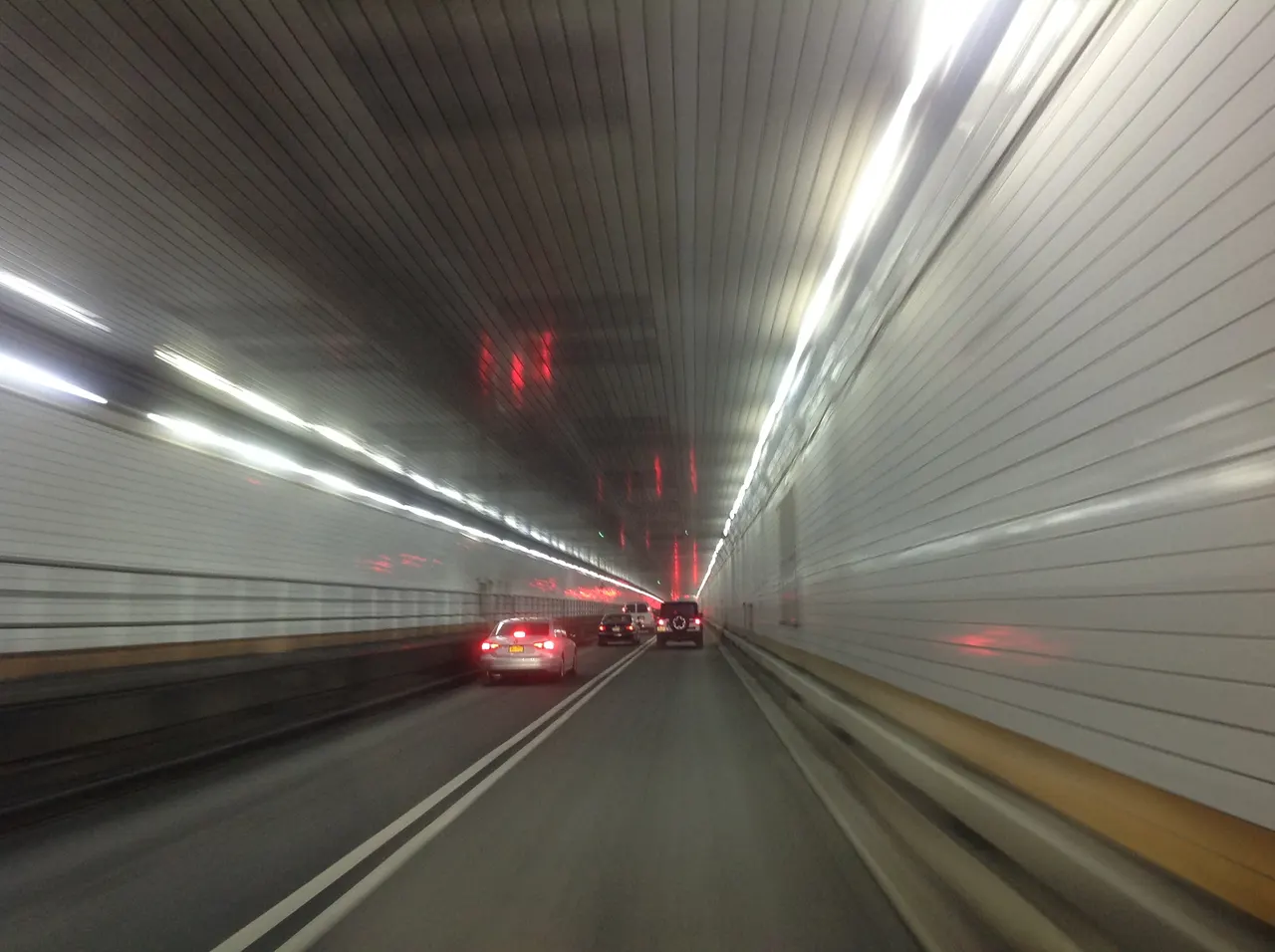
To prevent gridlock on local streets, planners positioned the approach portals two blocks apart on both sides of the Hudson River. On the New Jersey side, the eastbound entry was routed through Boyle Plaza on 12th Street, while westbound travelers exited onto 14th Street. Inside the tubes, drivers navigated a 20-foot-wide roadway paving two lanes of travel, framed by white glazed ceramic tiles flanked by decorative bands of yellow-orange and blue at the borders. Raised four feet above the road on the inner wall of each tube ran a narrow catwalk, continuously patrolled by officers utilizing built-in emergency telephone booths every 250 feet.

What happened on opening day in November 1927?
When the Holland Tunnel opened on November 13, 1927, it sparked massive public celebration across both New York and New Jersey. Tens of thousands of eager motorists rushed to experience the thrill of driving beneath the Hudson River for the very first time. At its debut, the structure stood as the longest continuous underwater vehicular tunnel on Earth, instantly transforming how goods and people moved across the tri-state metropolitan area.
The immediate operational success of the Holland Tunnel proved that long-distance underwater vehicular crossings were both safe and economically viable. For decades, tolls were collected in both directions across the twin tubes until westbound tolls were eliminated in 1970. The structure's ownership and maintenance eventually passed to the Port Authority of New York and New Jersey, which integrated the crossing into Interstate 78 and New Jersey Route 139.

At its lowest point beneath the Hudson River, the tunnel roadway rests 93 feet below mean high water, submerged deep within the riverbed silt.
In the decades that followed, the Holland Tunnel adapted to shifting urban demands and strict safety upgrades. The original road surface of Belgian blocks and concrete was resurfaced with smooth asphalt in 1955. Following the terrorist attacks of September 11, 2001, security regulations were tightened significantly, restricting certain heavy commercial vehicles and hazardous materials from entering the downtown conduit. Despite these restrictions and the later construction of neighboring crossings like the Lincoln Tunnel and George Washington Bridge, daily traffic volume remained vital, carrying tens of millions of vehicles annually.
Recognized for its extraordinary structural legacy, the Holland Tunnel was designated a National Historic Civil and Mechanical Engineering Landmark in 1982, followed by National Historic Landmark status in 1993. Nearly a century after its grand debut, Ole Singstad's pioneering transverse ventilation principles remain the global gold standard for subterranean highway design around the globe.
Did you know? Both of the project's first two chief engineers, Clifford Milburn Holland and Milton Harvey Freeman, died during construction before seeing the tunnel open.
Did you know? The four ventilation shaft buildings house 42 intake fans and 42 exhaust fans, which were designed with extra capacity so that two-thirds of the fans operated normally while the rest remained on standby for emergency conditions.
Watch: New Yorks Underwater Tunnel - The History of the Holland Tunnel
From the IT'S HISTORY channel.
Sources and further reading: Wikipedia — Holland Tunnel, Hudson River, New Jersey (CC BY-SA). Images: Wikimedia Commons.