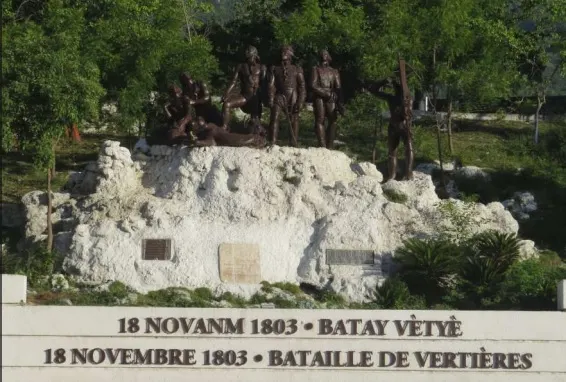
On November 18, 1803, the Indigenous Army led by Jean Jacques Dessalines defeated French expeditionary forces under General Donatien de Rochambeau at the Battle of Vertières. This engagement, fought just south of Cap-Français, was the final major conflict of the Haitian Revolution. It marked the definitive end of French colonial rule in Saint-Domingue and led directly to the establishment of the Republic of Haiti on January 1, 1804. As the first successful slave revolution to result in an independent state, Vertières remains a foundational moment in the history of the Western Hemisphere and the global struggle against slavery.
How did the conflict reach this final breaking point?
The path to the Battle of Vertières was paved by years of brutal conflict and the betrayal of Toussaint Louverture. In 1802, the French Governor-General Louverture was arrested and deported by French forces, famously warning his captors that the roots of liberty were too deep to be destroyed. By October 1802, Jean Jacques Dessalines had correctly sensed that the French intended to restore slavery and led a renewed revolt. Throughout 1803, the rebel forces systematically reclaimed the island, eventually pinning General Rochambeau’s 5,000 troops into a desperate corner at Cap-Français. By the morning of November 18, only a few strongholds remained in French hands, with the fort at Vertières standing as the final barrier to a total rebel victory.
Who were the heroes of the charge at Vertières?
The battle was defined by the extraordinary courage of François Capois, known as Capois-la-Mort. On the morning of November 18, as the rebel artillery began blasting Fort Bréda, Capois led his half-brigade forward under a murderous storm of bullets. Even as the French guns at Charrier thinned his ranks, the rebel soldiers did not falter; instead, they clambered over their fallen comrades while singing. When Capois’ horse was shot out from under him, he did not seek cover. He rose from the dirt, drew his sword, and continued the charge on foot, shouting his men forward into the face of certain death.

"In overthrowing me, you have done no more than cut down the trunk of the tree of black liberty in Saint-Domingue. It will spring back from the roots, for they are numerous and deep." — Toussaint Louverture
The bravery displayed by the rebels was so profound that it momentarily halted the machinery of war. Observing the charge from the ramparts, General Rochambeau ordered a sudden ceasefire. A French staff officer was dispatched to the rebel lines, not to negotiate, but to deliver a message: the Captain-general sent his compliments to the general who had covered himself with such glory. After this brief, chivalrous salutation, the officer returned to his lines and the slaughter resumed. This moment remains one of the most cinematic and surreal instances in military history, testifying to the undeniable merit of the revolutionary fighters.
How was the French defeat finalized?
As the day progressed, Dessalines committed his reserves under the command of Gabart, the youngest of the rebel generals. Along with Capois and Clervaux—who fought with a musket in hand even after his epaulette was shot away—the rebel leadership repulsed a desperate final charge by Rochambeau’s elite guard of grenadiers. Nature eventually intervened to end the bloodshed as a sudden tropical downpour, accompanied by thunder and lightning, drenched the battlefield. Under the cover of this storm, Rochambeau realized that Saint-Domingue was lost and withdrew his remaining forces from Vertières.

The following morning, the French sent emissaries to negotiate a surrender. Dessalines granted Rochambeau ten days to embark his remaining troops and depart the island. While the French army was allowed to leave, the aftermath was marred by the grim fate of wounded French soldiers left behind; they were reportedly drowned by the rebels in the days following the surrender. By the end of 1803, the French presence on the island had effectively vanished, leaving the path clear for a new political reality.
The Battle of Vertières led to the 1804 proclamation of Haiti as the first black-dominated republic in both the Americas and the New World.
What was the long-term impact of the victory?
The victory at Vertières changed the map of the world. On January 1, 1804, Dessalines officially proclaimed the independence of Haiti. However, the international community was slow to recognize the young republic. France, during the Second Restoration, refused to acknowledge Haitian sovereignty and later used its naval power to demand financial compensation. In 1826, King Charles X demanded 150 million gold francs in exchange for recognition, a debt that was later reduced to 90 million but continued to be paid by Haiti well into the 20th century.

Today, November 18 is celebrated as the Day of Victory in Haiti, a reminder of the day an army of the formerly enslaved defeated the premiere military power of the era. The battle proved that the "roots" Louverture spoke of were indeed deep enough to sustain a nation. Despite the economic hardships imposed by the independence debt, the legacy of Vertières remains a symbol of resistance and human dignity across the globe.
Did you know? The Battle of Vertières took place on the very same plantation where Toussaint Louverture had once worked as a coachman.

Did you know? Haiti is the third largest country in the Caribbean by area and currently has an estimated population of 11.4 million people.
Watch: The Battle of Vertières Explained: Haiti’s Decisive Victory
From the Spiritual Essence Publications channel.
Sources and further reading: Wikipedia — Battle of Vertières, Haitian Revolution, Haiti, Western Hemisphere (CC BY-SA). Images: Wikimedia Commons.