On November 20, 1805, Ludwig van Beethoven’s sole opera, originally presented under the title Leonore, oder Der Triumph der ehelichen Liebe (Leonore, or The Triumph of Marital Love), received its world premiere at the Theater an der Wien in Vienna. The work featured a German libretto prepared by Joseph Sonnleithner, adapted from a French text by Jean-Nicolas Bouilly. Today, the composition is universally recognized in its final, revised form as Fidelio, standing as a pivotal masterpiece that infused the operatic stage with Beethoven's profound commitment to political liberty, moral courage, and heroic sacrifice.
What brought Beethoven to the operatic stage in Vienna?
Ludwig van Beethoven’s path to composing an opera began in earnest in 1803 when the noted impresario and librettist Emanuel Schikaneder offered him a contract. The arrangement provided the composer with free lodging inside the vast complex of the Theater an der Wien. Initially, Beethoven was tasked with setting Schikaneder’s libretto Vestas Feuer to music. However, after spending about a month on the project, Beethoven found the text uninspiring and abandoned it. He turned instead toward an emerging tradition of French heroic opera that had taken Vienna by storm following the 1802 local performance of Luigi Cherubini’s Lodoïska.
This new French school popularized the "rescue opera" subgenre. These works blended realistic domestic settings, spoken dialogue in the Singspiel tradition, and high-stakes patriotic drama where heroes overcome catastrophic threats through extraordinary moral fortitude. This ethos appealed far more to Beethoven than the lighter character comedies of earlier eras. Borrowing plots and musical conventions from predecessors such as Pierre Gaveaux’s 1798 opera Léonore, ou L'amour conjugal and Ferdinando Paer’s 1804 Leonora, Beethoven set to work on his own rescue narrative in 1804. Though he abandoned Vestas Feuer, the effort was not lost; musical ideas from it were transformed into key moments for his new project, including Pizarro's aria "Ha! Welch' ein Augenblick!" and the triumphant reunion duet "O namenlose Freude."
What unfolds during the drama of Fidelio?
The storyline of Fidelio centers on a courageous noblewoman named Leonore whose husband, Florestan, has been secretly imprisoned by his political rival, the tyrannical prison governor Pizarro. Refusing to accept his disappearance, Leonore disguises herself as a young male prison guard using the alias "Fidelio." She gains employment at the fortress where Florestan is held in secret subterranean isolation, working alongside the jailer Rocco to find her husband before Pizarro can execute him.

The opera features several iconic dramatic sequences that mirror the political struggles of contemporary Europe. Among the most celebrated is the "Prisoners' Chorus" ("O welche Lust"—"O what a joy"), in which political captives are temporarily permitted to walk in the prison courtyard, singing a touching ode to air and freedom. Later, in the dark lower dungeons, a starving Florestan experiences a powerful vision of Leonore appearing as a saving angel. When Pizarro draws a dagger to murder Florestan, Leonore steps between them, revealing her true identity and brandishing a pistol to halt the assassination until the Minister of Justice arrives. The finale brings full liberation, celebrating Leonore’s heroic devotion through triumphant passages for soloists and chorus alike.
The rescue opera pattern featured a heroic or patriotic story involving violence, a strong ethical content dividing characters into sheep and goats, and a happy end produced by an act of superhuman courage—a model Beethoven adopted lock, stock, and barrel.
Why did the premiere of 1805 struggle to find an audience?
When the three-act version of the opera opened at the Theater an der Wien on November 20, 1805, the performance met an unfortunate historical coincidence. Just days before the premiere, French military forces occupied Vienna during the Napoleonic Wars. The Austrian aristocracy and local theater patrons had largely fled the capital, leaving the auditorium populated primarily by French military officers. These soldiers possessed little interest in a lengthy German opera, and the initial run closed after just three nights.
Recognizing the work's potential despite this setback, Beethoven’s close friend Stephan von Breuning stepped in to help revise the project. Von Breuning streamlined the three-act libretto into a tighter two-act structure, while Beethoven revised the music and composed a sweeping new overture, now known as "Leonore No. 3." This second version premiered at the Theater an der Wien on March 29 and April 10, 1806, achieving greater artistic and audience success. However, a bitter financial disagreement between Beethoven and the theater management cut the revival short, leaving the piece shelved for years.

How did Fidelio achieve its definitive triumph?
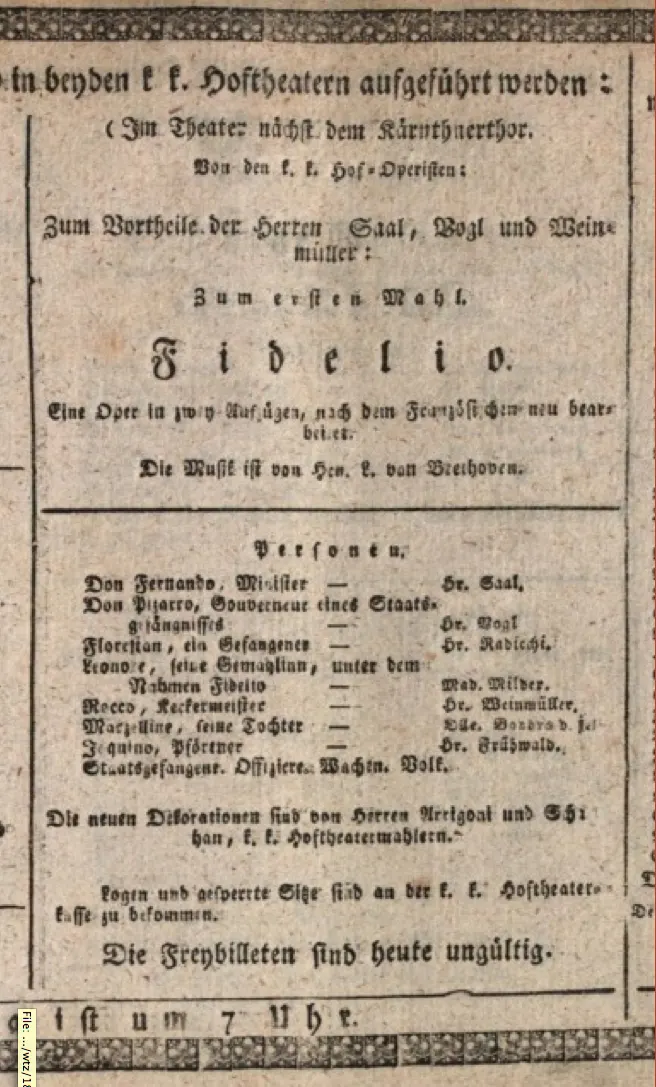
The definitive transformation of the opera took place in 1814, when librettist Georg Friedrich Treitschke collaborated with Beethoven on a third and final overhaul. Treitschke refined the dramatic flow while Beethoven extensively reworked the score once more. On May 23, 1814, this ultimate version premiered at the Kärntnertortheater in Vienna, billed permanently under the title Fidelio to distinguish it from rival adaptations by Gaveaux and Paer. The performance was conducted by the increasingly deaf Beethoven, who was discreetly assisted on stage by Michael Umlauf.
The 1814 staging was a resounding success, capturing the public imagination during a period of rising German national consciousness. In the audience that evening was seventeen-year-old Franz Schubert, who had sold his own school textbooks just to afford a ticket. The villainous role of Pizarro was performed by baritone Johann Michael Vogl, who would later become one of Schubert’s primary musical collaborators. Following this revival, Fidelio secured a permanent place in the international operatic repertoire, making its way to Prague in late 1814, London in 1832, and New York in 1839.
"I assure you, dear Treitschke, that this opera will win me a martyr's crown. You have by your co-operation saved what is best from the shipwreck. For all this I shall be eternally grateful to you." — Ludwig van Beethoven
What legacy did Beethoven’s only opera leave behind?
Despite the ultimate triumph of Fidelio, the grueling process of writing, revising, and defending the piece left a permanent scar on Beethoven. The composer found the theatrical infighting and structural rewriting so agonizing that he vowed never to compose another opera for the rest of his life. The full score of the opera was not officially published until 1826, just a year before his death, with all three historic versions categorized collectively under Beethoven's Opus 72.

In the 20th century, Fidelio took on immense symbolic weight during moments of global crisis. In December 1944, conductor Arturo Toscanini selected Fidelio for his first complete operatic radio broadcast in the United States, transmitting its anthem of liberation across the NBC network with the NBC Symphony Orchestra. Less than a year later, in September 1945, Fidelio served as the very first opera staged in Berlin following the end of World War II. Staged by the Deutsche Oper at the undamaged Theater des Westens under conductor Robert Heger, its themes of liberation from tyranny resonated deeply within a ruined city emerging from dictatorship.
Did you know? Beethoven spent a month composing music for an entirely different opera titled Vestas Feuer, written by The Magic Flute impresario Emanuel Schikaneder, before abandoning it to write Fidelio.
Did you know? By modern musicological convention, the early 1805 three-act and 1806 two-act versions are referred to as Leonore, reserving the name Fidelio exclusively for the final 1814 version.

Did you know? Michael Umlauf, who quietly assisted the hearing-impaired Beethoven during the 1814 premiere of Fidelio, was later called upon to perform the exact same assistance for Beethoven at the historic 1824 premiere of the Ninth Symphony.
Watch: FIDELIO - The OPERA Story Explained FAST
From the Ian Mac: The Arts Edge channel.
Sources and further reading: Wikipedia — Fidelio, Ludwig van Beethoven, Vienna (CC BY-SA). Images: Wikimedia Commons.