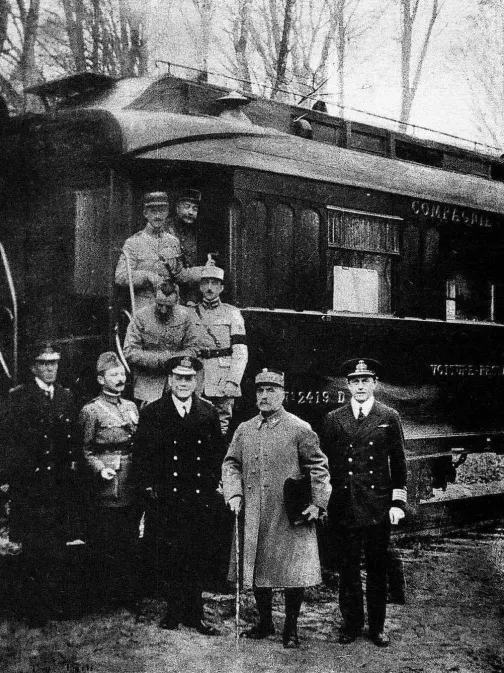
On November 11, 1918, the Allied Powers and the German Empire signed an armistice inside a stationary railroad car in the Forest of Compiègne, France, effectively ending the land, sea, and air combat of World War I. Allied Supreme Commander French Marshal Ferdinand Foch and German delegate Matthias Erzberger finalized the agreement at 5:00 a.m., with the ceasefire taking effect at 11:00 a.m. Paris Time. This monumental event silenced the guns of the Great War, halting a global conflict that resulted in an estimated 15 to 22 million deaths and reshaping the geopolitical map of Europe.
Why did Germany ask for an immediate armistice?
The strategic reality for the German Imperial Army deteriorated rapidly during the summer and autumn of 1918. Following the Allied victory at the Battle of Amiens in August, British, French, and American forces launched the relentless Hundred Days Offensive. German troops were forced to retreat to the Hindenburg Line, forfeiting all territorial gains achieved during their spring offensive. By late September, a massive joint American and French offensive in the Meuse-Argonne, combined with British assaults on the St Quentin Canal, threatened the German front with a massive pincer movement.
Beyond the Western Front, Germany’s allies were rapidly collapsing. The Bulgarian Army succumbed on the Macedonian front, prompting the Armistice of Salonica on September 29. The Ottoman Empire and Austria-Hungary were rapidly nearing complete military exhaustion and political collapse. At home, chronic food shortages driven by the relentless Allied naval blockade stoked widespread civil unrest. battlefield casualties, starvation rations, and the devastating spread of the Spanish flu pandemic drained the remaining reserves of the German military effort.
Faced with total catastrophe, Quartermaster General Erich Ludendorff summoned Emperor Wilhelm II and Imperial Chancellor Count Georg von Hertling to Imperial Army Headquarters in Spa, occupied Belgium, on September 29. Ludendorff declared the military situation hopeless, warning that he could not guarantee the front would hold for another two hours. To salvage the honor of the officer corps, Ludendorff urged an immediate ceasefire and advised accepting United States President Woodrow Wilson’s Fourteen Points. By transferring political responsibility to civilian leaders, Ludendorff famously remarked to his staff, "They now must lie on the bed that they've made for us."

How did political chaos in Berlin shape the negotiations?
On October 3, 1918, the liberal Prince Maximilian of Baden was named Imperial Chancellor to initiate peace talks. Two days later, Berlin sent a message to President Wilson seeking an armistice grounded in his Fourteen Points. However, diplomatic negotiations quickly stalled over Wilson’s demands. In diplomatic notes exchanged throughout October, Wilson made it clear that the retreat of German forces from occupied territories, the total cessation of submarine warfare, and the abdication of the Kaiser were non-negotiable preconditions. Wilson warned that if Washington had to deal with "the military masters and the monarchical autocrats of Germany," it would demand capitulation rather than peace.
The Allied statesmen were faced with a problem: so far they had considered the "fourteen commandments" as a piece of clever and effective American propaganda... Now, suddenly, the whole peace structure was supposed to be built up on that set of "vague principles".
When Ludendorff realized the severity of the Allied demands, he attempted to reverse course and demanded a resumption of hostilities. Recognizing the insanity of the request, the Kaiser dismissed Ludendorff and appointed Lieutenant General Wilhelm Groener, who advocated for continuing the armistice path. By early November, the crisis deepened. On November 3, Austria-Hungary and the Ottoman Empire signed armistices, leaving southern Germany completely exposed to a potential Allied invasion. The following day, a naval mutiny in the German High Seas Fleet sparked a full-scale revolution across the German Empire.
Recognizing that the monarchy was doomed and acting as a friction point in negotiations, Prince Maximilian unilaterally announced the abdication of Kaiser Wilhelm II on November 9. Power was transferred to Friedrich Ebert of the Social Democratic Party, while fellow Social Democrat Philipp Scheidemann proclaimed Germany a republic. That same day, the civilian politician Matthias Erzberger led a German delegation into France to meet the Allied military command, knowing that his home country was rapidly falling apart behind him.

What took place inside the railroad car in the Forest of Compiègne?
The high-stakes negotiations occurred in a private railway carriage belonging to Allied Supreme Commander Ferdinand Foch, parked on a siding deep within the Forest of Compiègne, roughly 80 kilometers north of Paris. Foch dictated terms designed to render Germany entirely incapable of resuming military operations. While British Field Marshal Douglas Haig urged moderate terms—warning that Germany was not completely broken in a military sense and noting the need to preserve the German army to counter communist uprisings—Foch insisted on rigorous concessions.
The armistice terms mandated the immediate cessation of hostilities on the Western Front, the total evacuation of invaded territories west of the Rhine, and the Allied occupation of the Rhineland along with key bridgeheads further east. Germany was required to surrender vast amounts of military equipment, including aircraft, warships, and artillery, while preserving basic civilian infrastructure. Furthermore, the terms dictated the immediate release of all Allied prisoners of war and interned civilians without an immediate reciprocal release of German prisoners. Crucially for the starving German populace, the harsh Allied naval blockade remained fully in force.
At 5:00 a.m. Paris Time on November 11, 1918, the representatives signed the Armistice of Compiègne. The agreement specified that fighting would cease six hours later, at 11:00 a.m. Even as the signatures were affixed in the quiet railroad car, soldiers on the front lines continued to fight and fall throughout the morning hours. A total of 2,738 men were killed on the final day of the Great War before the order to cease fire reached every trench.

What was the immediate aftermath and long-term legacy of the armistice?
When the clock struck 11:00 a.m. on November 11, an eerie silence descended over the Western Front, replacing four years of non-stop artillery bombardment. The Armistice of Compiègne was not a formal surrender, but it shattered Germany’s war capacity. Because the underlying peace treaty took months to construct, the armistice had to be extended three times before the Paris Peace Conference produced the Treaty of Versailles on June 28, 1919. That treaty, which took effect on January 10, 1920, forced heavy financial reparations and territorial losses upon the young German Republic.
Fighting continued up until 11 a.m. UT on 11 November 1918, with 2,738 men dying on the last day of the war.
The circumstances of the signing left deep scars on European history. By assigning civilian political leaders like Matthias Erzberger to seek the truce while the German Army remained on foreign soil, Ludendorff and the high command fostered a bitter domestic myth that the military was never defeated on the battlefield, but rather betrayed from within. The Forest of Compiègne thus became a solemn landmark of Allied triumph and a symbol of profound German resentment, setting political currents in motion that would echo decades later.
Today, November 11 is observed worldwide as Remembrance Day, Veterans Day, or Armistice Day. It remains an enduring moment of collective memory, honoring the millions of soldiers and civilians killed in the Great War and reflecting on the fragile nature of international peace.

Did you know?
• Quartermaster General Erich Ludendorff publicly demanded a ceasefire on September 29, 1918, claiming he could not guarantee the Western Front would hold for even two more hours.
• The naval blockade of Germany was not lifted by the Armistice of Compiègne; it remained strictly active, continuing to restrict food imports to the country.
• The Treaty of Versailles, which permanently settled the terms of peace foreshadowed in the railroad car, was signed on June 28, 1919, but did not officially take effect until January 10, 1920.
Watch: Armistice 1918 - The Best Documentary Ever
From the Stephania Hudson channel.
Sources and further reading: Wikipedia — Armistice of 11 November 1918, World War I, Allies of World War I, Forest of Compiègne (CC BY-SA). Images: Wikimedia Commons.