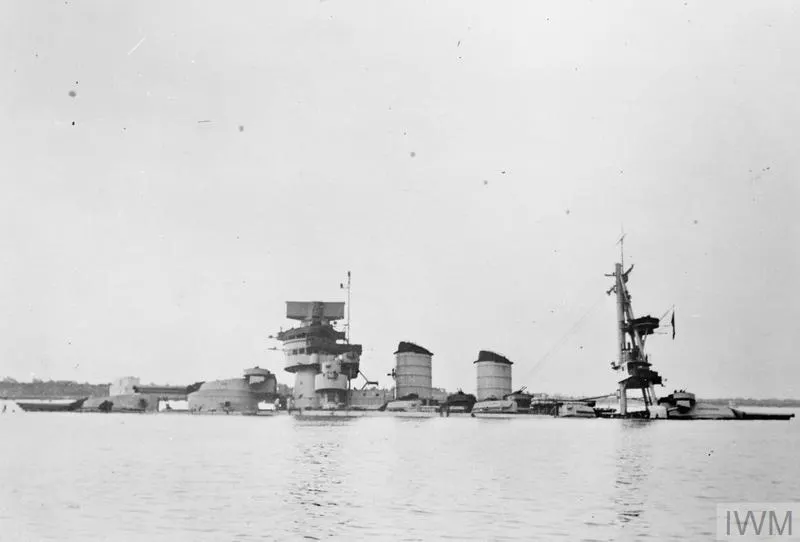
On the night of 11 November 1940, British naval forces under the command of Admiral Andrew Cunningham executed Operation Judgement, an unprecedented aerial strike against the Italian Regia Marina anchored at Taranto. By deploying 21 Fairey Swordfish biplane torpedo-bombers from the aircraft carrier HMS Illustrious, the Royal Navy demonstrated the devastating potential of naval aviation. This engagement, which effectively neutralized a significant portion of Italy’s battlefleet, signaled the end of the era of the big-gun battleship as the sole arbiter of maritime power.
Why was the Regia Marina at Taranto so vulnerable?
The Italian fleet at Taranto occupied a strategically critical position, yet its protection was dangerously insufficient. Although the base was defended by 101 anti-aircraft guns and 193 machine-guns, a series of unlucky environmental and operational failures left the warships exposed. Strong winds on 6 November had destroyed 60 of the base's barrage balloons, leaving only 27 in place. Furthermore, a scheduled gunnery exercise meant that only a third of the required 12.8 kilometers of anti-torpedo netting had been installed. Critically, these nets did not reach the harbor floor, leaving a gap of approximately 60 centimeters that allowed British torpedoes to pass beneath them.
How did the Royal Navy execute a night attack?
The Royal Navy’s success relied on the unique capabilities of the Fairey Swordfish and the specialized training of the Fleet Air Arm. Because the shallow waters of the harbor, only 39 feet deep, posed a risk of torpedoes striking the bottom, the British engineers developed a brilliant solution: a wire-pull system attached to a drum under the aircraft's nose. As the torpedo dropped, the wire pulled its nose up, forcing the weapon to perform a shallow belly-flop rather than a dangerous dive. To reach the target, the Swordfish were stripped of their standard configuration; observers replaced radio operators to manage 60-gallon auxiliary fuel tanks, extending the range of the biplanes for the long flight from the carrier task force positioned off the Greek island of Cephalonia.

Taranto, and the night of 11/12 November 1940, should be remembered forever as having shown once and for all that in the Fleet Air Arm the Navy has its most devastating weapon. — Admiral Andrew Cunningham
The operation was the result of long-held British ambitions to neutralize the Italian fleet, which had made Mediterranean supply routes to Egypt perilous. Admiral Sir Dudley Pound had begun planning for such a contingency as early as the 1938 Munich Crisis, recognizing that the Fleet Air Arm was the only aviation branch capable of night operations. When the collapse of France made the security of the Mediterranean fleet a matter of survival, Admiral Andrew Cunningham moved forward with the plan. Originally intended to coincide with Trafalgar Day on 21 October, the attack was delayed by a fire that destroyed two aircraft and the subsequent mechanical failure of the carrier HMS Eagle, leaving HMS Illustrious to carry out the strike alone.
As the task force detached from the main fleet at 20:00, the tension among the aircrews was palpable. The first wave of 12 aircraft, led by Lieutenant Commander Kenneth "Hooch" Williamson, approached the harbor with a clear, coordinated mission: flare-dropping aircraft were to illuminate the battleships to provide targets for the torpedo bombers, while others dove upon the smaller vessels moored in the Mar Piccolo. The intelligence gathered by Martin Maryland aircraft from Malta allowed the British to precisely map the disposition of the six battleships and various cruisers, despite the late addition of unforeseen barrage balloons.

The Regia Marina, adhering to a conservative naval philosophy that prioritized the preservation of their fleet, remained at anchor. Even after the initial waves alerted the harbor defenses, the Italian lack of radar meant they could do little to counter the incoming biplanes. The British expectation of a 50 percent loss rate for the bombers did not materialize; instead, the Swordfish crews exploited the lack of effective air defense and the inadequate netting, delivering their torpedoes with clinical precision against the anchored giants of the Italian navy.
The impact of this raid resonated far beyond the immediate damage to the Italian ships. It validated the theories of naval planners who had long argued that the aircraft carrier would define the future of combat at sea. By proving that a relatively small group of biplanes could humble a massive surface fleet, the Royal Navy altered the trajectory of the entire Second World War. The victory provided the British Mediterranean Fleet with the breathing room necessary to secure supply lines, and it forced navies across the globe to scramble to integrate carrier-based aviation into their core doctrines.

The Battle of Taranto marked the first time in history that a major naval engagement was conducted entirely by carrier-borne aircraft against stationary warships.
To accommodate the long-range requirements of the mission, the British modified their Swordfish biplanes by placing auxiliary fuel tanks in the cockpit, forcing the observer to replace the air gunner.

Despite the defensive strength of the port, the Italian Regia Marina was hampered by a lack of radar, which rendered them unable to track the incoming British aircraft during the darkness of the 11th and 12th of November.
Watch: Battle of Taranto 1940 - Pearl Harbor of the Mediterranean DOCUMENTARY
From the Kings and Generals channel.
Sources and further reading: Wikipedia — Battle of Taranto, World War II, Royal Navy (CC BY-SA). Images: Wikimedia Commons.