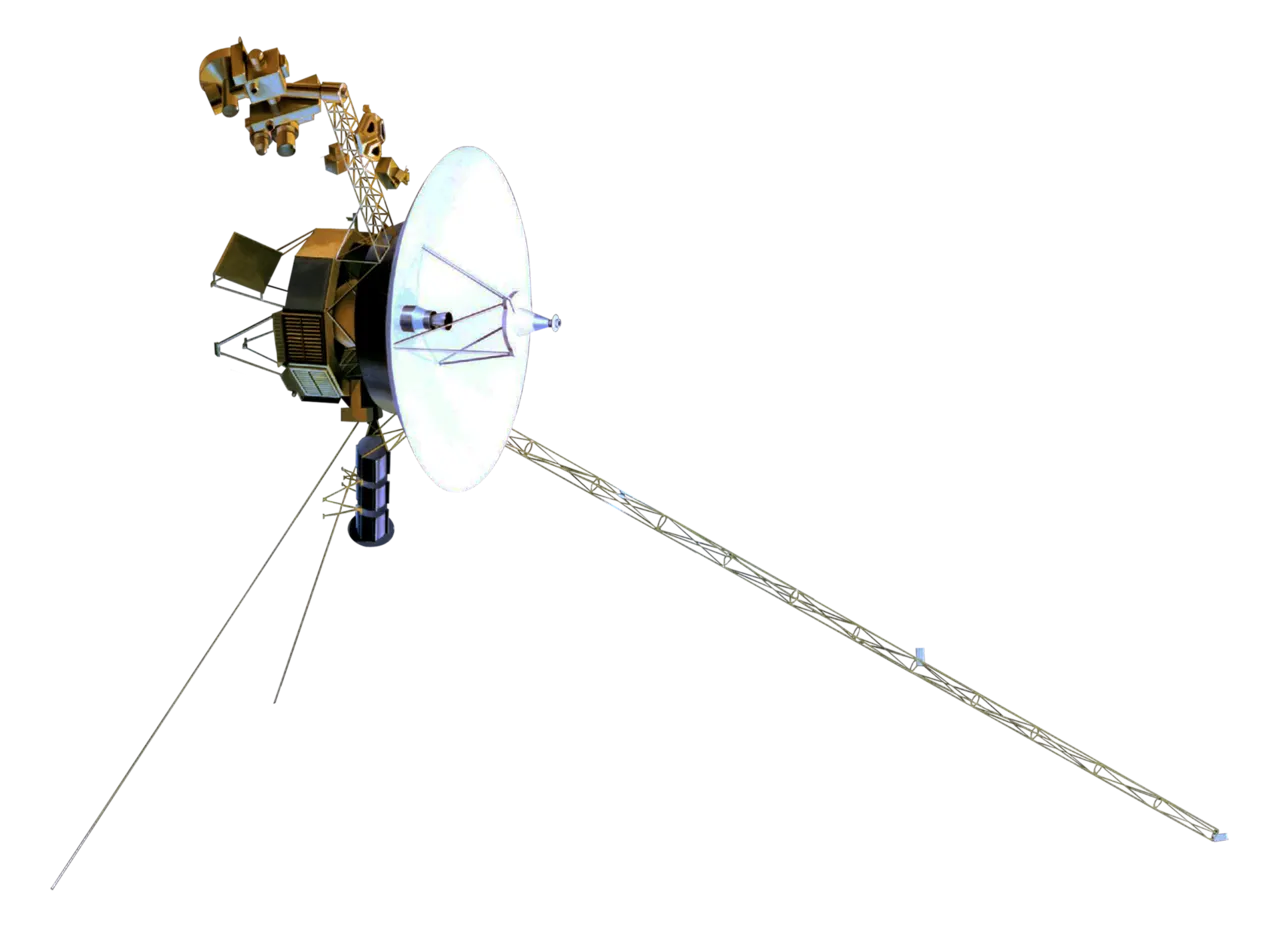
On November 12, 1980, the NASA space probe Voyager 1 made its historic closest approach to the planet Saturn. This encounter took place at the sixth planet from the Sun, approximately 9.59 AU away from the center of our Solar System. The mission provided the first detailed images of Saturn’s rings and its atmosphere, fundamentally changing human knowledge of the gas giant. This date remains a landmark in space exploration because it proved that human-made instruments could successfully navigate the outer reaches of the Solar System to conduct sophisticated scientific research.
How did Voyager 1 reach the ringed giant?
The journey to Saturn began years earlier at the Kennedy Space Center. NASA launched Voyager 1 on September 5, 1977, as part of the ambitious Voyager program. Interestingly, Voyager 1 was launched sixteen days after its twin, Voyager 2, but was placed on a faster trajectory that allowed it to reach the outer planets more quickly. Managed by the Jet Propulsion Laboratory (JPL) and headquartered in Washington, D.C., the National Aeronautics and Space Administration utilized the Deep Space Network to guide the craft across the vast vacuum of space. By the time Voyager 1 reached the Saturnian system in late 1980, it had already survived the intense radiation environment of Jupiter, using that planet's gravity as a slingshot to propel itself toward its next target.
As Voyager 1 neared its November 12 encounter, the scale of its subject became clear to the scientists waiting on Earth. Saturn is the second largest planet in the Solar System, boasting an average radius roughly nine times that of Earth. Despite this immense size, Saturn is a gas giant with an average density only one-eighth that of our home planet. This lack of density means that while Saturn is 95 times more massive than Earth, it is less than a third of the mass of its neighbor, Jupiter. Navigating such a massive gravitational well required precise calculations from NASA’s flight controllers to ensure the probe could gather data without being pulled into a terminal descent.

Saturn orbits the Sun at a distance of 1,434 million kilometers, taking approximately 29.45 years to complete a single revolution through the heavens.
What did the probe discover within the rings?
The defining moment of the November 12 encounter was the close-up study of Saturn’s rings. Before Voyager 1, these features were largely seen as blurry bands through even the most powerful terrestrial telescopes. Voyager 1 revealed that the rings are the most extensive and complex system in the Solar System, composed of countless particles ranging in size from microscopic dust to boulders the size of houses. The probe's sensors confirmed that these particles are made almost entirely of water ice, with only trace components of rocky material mixed in. The images transmitted back to Earth showcased a delicate, intricate structure that scientists are still studying decades later.
Beyond the rings, Voyager 1 provided essential data on the composition of the planet itself. As a gas giant, Saturn lacks a solid surface, but the probe was able to capture the dynamics of its high-velocity winds and atmospheric storms. The encounter on November 12 was not just about the planet; it was also a mission to survey Saturn's many moons. The trajectory was specifically designed to allow for a close flyby of Titan, the largest of Saturn’s moons, which necessitated a path that eventually tilted the spacecraft out of the ecliptic plane of the planets and toward the stars.

How does the 1980 mission impact us today?
The legacy of the Voyager 1 encounter with Saturn on November 12, 1980, is measured both in scientific data and in the sheer longevity of the spacecraft. Following its departure from Saturn, Voyager 1 began its long trek toward the edge of the Sun's heliosphere. As of October 2026, it holds the title of the most distant human-made object from Earth, situated at a staggering distance of 172.52 AU. The probe continues to communicate through the Deep Space Network, sending back routine data from the interstellar void that it now calls home.
As of November 2026, Voyager 1 is projected to reach a distance of exactly one light day from Earth, meaning its signals take 24 hours to reach NASA at the speed of light.
The success of the 1980 flyby solidified NASA’s role as the leader in outer-planet exploration. Since its establishment in 1958 as a successor to the National Advisory Committee for Aeronautics (NACA), NASA has used missions like Voyager 1 to bridge the gap between speculative science and concrete discovery. The data collected on this day in 1980 informed every subsequent mission to the outer planets, including the Cassini-Huygens mission and the ongoing multinational Artemis program, which seeks to push the boundaries of human presence in space once again.

Today, as Voyager 1 moves further into interstellar space, it carries with it the memory of that day in November when it looked back and saw the frozen rings of Saturn in high definition. It remains a testament to the engineering of the late 1970s and the vision of the scientists who dared to send a machine across billions of kilometers to photograph a world that, until then, had been little more than a golden speck in the night sky. The probe's continued operation 46 years after its encounter with Saturn serves as a reminder of the enduring nature of human curiosity and the peaceful application of technology.
Did you know that although Saturn is massive enough to hold 95 Earths, its density is so low that it is the only planet in the Solar System less dense than water?

Did you know that Voyager 1 was actually the second probe in its series to launch, departing 16 days after Voyager 2, yet it arrived at Saturn first due to its more direct path?
Watch: 1980 Voyager 1 reveals Saturn's complex of rings
From the FastTheLatestNews channel.
Sources and further reading: Wikipedia — Voyager 1, NASA, Saturn, Rings of Saturn (CC BY-SA). Images: Wikimedia Commons.