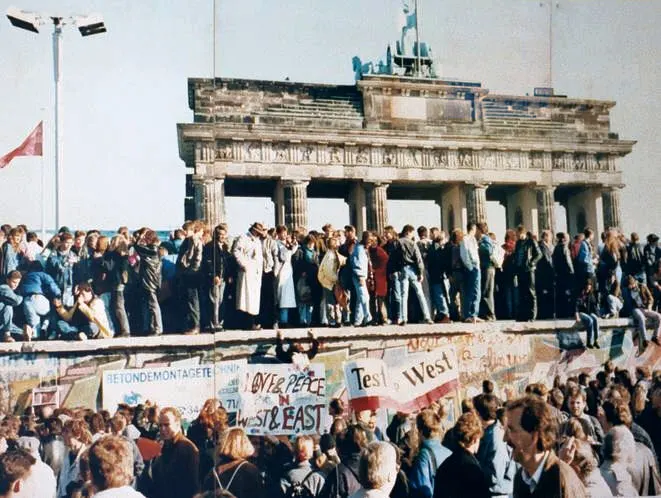
On November 9, 1989, the German Democratic Republic opened its borders, effectively ending the division of Berlin and signaling the death knell of the Iron Curtain. Following a bungled press conference by party official Günter Schabowski, thousands of East Germans descended upon checkpoints, overwhelming border guards and dismantling a structure that had stood as the ultimate symbol of the Cold War for twenty-eight years. This event remains a defining moment in modern history, representing the triumph of peaceful revolution over state-enforced isolation.
What forces finally shattered the wall?
The Berlin Wall was never merely a physical barrier; it was a psychological cage built to prevent the mass exodus of East German citizens. By 1989, the geopolitical landscape was shifting rapidly. The opening of the Hungarian border earlier that summer, followed by the dramatic scenes at the West German embassy in Prague, had exposed the fragility of the Eastern Bloc. While the regime of Erich Honecker had long relied on force to maintain the death strip—a mine-filled corridor featuring 302 watchtowers—the systemic failure of the economy and the growing pressure from citizens demanding reform left the leadership in a state of paralysis. When Egon Krenz replaced Honecker in October, he inherited a country in full-scale revolt, with protests peaking at the famous Alexanderplatz demonstration, forcing the government into a desperate, ill-fated attempt to manage the dissent through new travel regulations.

How did a bureaucratic error trigger a revolution?
The catalyst for the wall's fall was a comedy of errors performed on a stage of high-stakes politics. On the evening of November 9, 1989, Günter Schabowski, a member of the SED Central Committee, conducted a live-broadcast press conference. Having not been fully briefed on the nuances of the new, hastily drafted travel policy, Schabowski mistakenly announced that permanent exit permits would be available to all citizens immediately, without delay. When asked by a journalist when the regulation took effect, a flustered Schabowski shuffled his papers and famously replied, "As far as I know, it takes effect immediately, without delay." The broadcast was picked up by news agencies and shared across the city, acting as an invitation that thousands of East Berliners were all too eager to accept.

The Berlin Wall, designed to keep citizens in, was made up of two four-metre-tall concrete walls separated by a mined corridor that included 302 watchtowers.
Why did the border guards stand aside?
As word of the announcement spread, massive crowds gathered at the Berlin border crossings, demanding to be let through. The border guards, caught off guard and lacking clear orders from their superiors in the Ministry of State Security, faced a binary choice: open fire on their own people or open the gates. Faced with the sheer scale of the humanity pressing against the checkpoints and the confusion radiating from the Politburo, the guards chose the latter. In the late evening hours, the barriers were lifted. People poured into West Berlin in a scene of unprecedented jubilation, with live television crews broadcasting the historic footage to a global audience that watched in collective disbelief as the Iron Curtain was dismantled from below.

What was the immediate aftermath of this collapse?
The opening of the border on November 9 ignited a "Peaceful Revolution" that moved with astonishing speed. While the wall was physically still standing in the days that followed, its power to intimidate had evaporated. The demolition began in earnest as citizens chipped away at the concrete, turning segments of the L-shaped structures into historical souvenirs. Politically, the collapse necessitated a swift transition toward democracy; the following spring, free elections revealed a resounding public mandate for reunification. By July 1990, the Deutsche Mark was introduced to the East, and on October 3, 1990, the German Democratic Republic ceased to exist as five new states joined the Federal Republic of Germany.

The wall stood for twenty-eight years, having been constructed on August 13, 1961, to stop the hemorrhage of citizens fleeing to the West.
The official "anti-fascist protection wall" was actually 155 kilometers long and was designed specifically to prevent migration, not to protect against external military threats.
Although the wall opened in 1989, the final withdrawal of Soviet occupation forces from the reunified German territory was not completed until 1994.
Watch: The Fall of the Berlin Wall | Rare and Unseen Footage from 1989
From the Frontline by ITN channel.
Sources and further reading: Wikipedia — Fall of the Berlin Wall, East Germany, Border checkpoint, Berlin Wall (CC BY-SA). Images: Wikimedia Commons.