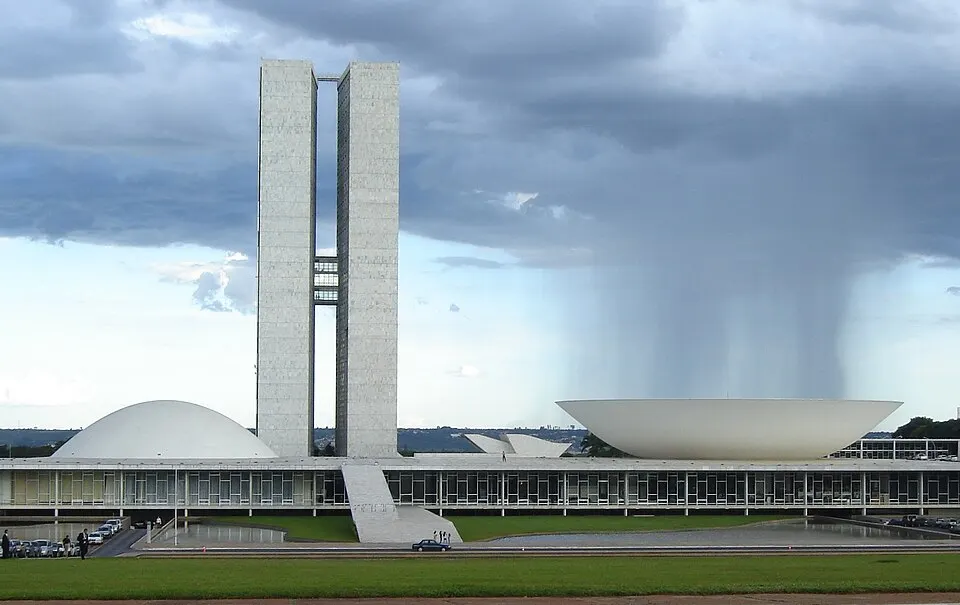
The National Congress of Brazil approved a legislative authorization on November 12, 2026, enabling President Luiz Inácio Lula da Silva's administration to incur R$149.44 billion (approximately $150 billion) in government debt to maintain vital social welfare and pension disbursements, while the Senate simultaneously advanced a separate R$60 billion fiscal adjustment proposal in Brasília.
How did Congress vote on the R$150 billion debt request?
The National Congress of Brazil approved the debt authorization through Budget Congressional Bill (PLN) 23/2026 during a joint legislative session, granting the executive branch an explicit constitutional bypass to finance essential operational liabilities. The measure passed in the Chamber of Deputies with 402 votes in favor, 12 against, and one abstention, while the Federal Senate voted unanimously for the bill with 55 votes in favor, zero against, and no abstentions. This legislative consensus allows the federal government to bypass the constitutional rule of gold, which prohibits credit transactions from exceeding capital expenditures unless explicitly permitted by an absolute majority in Congress.
Out of the total R$149.44 billion in borrowing authority allocated for the 2026 budget year, approximately R$120 billion is designated specifically to fund social security obligations, covering state pensions and retirement benefits. Another R$26 billion will fund the flagship Bolsa Família welfare program, while R$4.4 billion is targeted toward the Continuous Cash Benefit (BPC) program, which supports low-income elderly citizens and individuals living with severe disabilities. Alongside this borrowing package, lawmakers cleared 25 additional adjustments to the 2026 federal budget, releasing R$543.7 million shared between the Ministry of Justice and Public Security and the Ministry of Mines and Energy, as well as directing R$290 million into state nuclear power operator Eletronuclear for ongoing capital investments.
What are the terms of Lula's parallel fiscal adjustment package?
President Luiz Inácio Lula da Silva's government separately introduced a fiscal restraint package designed to curb public expenditure growth and protect sovereign primary target balance goals through 2027. The Senate backed the main text of the executive's R$60 billion spending control plan on Thursday by a margin of 45 votes to 31. Executive projections indicate the measure will yield a primary balance enhancement ranging between R$45.1 billion and R$56.1 billion in 2027, representing a net fiscal impact of approximately R$190 billion when calculated through 2027.

Support for the fiscal adjustment package relied on a coalition led by Lula's Workers' Party (PT) combined with crucial alignment from centrist political groups known as the Centrão. The Social Democratic Party (PSD) contributed nine votes in favor, the Brazilian Democratic Movement (MDB) added eight votes, and União Brasil delivered two votes. Internal divisions fractured other factions: the Progressive Party (PP) split with three senators voting for and four against, while Republicans saw two members support the text and four oppose it. Even within the opposition Liberal Party (PL), Senators Eduardo Gomes and Izalci Lucas broke rank to vote with the government, whereas government-aligned Senator Jorge Kajuru of the Brazilian Socialist Party (PSB) recorded a vote against the plan. Faction leadership for the PL, the Brazilian Social Democracy Party (PSDB), and core opposition blocks formally recommended voting against the text, while the PT, PSD, and MDB instructed members to approve it. Senators must still vote on individual amendments before sending the text to the Chamber of Deputies.
How are financial markets and lawmakers reacting to the budget measures?
Financial analysts and legislative figures expressed deep concern that the proposed expenditure reductions are insufficient to stabilize Brazil's long-term sovereign debt dynamics. Planning and Budget Minister Bruno Moretti framed the adjustment as saving up to R$60 billion ($10.75 billion) in 2027, equal to roughly 0.5% of GDP. However, Federal Deputy Lindbergh Faria of the ruling Workers' Party admitted during a Joint Budget Committee hearing that the package would fail to impress financial actors on Faria Lima, pointing out that spending cuts were absent from recent campaign promises. Opposing views inside Congress, such as those raised by former Health Minister and current Deputy Ricardo Barros of the Progressive Party, argued that lawmakers should dilute proposed tax incentive reductions to keep domestic industries competitive against neighboring countries.
"Nobody talked about fiscal adjustment in the campaign," said PT Federal Deputy Lindbergh Faria during a budget committee hearing, noting that market observers on Faria Lima would view a small adjustment as amateurish.
Market analysts echoed warnings over the structural limits of the government's economic strategy. AllianceBernstein senior economist Armando Armenta noted that Brazil requires a larger medium-term fiscal adjustment than the 2027 framework currently provides. Similarly, Hike Capital investment specialist Maria Carolina Luchesi emphasized that sustained asset recovery depends on permanent statutory limits on spending growth and deep legislative reform. Following the legislative debates, the Brazilian real traded near its weakest valuations relative to the US dollar observed since mid-2025, while economists noted that market expectations remain anchored to whether the central bank will keep monetary policy restrictive to offset public sector borrowing.

What is the political context behind Brazil's budgetary rules?
To evaluate these fiscal developments, international readers must understand Brazil's legal and political governance structures. Under Article 167 of the 1988 Brazilian Constitution, the federal government is bound by the "golden rule" (regra de ouro), an absolute legal bar against borrowing funds to pay for ongoing operational costs like salaries or social transfers. Executive exceptions require explicit Congressional approval through supplementary credit legislation, such as PLN 23/2026. Legislative authority is divided between the 513-member Chamber of Deputies—currently led by Deputy Hugo Motta—and the 81-member Federal Senate, which together form the National Congress in Brasília.
President Luiz Inácio Lula da Silva, a founding member of the Workers' Party now serving his third non-consecutive presidential term, leads a complex multi-party coalition while navigating an increasingly conservative legislature. The economic backdrop remains delicate: according to World Bank data for 2025, Brazil's total gross domestic product reached $2.28 trillion across a population of 212.8 million people, with per capita GDP at $10,713, annual consumer price inflation at 5.0%, and broad unemployment standing at 6.0%. Lula's administration faces structural pressures as it attempts to sustain major anti-poverty initiatives while reassuring foreign and domestic bondholders against unsustainable sovereign deficit expansion.
What happens next?
The legislative and administrative roadmap for Brazil's fiscal policy includes several immediate legal and political milestones that reporting outlets have established:
- Senate Amendments: The Federal Senate will convene on Tuesday to debate and vote on specific amendments (destaques) to the primary R$60 billion fiscal adjustment bill before transmitting the final text to the Chamber of Deputies.
- Presidential Enactment: PLN 23/2026, authorizing the R$149.44 billion debt issuance for social benefits, has cleared both legislative chambers and now awaits formal presidential signature into law.
- Cabinet Selection: President Lula is scheduled to announce his choice for the next finance minister upon returning from international commitments next week, which will provide clearer signals regarding macro-economic management.
- New Congressional Session: A newly elected, right-leaning Congress will take office in February, closing the current legislative window President Lula has utilized to push budgetary framework adjustments.
- Unresolved Economic Target Dilution: Outlets note it remains unconfirmed whether Congress will preserve the revenue-raising aspects of the fiscal package or further dilute proposed tax incentive cuts during upcoming lower house debates.
Sources: This report draws on coverage by Bloomberg.com, Valor International, O GLOBO, Revista Oeste, Newsquawk, The Lufkin Daily News, CounterPunch.org, Business Wire. The wording is our own.