

A corporate borrower facing a margin call in traditional finance usually receives a direct phone call from a credit officer. Decentralized finance protocols do not work that way. On Aave, automated code dictates when collateral is sold, regardless of whether the borrower is an individual trader or a publicly traded corporation [1].
BTCS, an Ethereum treasury firm listed on Nasdaq, disclosed in November 2026 that it sold ether below its original purchase price to defend a debt position on Aave worth roughly $64 million [1]. The strategic sales were executed to maintain the loan's health factor as market prices for ether declined [1]. The decision highlights the unforgiving nature of algorithmic lending parameters when corporate balance sheets interact with automated credit markets [1].
Snapshot of a Debt Position
In its quarterly financial filing released on Thursday, November 12, 2026, BTCS provided detailed figures regarding its outstanding credit facilities [1]. The company reported owing approximately $64.1 million on Aave as of November 9, 2026, a figure that includes accrued interest obligations [1]. To secure that balance, BTCS had deposited 46,676 ETH into the protocol [1].
At the company's stated valuation price of $2,127 per ether on November 9, that collateral carried a market value of $99.3 million [1]. That put total collateral value at approximately 155 percent of the debt balance [1].
Decentralized lending protocols apply specific risk margins to pledged collateral. Aave does not grant 100 percent borrowing power against deposited assets. For ether, the protocol generally recognizes about 80 percent of the asset's market value when evaluating collateral sufficiency [1].
Based on the November 9 filing figures, BTCS maintained a loan health factor of roughly 1.24 [1]. On Aave, a health factor dropping below 1.0 triggers automated liquidation procedures, allowing external liquidators to purchase collateral at a discount to repay the outstanding debt [1]. According to calculations based on the company's disclosed numbers, the liquidation threshold for the BTCS position sat near $1,717 per ether, assuming debt totals and collateral amounts remained constant [1].
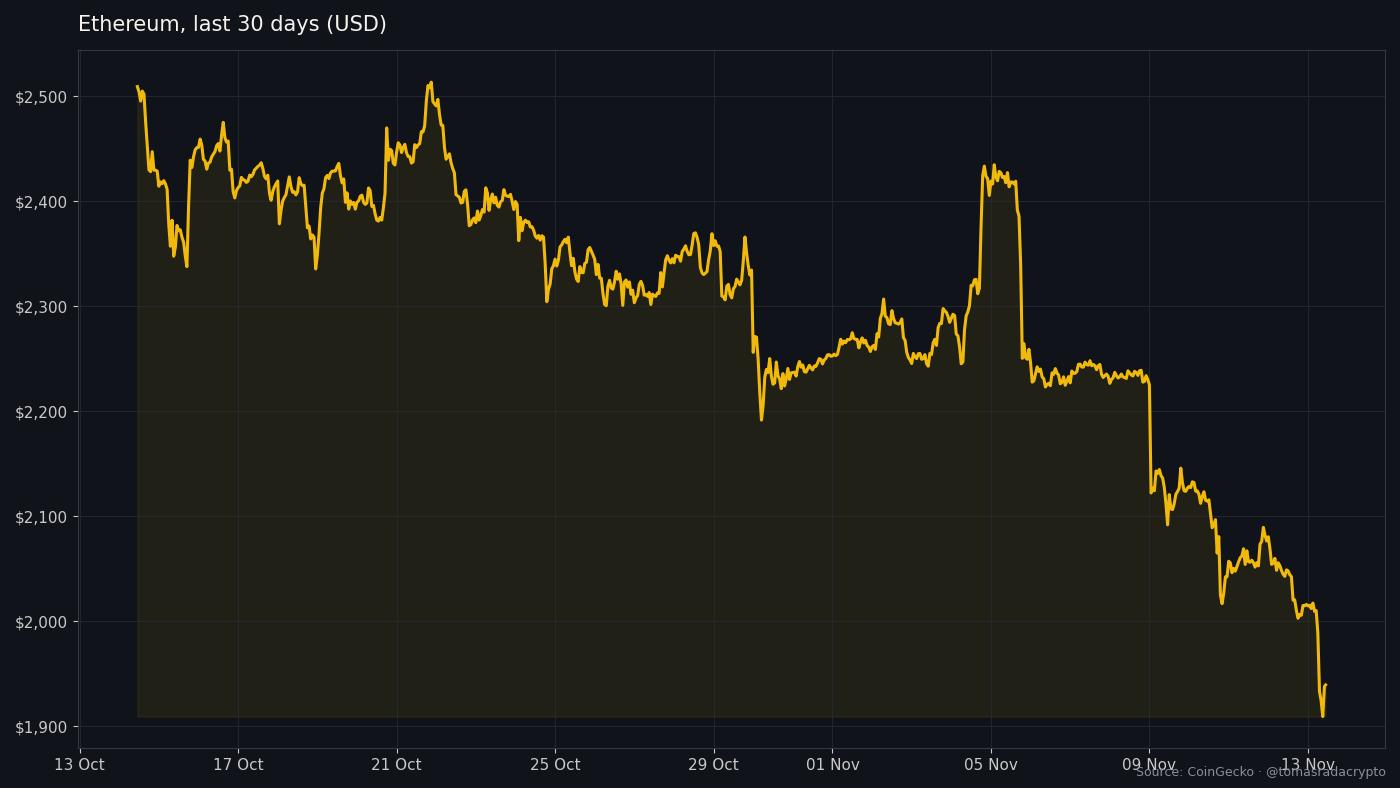
By Friday, November 13, 2026, ether traded around $1,950 per coin [1]. That spot market price was roughly 12 percent above the $1,717 liquidation threshold, but well below the $2,127 benchmark price recorded in the November 9 company snapshot [1].
Defensive Sales at a Loss
To prevent the health factor from deteriorating toward the liquidation point, BTCS took active steps to adjust its balance sheet [1]. The company confirmed in its quarterly report that it sold ether at prices below its original cost basis [1]. BTCS explained that these sales were part of active collateral management to protect health factors and loan-to-value ratios associated with its decentralized finance borrowing arrangements [1].
The company's filing omitted several specific details. BTCS did not state the exact volume of ether sold to protect the loan, nor did it disclose the magnitude of realized losses generated by those sales [1]. Additionally, BTCS noted that its exact position on Aave may have changed following the November 9 snapshot date [1]. However, the firm confirmed that no automatic liquidations had taken place on its position as of November 11, 2026 [1].

Choosing to sell crypto assets at a loss represents a calculated financial trade-off. In an automated protocol liquidation, smart contracts liquidate collateral programmatically and assess an extra penalty fee against the borrower. By selling assets manually prior to hitting the liquidation boundary, corporate managers avoid smart contract penalty fees, though they are forced to log realized balance sheet losses [1].
Cash Reserves and Capital Constraints
Corporate treasury management often relies on cash buffers to handle unexpected financial stress or debt service requirements. Financial statements from BTCS indicate limited cash liquidity outside its crypto position [1]. The company reported holding approximately $463,000 in cash at the end of September 2026 [1].
Furthermore, BTCS reported that a significant majority of its digital assets were deployed directly as collateral on Aave [1]. Crypto assets pledged to a lending protocol remain locked inside smart contracts until the corresponding debt is paid off or collateral limits are adjusted. With cash reserves under $500,000 and the vast majority of its tokens tied up in smart contracts, BTCS faced tight capital constraints outside its active lending arrangement [1].
When underlying collateral drops in value, corporate borrowers with low cash reserves cannot easily inject new cash to lower their debt balances. Instead, they must supply extra crypto collateral if available, or liquidate existing collateral to pay down debt. Because BTCS had committed most of its digital holdings to Aave, selling ether became the primary practical option to maintain loan stability [1].
Evolution of Corporate DeFi Borrowing
The $64.1 million debt balance reflects a rapid expansion of corporate leverage over an eighteen-month window. BTCS first disclosed borrowing on Aave in April 2025, reporting an initial loan balance of $320,000 backed by 446 ETH [1].
That position scaled up rapidly over the following quarters. By August 2026, the company's Aave debt grew to $53 million secured by more than 46,500 ETH [1]. Overall, between early 2025 and November 2026, BTCS drew down approximately $152.4 million in stablecoins from Aave, focusing its borrowing on Tether's USDT and Aave's native GHO stablecoin [1]. During that same timeframe, the company repaid approximately $89.4 million of its principal [1].
Corporate governance policies set by the BTCS board of directors establish clear borrowing boundaries [1]. The board permits new Aave borrowing up to a maximum loan-to-value ratio of 50 percent, meaning the company can borrow at most half of the dollar value of its collateral at the moment of execution [1].
However, board mandates operate on initial execution terms, whereas market prices move continuously. When the market price of ether falls, the dollar value of the debt remains unchanged while the total collateral value drops, pushing the real-time loan-to-value ratio higher. To pull the ratio back down under corporate or protocol limits, BTCS must deposit more ETH, pay down stablecoin debt, or sell collateral assets [1].
As of November 13, 2026, BTCS operates with ether spot prices resting near $1,950 against its calculated $1,717 liquidation line [1].
Sources
- CoinDesk, "Ethereum treasury firm BTCS sold ether at a loss to keep $64 million Aave loan healthy", https://www.coindesk.com/markets/2026/11/13/ethereum-treasury-firm-btcs-sold-ether-at-a-loss-to-keep-usd64-million-aave-loan-healthy
Cover: Alesia Kozik, Pexels.