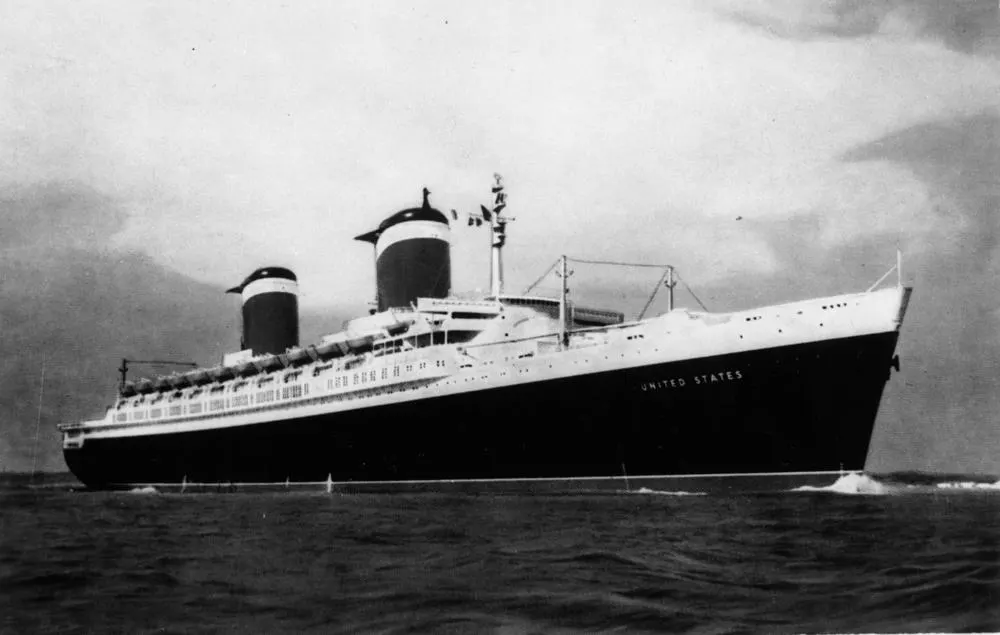
A Final Resting Place Beneath the Waves
The SS United States, an enduring icon of American maritime history and the holder of the prestigious Blue Riband, has been deliberately sunk off the Florida coast. While activists had long championed the preservation of the historic vessel as a floating museum, those efforts ultimately failed, leading to the ship’s conversion into the world’s largest artificial ocean reef. This transformation marks the definitive end for a vessel that once represented the pinnacle of transatlantic engineering.
To understand why a ship of such stature met this submerged fate, you have to go back to the optimistic landscape of the post-war era, when the SS United States was conceived as a dual-purpose marvel of naval architecture.
The Zenith of Speed and Security
Built between 1950 and 1951 for United States Lines, the SS United States was not merely a passenger vessel; she was a national statement. Designed by naval architect William Francis Gibbs, the ship was constructed to be the largest ocean liner ever built in the United States. Her design prioritized safety and functionality, incorporating revolutionary advancements in fire safety, damage control, and steam propulsion. Crucially, the vessel was engineered with Cold War realities in mind; her layout allowed for a swift conversion into a troopship should the United States Navy require it during wartime.
In 1952, the vessel proved her mettle on her maiden voyage, capturing the Blue Riband—the unofficial accolade for the passenger liner achieving the highest average speed across the Atlantic. By setting a record that remains uncontested to this day, the ship solidified her status as a symbol of American dominance. For nearly two decades, she served as a floating bridge for celebrities and immigrants alike, representing the height of luxury and technological prowess.

The record set by United States in 1952 remains unbroken by any passenger liner.
The Jet Age and the Turning Tide
The decline of the SS United States was not a failure of engineering, but a consequence of a shifting global infrastructure. By the mid-1960s, the emergence of jet-propelled transatlantic flights rendered the slow, albeit luxurious, pace of ocean liners increasingly obsolete. As travelers traded days at sea for hours in the sky, passenger counts for ocean-going vessels plummeted.
In 1969, a surprise announcement signaled the end of an era: the SS United States was withdrawn from service, and all scheduled cruises were abruptly canceled. What followed were decades of uncertainty. The ship cycled through various owners, each attempting to find a profitable future for the aging giant. However, the costs of maintenance and the challenges of modernizing such a massive, specialized structure proved insurmountable. The grand interiors that once hosted the global elite were slowly stripped away, leaving a hollowed-out hull that drifted from one failed project to the next.
An Artificial Future
The scuttling of the SS United States places her into the long tradition of the "opportunity artificial reef." Throughout history, humans have repurposed discarded materials to foster marine growth and restore underwater ecosystems. By resting on the seafloor, the ship will transition from a relic of human transport to a substrate for algae and invertebrates, functioning as a benthic structure to promote marine life in a once-featureless seabed.

History suggests that while the vessel has ceased to be a functioning liner, her legacy is now tethered to the ecology of the Florida coast. As the world’s largest artificial reef, the SS United States enters a final, unexpected service: providing a sanctuary for marine biodiversity, a transformation that ensures the ship will remain a point of focus, even if it is no longer visible to the passengers she once carried across the waves.
Sources: This report draws on coverage by BBC News. The wording is our own.