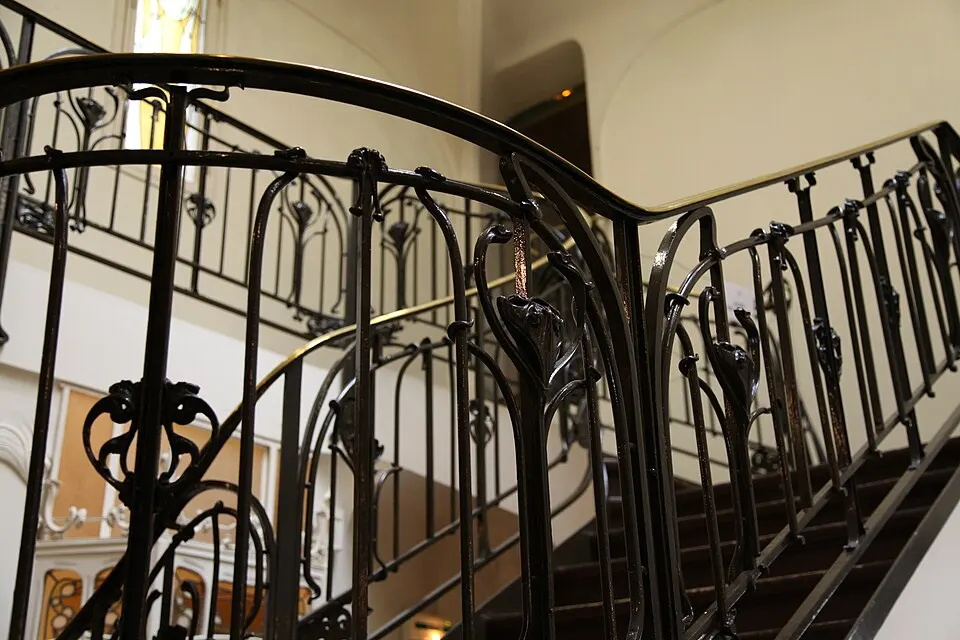
To step beneath the iron and glass canopies of the Paris Métro is to encounter the delicate, botanical fantasies of Hector Guimard. His glass edicules—crafted with undulating curves reminiscent of stems, vines, and unfurling blossoms—transformed the mundane subterranean transit of turn-of-the-century Paris into an immersive encounter with the modern avant-garde. Yet the subway entrances were only a public prologue. Tucked away in the quiet capital, another of Guimard’s creations offers an even more radical vision: the Hôtel Mezzara, a private townhouse currently being prepared for its future life as a museum dedicated to Art Nouveau.
This transition marks a triumphant resurgence for a structure that embodies the total synthesis of design. In the Hôtel Mezzara, Guimard did not merely erect walls; he sculpted a domestic sanctuary where architecture, interior design, and decorative craft merged into a single, breathtaking organism.
The Architecture of the Whiplash Line
Born in 1867, Hector Guimard achieved early acclaim with the Castel Béranger, the first Art Nouveau apartment building in Paris, which won a prestigious 1899 city competition for its innovative facade. But it was in the wider movement of Art Nouveau—literally "New Art"—that his philosophical ambitions truly crystallized. Popular between 1890 and 1910 during the exuberance of the Belle Époque, Art Nouveau was conceived as a direct rebellion against the rigid academicism, historicism, and eclectic revival styles that dominated nineteenth-century design.
Influenced by the theoretical writings of French architect Eugène-Emmanuel Viollet-le-Duc and British critic John Ruskin, Art Nouveau sought inspiration in the dynamic rhythms of the natural world. It pioneered the use of asymmetric composition and the famous whiplash line—a sinuous, energetic curve that mimicked the organic vitality of growing plants. Crucially, the movement championed modern industrial materials like iron, glass, ceramics, and concrete, bending them into unusual, expressive forms to open up vast, luminous spaces.

"One major objective of Art Nouveau was to break down the traditional distinction between fine arts—especially painting and sculpture—and applied arts."
At the Hôtel Mezzara, this ethos reached its ultimate domestic expression. Guimard designed every element of his buildings, spanning from structural ironwork and custom furniture to delicate ceramics, textiles, and metal fittings. Between 1890 and 1930, the architect produced around 50 buildings and 141 subways entrances, but the townhouse scale allowed for an unprecedented level of intimacy and control.
A Vanishing Vision and a Resurgent Legacy
Despite its extraordinary originality, the brilliance of Art Nouveau was remarkably short-lived. By the 1910s, public taste shifted abruptly away from organic flourishes toward the stark geometries of Art Deco and early Modernism. Art Nouveau fell dramatically out of fashion, treated as an overly ornate relic of a bygone era.
The middle of the twentieth century was tragic for Guimard’s legacy. By the 1960s, the vast majority of his physical works had been demolished by developers. Of the 141 signature subway entrances he constructed to cover the entrances of the first Paris Métro stations, only two of his original edicules remained standing in their original spots. A priceless chapter of urban architectural history was nearly erased.

The tide finally turned in the 1960s, as art historians began to re-evaluate the groundbreaking nature of his vision. High-profile acquisitions of Guimard’s furniture and architectural fragments by major international institutions, such as the Museum of Modern Art in New York, helped spark a global critical revival. Scholars recognized that Guimard was not merely an eccentric decorator, but a visionary pioneer who reshaped spatial design.
Why Guimard’s Living Manifesto Matters Today
The transformation of the Hôtel Mezzara into a dedicated museum ensures that Guimard’s masterwork will finally be celebrated as it was meant to be experienced: as a living canvas. Art Nouveau’s central dream was to erase the hierarchy that elevated painting and sculpture while reducing functional objects to mere craft. In Guimard’s world, a chair, a door handle, a wrought-iron banister, or a glass canopy possessed the same artistic weight as a fine oil painting.
By bringing this total work of art back to the public consciousness, the new museum honors an architect who looked at the modern industrial world and insisted it be filled with grace, rhythm, and natural wonder. In an era still searching for harmony between nature and human construction, Guimard’s legacy offers a timeless, captivating guide.
Sources: This report draws on coverage by The New York Times Arts. The wording is our own.