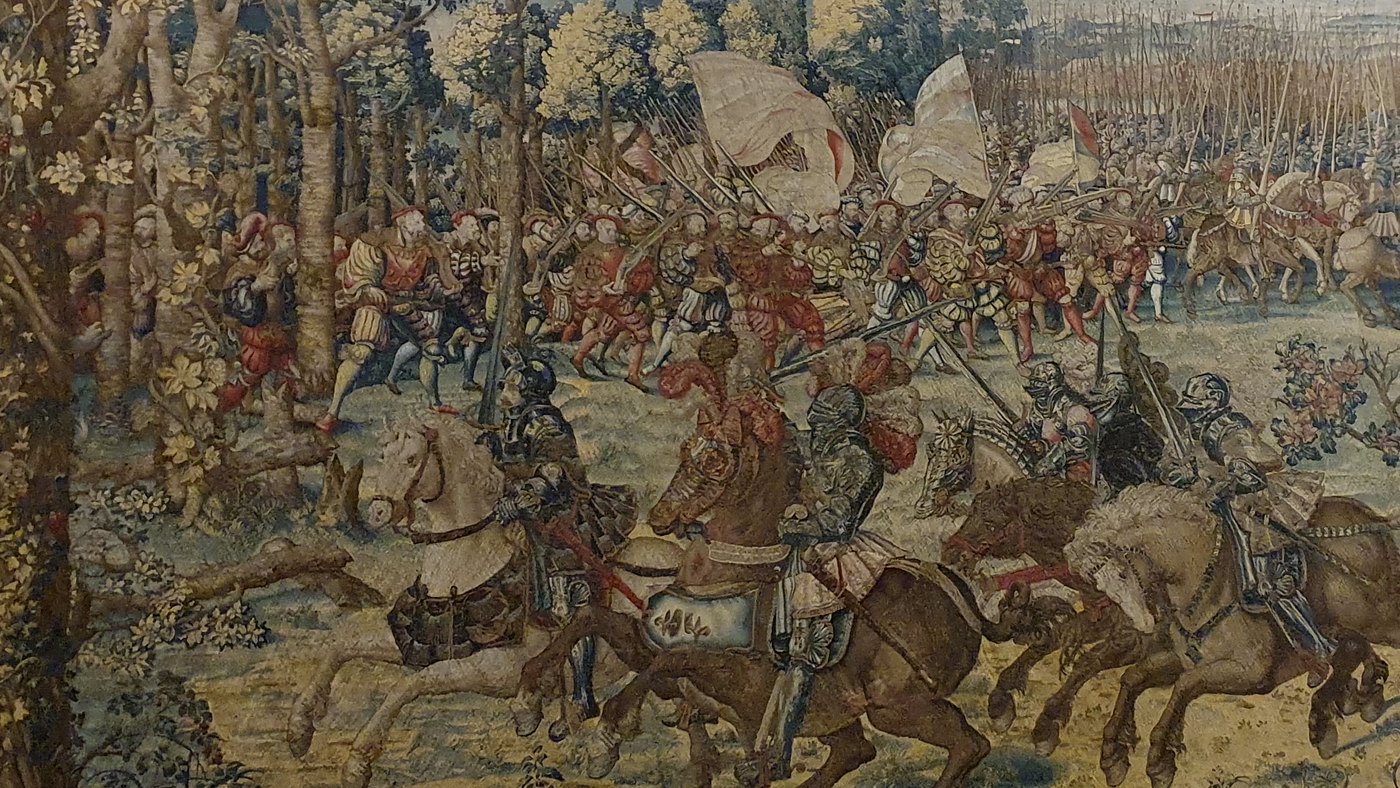
In August 1498, Paolo Vitelli commanded the mercenary army of Florence against Pisa. He laid siege to the fortress of Buti for two days, utilizing 14 heavy cannons and 50 falconets to batter the stone walls. Upon the fortress's surrender, Vitelli ordered the hands of the five captured artillerymen to be severed, then had the severed limbs hung around their necks before sending the men back to Pisa. According to contemporary chronicles, Vitelli had announced his intent to punish those who used gunpowder weapons in this manner a year prior.
Vitelli’s army deployed firearms extensively while simultaneously treating opposing artillerymen as criminals. Over the next three decades, Italian states would formalize this duality through their poetry, law, and military organization.
- Ludovico Ariosto added a passage condemning firearms to his epic poem in the 1532 edition.
- The French knight Bayard’s legendary disdain for musketeers ultimately preceded his own death by such a weapon.
- Niccolò Machiavelli’s peasant militia consciously avoided arming specific towns.
- The oldest existing firearms manufacturer, Beretta, traces its origins to a documented request for 185 arquebus barrels in 1526.
Why were early firearms considered diabolical?
When King Charles VIII of France crossed the Alps in 1494, he brought with him an artillery train previously unseen in Italy. The Florentine historian Francesco Guicciardini would later describe these in his Storia d'Italia as bronze cannons pulled by horses instead of oxen, firing iron balls instead of stone, and capable of breaching town walls in hours rather than days. Guicciardini famously characterized this technology as being "more suited to demons than to men."
Poetry reflected this profound cultural unease. Ludovico Ariosto added a new episode to the final 1532 edition of Orlando Furioso that was absent from the 1516 and 1521 versions. In this passage, the King of Frisia, Cimosco, uses a metallic tube to kill his enemies from a distance. The protagonist, Orlando, defeats him, seizes the weapon, and travels into the open sea to cast it into the abyss. He denounces the device as "accursed and abominable" and claims it was crafted by the hands of Beelzebub.
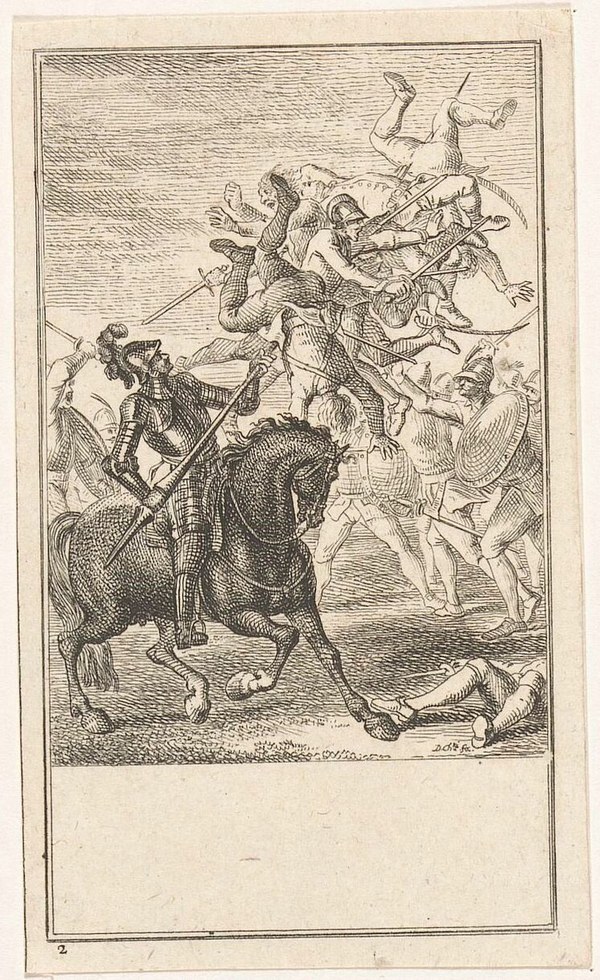
Ariosto subverts his own narrative only a few stanzas later. The weapon is recovered from the sea years later by a sorcerer, appearing first among the Germans before spreading to Italy and France. The poet instructs the soldier to take his sword to the blacksmith, for a soldier who does not carry a firearm on his shoulder will no longer receive pay. Ariosto wrote these lines while in the service of Alfonso d'Este, Duke of Ferrara, whose own artillery proved decisive for the French at the Battle of Ravenna in 1512.
How did the battlefield shift from armor to trenches?
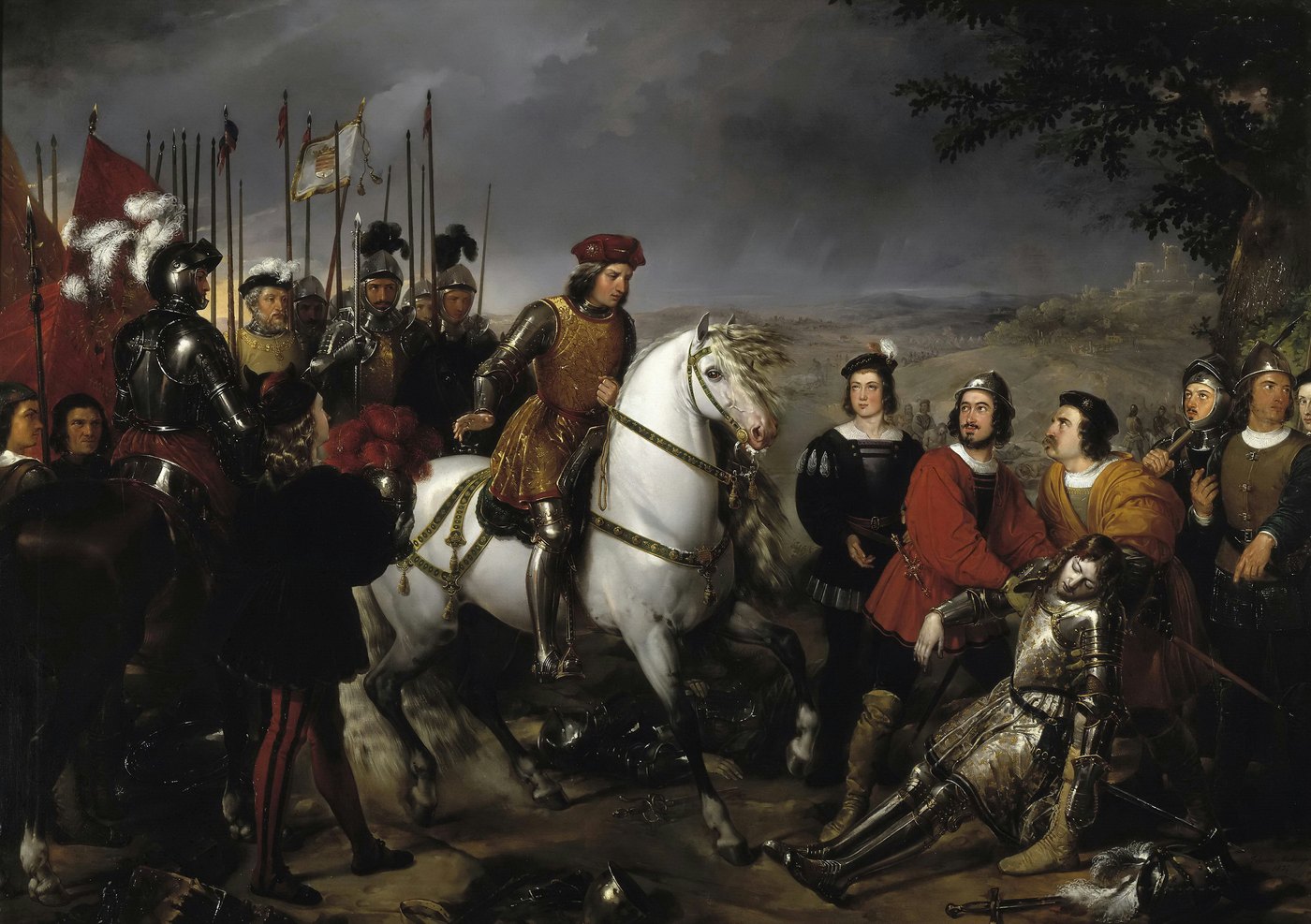
The battlefield evolved faster than the poets could lament. On April 28, 1503, at Cerignola in Southern Italy, the Spanish commander Gonzalo Fernández de Córdoba positioned approximately 1,000 arquebusiers behind a trench and an earthen rampart. The arquebus was the first hand-held firearm ignited by a match. The French heavy cavalry charged twice, only to be broken by this defensive fire. The French commander, Louis d'Armagnac, Duke of Nemours, was killed that day; some historians consider him the first prominent European commander to be killed by a handheld firearm. The British historian Jeremy Black notes that the firearm did not change warfare alone, as its success at Cerignola was inextricably linked to the use of field fortifications.
Nine years later, at Ravenna, two armies bombarded each other with artillery for over two hours. Military historians view this as the first major artillery duel on an open field. Spanish cannons killed approximately 2,000 French infantry, while the artillery moved to the flanks by Alfonso d'Este effectively shattered the opposing cavalry.
Notes and Sources
- Condottieri di ventura. "The Ferocity and Caution of Captain Paolo Vitelli," August 1498 record, and citations from Pieri, Ricotti, Fabretti.
- Warfare.it. "Mozzare mani, cavare occhi: armi da fuoco e cultura cavalleresca."
- Guicciardini, F. Storia d'Italia, Book I, Chapter XI (written 1537-1540, first published 1561).
- "Ludovico Ariosto: Orlando Furioso," four sections added to the 1532 edition.
- Ariosto, L. (1532). Orlando Furioso, Canto IX 88-91 and Canto XI 21-28.
- Hall, B. S. (1997). Weapons and Warfare in Renaissance Europe. Johns Hopkins University Press; Taylor, F. L. (1921). The Art of War in Italy, 1494-1529. Cambridge University Press.
- Oman, C. (1937). A History of the Art of War in the Sixteenth Century. Methuen.
- Black, J. (April 9, 2026). "The line of fire." The New Criterion.
- "Sur les traces de Bayard. Bref compte-rendu d'un voyage d'étude effectué les 29 et 30 mai 1999 dans le Valsesia." Revue historique des armées, 216 (1999).
- Archivo Histórico de la Nobleza (Spanish Ministry of Culture). "La jornada de Pavía y prisión del rey de Francia," account by Alonso Pita da Veiga.
- Archivio di Stato di Firenze. "I Nove conservatori di ordinanza e milizia (1506-1530)," inventory entry.
- Guidi, A. and Simonetta, M. "Alamanno Salviati, Machiavelli and the Surrender of Pisa. New Documents from the Salviati Archives (years 1502-1509)."
- Machiavelli, N. (1521). Dell'arte della guerra, Book II.
- Archivio di Stato di Milano. "Prohibitione di portar li archibuggi di ruota," monthly document.
- Fletcher, C. (2026). The Firearm Revolution: From Renaissance Italy to the European Empires. Princeton University Press.
- Beretta. "Beretta Since 1526"; Morin, M. and Held, R. (1980). Beretta. Acquafresca Editrice; La Stampa archives (1982).