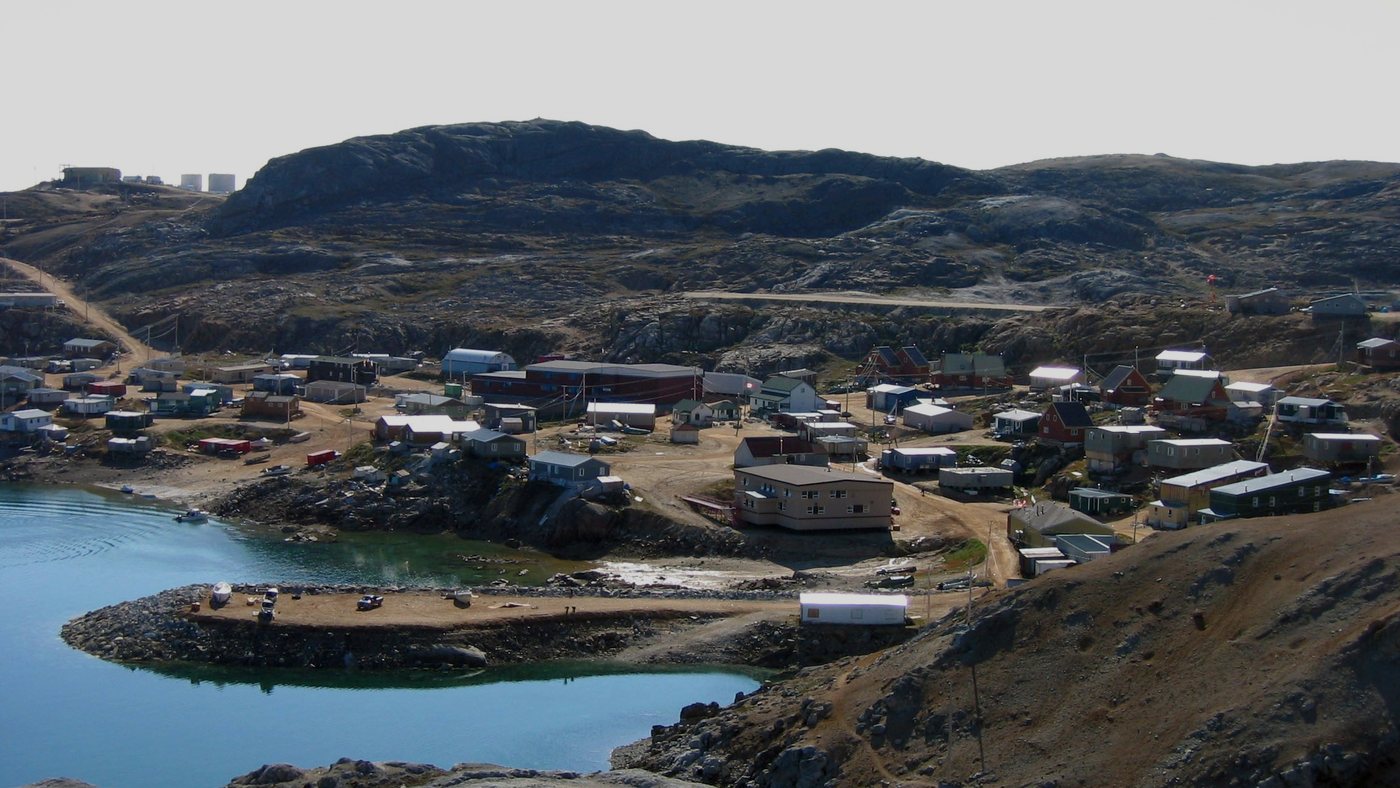
A 5.4-centimeter wooden figurine discovered on the southern coast of Baffin Island may represent a member of Martin Frobisher’s 16th-century expedition rather than a medieval Norse traveler as previously believed. Found in 1977 by a Michigan State University team near the community of Kimmirut, the artifact was unearthed from the stone floor of an ancestral Inuit (Thule) house at a site known as Okivilialuk. The small figure, carved from driftwood, was found tucked beneath a flat oval stone in a small niche.1
The figurine stands just over two inches tall with a featureless face and two short stubs for arms.2 When archaeologists Deborah and George Sabo first published the find in 1978, they noted the presence of incised lines depicting a long, slit-front garment with a cross on the chest. They argued this attire resembled the tunics worn by Norse Christians in Greenland between the 11th and 13th centuries. Baffin Island is widely considered to be the "Helluland" mentioned in Icelandic sagas—the land of flat stones visited by Leif Eriksson. However, the researchers remained cautious, concluding there was insufficient evidence to definitively confirm the nature of the contact.1
How does the Canadian Museum of History identify the figurine?
The Canadian Museum of History currently catalogs the figurine (artifact KeDq-7:325) as a Norse person, dating it to approximately 1250–1350 AD. According to museum records, while the style of the face and arms is consistent with traditional Inuit carving, the depiction of European-style clothing is unique. The museum suggests the figure represents a Norseman who may have landed on the Baffin coast to trade for walrus ivory, a commodity highly prized in Europe during the Middle Ages.2
Interactions between the Norse and the Thule people—the ancestors of today’s Inuit—are well-documented elsewhere. On Ellesmere Island to the north, Thule sites have yielded chain mail, oak carpenter’s planes, and ship rivets. Wool fabric from those sites was directly dated in 2018 to the late 13th century.3 The debate regarding the Okivilialuk figurine centers on whether this specific artifact actually belongs to that same medieval era.
What evidence supported the original 13th-century dating?
The original 13th-century date for the Baffin Island figurine was based on the typology of harpoon heads rather than direct radiocarbon testing. In 1980, George Sabo and John Jacobs dated the lower level of the house to between 1100 and 1250 AD by comparing the styles of tools found there to other known Thule settlements.4 While 16 fragments of textile were recovered from the same layer, they were not subjected to carbon dating for nearly four decades.3
In 2017, Michèle Hayeur Smith of Brown University obtained samples of these yarns and fabrics for analysis. Because organic materials in the Arctic are often contaminated by marine mammal oils—which can skew radiocarbon results by centuries due to the "old carbon" in the ocean—the samples were processed using a specialized cleaning method developed by Gørill Nilsen at the University of Tromsø to remove fatty acids before measurement.5
What did the 2018 radiocarbon results reveal?
Radiocarbon dating of the textiles from Okivilialuk produced two possible age ranges, both of which fall after the medieval period. For sample 75, there is a 61.6% probability the fabric dates to 1445–1524 and a 33.8% probability it dates to 1558–1632. Sample 77 yielded similar results, with a 47.7% probability for both 1450–1530 and 1540–1635.3 Given that Norse settlements in Greenland vanished around 1450, even the earliest possible dates for these fabrics coincide with the very end of the Norse era or later.6
The weaving technique also appears non-Norse. Sample 75 features a balanced weave of 15 threads per centimeter in both warp and weft. Researchers note that such balanced weaves are rare in medieval Icelandic or Greenlandic textiles, which typically became weft-dominant after 1300.3
Could the figurine represent a member of Martin Frobisher’s crew?
The figurine may represent an Elizabethan explorer or clergyman from the expeditions led by Martin Frobisher between 1576 and 1578. Frobisher conducted three voyages to the bay that now bears his name, attempting to find a Northwest Passage and mining over 1,200 tons of what he mistakenly believed was gold ore.7 The Okivilialuk site is approximately 240 kilometers along the coast from Frobisher’s base at Kodlunarn Island. Oak and charcoal samples from Frobisher’s camp have yielded radiocarbon dates that overlap perfectly with the second probability range of the Okivilialuk textiles.3
If the figurine belongs to the same chronological layer as the textiles, it could depict an English sailor or even Robert Wolfall, the Anglican chaplain who accompanied Frobisher’s 1578 voyage and performed the first recorded English communion in North America.8 While Frobisher is famously depicted in short jackets and padded breeches, the figurine wears a long, robe-like garment, which could correspond to a cleric’s gown or perhaps an Inuit interpretation of European dress.2
What questions remain unanswered about the figurine?
The figurine itself has never been directly radiocarbon dated, leaving its exact age unconfirmed. While the 2018 study suggests the figurine and the textiles were found in the same archaeological context, the authors acknowledge that this remains an assumption unless the excavation records are re-evaluated or the wood is tested directly.3 The site may have been occupied during multiple periods, including the 13th and 16th centuries.
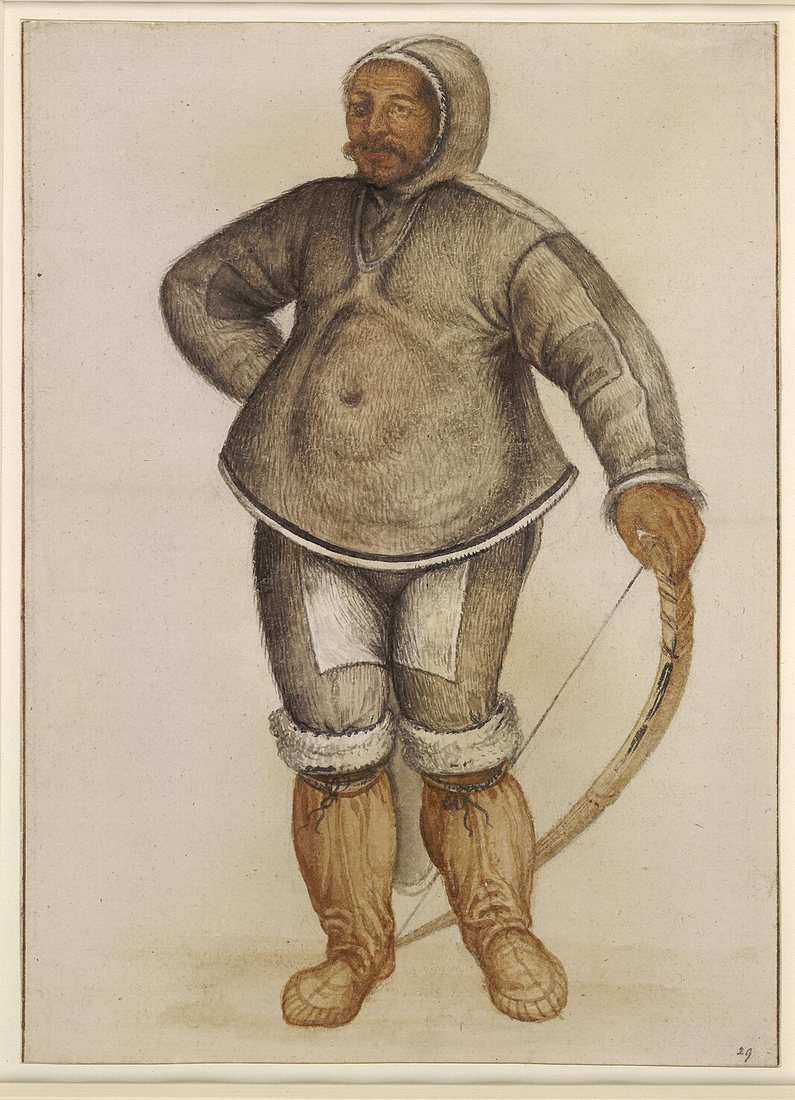
The encounter between Frobisher’s crew and the Inuit was documented in detail and ended tragically. In 1577, the crew captured an Inuit man named Kalicho, a woman named Arnaq, and her infant Nutaaq. All three died shortly after arriving in England.9 Whether the figurine is a relic of the Norse "Helluland" or a witness to the Elizabethan age of exploration depends on future testing of the wood itself. For now, the Canadian Museum of History maintains its 13th-century attribution, even as the fabric found alongside it points to a much later century.
Notes and Sources
- Deborah Sabo and George Sabo III (1978). "A Possible Thule Carving of a Viking from Baffin Island, N.W.T." Canadian Journal of Archaeology 2, 33-42.
- Canadian Museum of History. Figurine, artifact no. KeDq-7:325 (Okivilialuk, Southern Baffin, Nunavut). Catalog record and exhibition text.
- Michèle Hayeur Smith, Kevin P. Smith and Gørill Nilsen (2018). "Dorset, Norse, or Thule? Technological transfers, marine mammal contamination, and AMS dating of spun yarn and textiles from the Eastern Canadian Arctic". Journal of Archaeological Science 96, 162-174.
- George Sabo III and John D. Jacobs (1980). "Aspects of Thule Culture Adaptations in Southern Baffin Island". Arctic 33(3), 487-504.
- Brown University (August 20, 2018). "Brown study shows indigenous Canadian Arctic people's textiles predated European contact". Interview with Michèle Hayeur Smith.
- Jette Arneborg et al. (2012). "Norse Greenland Dietary Economy ca. AD 980-ca. AD 1450: Introduction". Journal of the North Atlantic, Special Vol 3, 1-39.
- William W. Fitzhugh and Jacqueline S. Olin (eds.) (1993). Archeology of the Frobisher Voyages. Smithsonian Institution Press.
- George Best (1578). A True Discourse of the Late Voyages of Discoverie. London. James McDermott (ed.) (2001), The Third Voyage of Martin Frobisher to Baffin Island, 1578, Hakluyt Society, p. 234.
- Edward Dodding (November 8, 1577). Letter from Bristol on the death of Kalicho and St. Stephen’s Parish burial records. National Humanities Center.